Sep 13, 2026 · 1h 16m
Listen from 0:00
Listen at 0:00
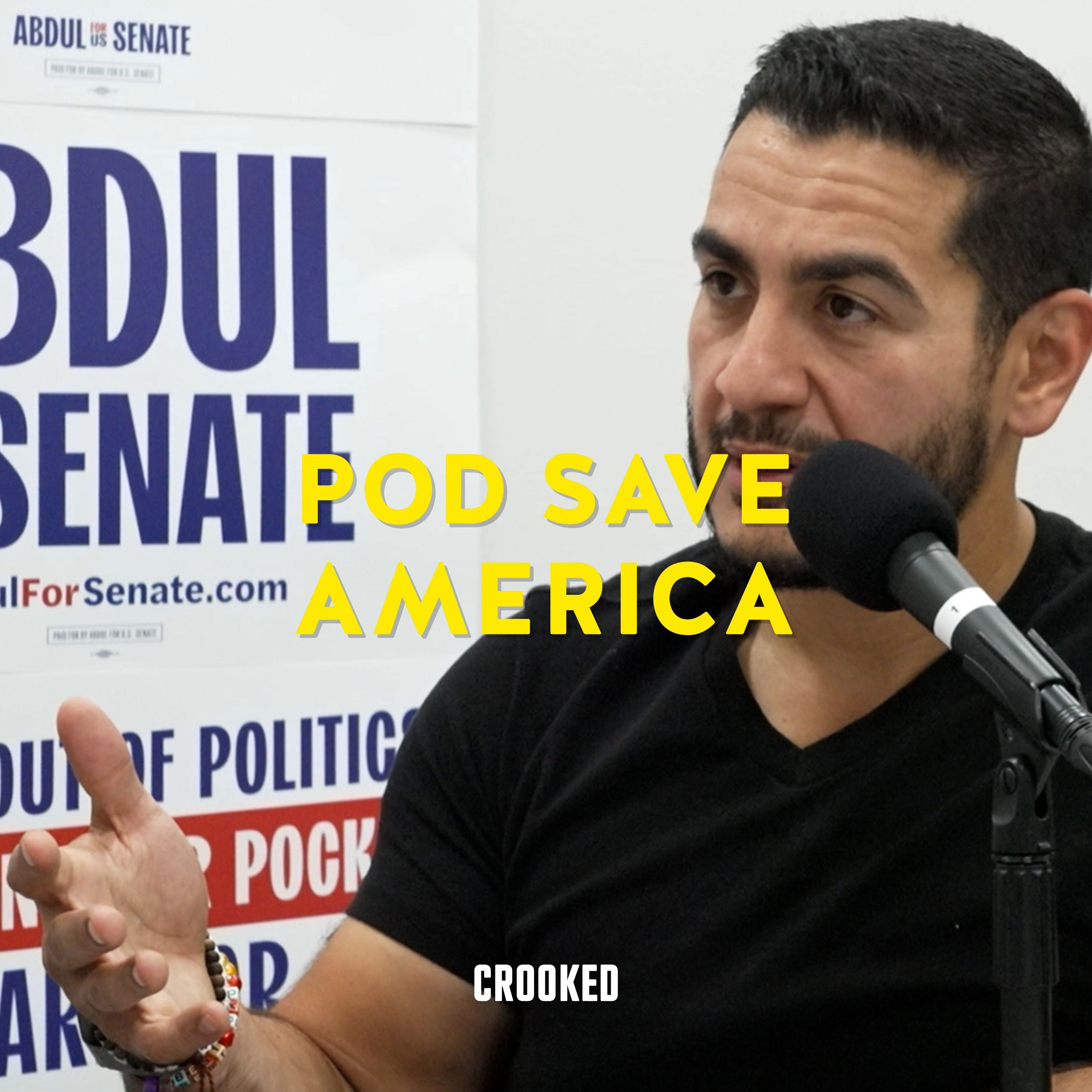
Abdul El-Sayed bets authenticity can break through Michigan’s noise
On the Ground in Michigan with Abdul El-Sayed
The conversation tests whether a progressive, Muslim candidate can turn economic concerns, public-health distrust, and personal authenticity into a general-election strategy.
- 1Abdul El-Sayed argues that affordability, healthcare, public safety, and dysfunction matter more to voters than sensational campaign controversies.
- 2The hosts debate whether his combative progressive identity expands his coalition or gives Republican attacks more material.
- 3El-Sayed presents Medicare for All as both healthcare policy and a way to rebuild trust in public institutions.
Don't miss
Abdul El-Sayed explains how presenting his full personality, including his masculine and combative sides, can counter attacks portraying him as radical.
The brief
From Detroit, Tommy Vietor reports on Abdul El-Sayed’s Michigan Senate campaign, where progressive policy, establishment anxiety, and the demands of a general election collide.
Michigan voters describe a candidate whose clarity and healthcare agenda speak to everyday concerns, while the campaign tries to reach moderates and conservatives beyond viral clips.
The hosts examine Republican attacks tied to Islamophobia, Israel, Hasan Piker, and post-9/11 fear, then debate whether El-Sayed should moderate or lean into his anti-establishment persona.
In the interview, El-Sayed says authenticity means showing his academic, athletic, humorous, and combative sides, including a more direct appeal to young men.
El-Sayed links unaffordable care to collapsing public-health trust and argues that Medicare for All could address both the material problem and the credibility crisis.
What was said on this episode
30 statements · 11 positive · 18 negative · 1 neutral
Michigan’s Senate race is among the country’s most competitive Senate contests.
“this is one of the most hotly contested Senate races in the country”
Listen at 1:08
The Michigan Senate race is backed by $70 million in attack advertising.
“it's backed by $70 million in attack ads”
Listen at 15:42
Abdul El-Sayed’s campaign has adopted a clear message centered on money, pockets, and Medicare for All.
“he has landed on a clear, succinct message, which is money out of politics, money in your pockets, and Medicare for All”
Listen at 16:54
Mike Rogers’s speech omitted Michigan costs, the economy, and policy proposals for residents.
“Nothing about costs in Michigan, the economy, the economy, what to do for people.”
Listen at 21:22
Mike Rogers’s campaign is relying on fearmongering and Islamophobic messaging.
“the campaign's going, which is all fearmongering Islamophobia stuff”
Listen at 22:18
Republican references to Zohran Mamdani are blatantly Islamophobic and racist.
“the Mamdani stuff is crazy and, and just blatantly, uh, Islamophobia and racism”
Listen at 24:22
Abdul El-Sayed’s electoral challenge is whether voters view him as too extreme or progressive.
“I think to the extent he has a challenge, and he does have a challenge, it is do people think that he is too extreme or too progressive or too liberal?”
Listen at 27:48
Jon Favreau predicts El-Sayed would perform well if Michigan voters experienced his campaign directly.
“If he could, if he could meet everyone in Michigan, everyone who sees him campaign, everyone who gets contact by the campaign, contact by Abdul, like has that kind of experience, I think he'll be fine.”
Listen at 28:12
Abdul El-Sayed’s campaign is being outspent four-to-one in some markets by outside money.
“in some markets right now, they're getting outspent 4 to 1 with all the outside money”
Listen at 33:39
Diesel prices are above six dollars.
“diesel's over $6”
Listen at 36:54
Support for Medicare for All declines when people learn it eliminates private insurance.
“Once you tell people that it means getting rid of private insurance, the support goes down.”
Listen at 40:12
Support for Medicare for All declines when its costs and tax limitations are explained.
“Once you tell people the cost and that you cannot pay for Medicare for All, a real single-payer system, by just raising taxes on wealthy, support goes down.”
Listen at 40:18
Abdul El-Sayed’s healthcare plan resembles Pete Buttigieg’s 2020 Medicare approach.
“his plan is more like Pete's plan was in the 2020 primary”
Listen at 41:38
Jon Favreau evaluates El-Sayed’s healthcare flexibility positively.
“I think that is a great thing”
Listen at 41:43
Abdul El-Sayed recommends prohibiting AI from replacing jobs, handling healthcare, or firing weapons.
“AI should not be used to do certain things like take your job or provide you healthcare or deny your healthcare or fire a weapon.”
Listen at 43:28
Abdul El-Sayed recommends an international treaty governing compute use.
“We need an international treaty that governs the use of compute”
Listen at 43:37
Abdul El-Sayed recommends state and local moratoria on data-center construction until federal rules exist.
“there need to be state and local moratoria on data center construction”
Listen at 44:13
Abdul El-Sayed gave Jon Favreau one of his most thoughtful answers about AI.
“Abdul, who is supposed to be the, like, you know, oh, he's a crazy progressive and he just has slogans like Medicare for All. He gave one of the most thoughtful answers about AI that I have heard.”
Listen at 45:15
Tommy Vietor evaluates El-Sayed’s AI proposal as a genuine plan.
“it was like a real plan”
Listen at 46:06
Michigan voters commonly raise affordability, government dysfunction, data centers, AI, and healthcare.
“it's almost always about something having to do with affordability, something having to do with government not working for them, something having to do with the existential dread of a data center or AI or healthcare.”
Listen at 52:10
El-Sayed argues Republican political demonization contributes causally to political violence.
“it's been very clear they've been running against democracy for a very long time, and this becomes the logical outcome.”
Listen at 56:45
El-Sayed says power-seeking actors have spent 25 years excluding groups from the American norm.
“we have seen in the past 25 years an attempt by a few people who want to gain power to constantly define out of the American norm certain groups of people.”
Listen at 59:26
El-Sayed recommends confronting political bullies directly rather than relying on reason.
“the only way you take on bullies is to take on bullies”
Listen at 1:04:31
El-Sayed argues masculinity can be strong without being abusive or contemptuous.
“you could be strong and you can be masculine and not be an asshole”
Listen at 1:07:06
El-Sayed characterizes Mike Rogers as motivated solely by power and money.
“what I think he sees in Mike Rogers is what all of us see in Mike Rogers, somebody whose only interest is power and the money he can make off of power.”
Listen at 1:09:23
Public trust in public health and healthcare had declined before COVID-19.
“people had lost public trust in public health and healthcare well before COVID”
Listen at 1:11:05
Healthcare science is often inaccessible because it is placed behind paywalls.
“there's a lot of amazing science out there But it always sits behind a paywall”
Listen at 1:11:11
Unaffordable healthcare undermines public trust in health institutions.
“if we want people to trust health and healthcare, it can't feel like they're getting their pocket picked every day.”
Listen at 1:12:06
El-Sayed says his campaign overcame $70 million and an 11-to-1 spending disadvantage in the primary.
“We took $70 million on in the primary and still won, got it spent 11 to 1”
Listen at 1:12:44
El-Sayed says his campaign has an opportunity to win the Michigan Senate race.
“we've got an opportunity to win”
Listen at 1:13:03
Statements are attributed to the speaker as said on the episode and reflect their view at the time, not PodLume's. They are not advice.