Sep 16, 2026 · 16 min
AI regulation could entrench frontier labs
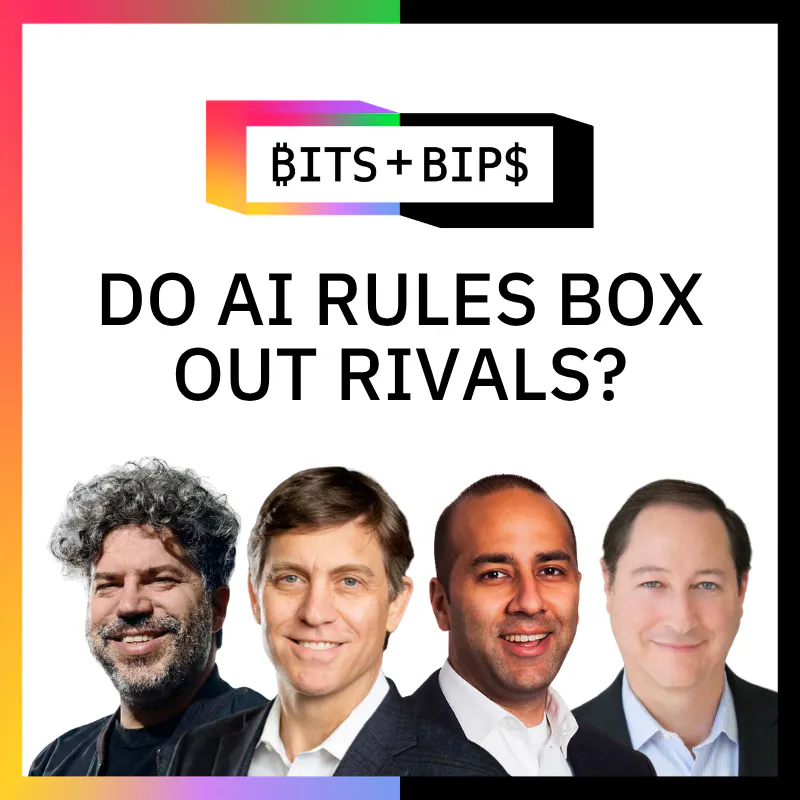
Bits + Bips: Would AI Rules Box Out Everyone but the Frontier Labs?
Rules intended to manage AI risk may raise compliance, liability, and capital costs enough to narrow competition and weaken decentralized alternatives.
- 1Frontier AI regulation could make shared compliance costs and capital requirements advantages for the largest labs.
- 2Open-weight models may retain a meaningful market without dislodging premium pricing from firms such as OpenAI and Anthropic.
- 3Decentralization offers an alternative to concentrated control, but liability and user responsibility remain unresolved.
Don't miss
The discussion’s sharpest question is whether decentralization can reduce concentrated AI control without leaving liability and user responsibility undefined.
The brief
The discussion opens with Bits and Bips leaving the Unchained feed, then turns to whether AI’s rapid evolution is validating Leopold Aschenbrenner’s situational-awareness thesis.
Jordi Visser and the hosts examine how Anthropic, OpenAI, and SpaceX are shifting from aggressive revenue growth toward cash flow, capital discipline, and long-term positioning.
The central argument is that frontier-model rules could function like banking regulation: shared fixed costs, liability exposure, and capital requirements may favor the biggest firms.
Open-source and open-weight models could remain commercially important, but the conversation questions whether they can materially reduce frontier labs’ pricing power or dominance.
The standout tension is decentralization: it could counter concentrated control, yet any system that distributes power must still decide who bears responsibility when models cause harm.
What was said on this episode
19 statements · 8 positive · 9 negative · 1 mixed · 1 neutral
AI-enabled hacking will continue.
“This is not going to stop.”
Listen at 1:39
AI progress will not slow down.
“I don't think there is any way that the slowdown will happen.”
Listen at 3:07
AI model training will continue as planned.
“the training side will continue to go as planned.”
Listen at 4:15
AGI has not arrived.
“I'm not of the view that like agi is here”
Listen at 5:12
AI development remains far from completion.
“We still have a long way to go.”
Listen at 5:22
AI systems currently need more compute.
“Do we need more compute now? Absolutely.”
Listen at 5:30
AI's major promise and potential remain ahead.
“Is the promise and potential substantially in front of us? Yes.”
Listen at 5:34
Open-source AI cannot compete with frontier models.
“I'm not a believer in open source being able to compete in any way with these models.”
Listen at 9:27
Frontier AI companies are increasingly concerned about liability.
“I do agree with Chris that the liability side is something that they're starting to worry about more”
Listen at 10:22
AI may move toward decentralization if regulation remains unresolved.
“There is a possibility here that if this doesn't get sorted, you see a move to decentralization.”
Listen at 11:10
Decentralized AI typically shifts liability to users.
“typically the liability falls back on the user”
Listen at 11:26
Open-weight models have a credible market opportunity.
“open weights have a credible opportunity.”
Listen at 12:30
Open-weight models will never match frontier lab quality.
“They're not going to be ever as good as Frontier Lab models.”
Listen at 12:33
Open-weight models will be much cheaper than frontier models.
“They're going to be a lot cheaper.”
Listen at 12:36
Open-weight operating models may reach Astra-like capability within nine months.
“those operating models have an astral capability in, say, nine months time, plus or minus.”
Listen at 12:51
Open-weight competition will not reduce Anthropic and OpenAI pricing.
“You're not going to bring the price down of of anthropic and open AI.”
Listen at 13:09
Anthropic and OpenAI will focus on the hardest problems.
“They are going to focus their attention on the hardest things in the world.”
Listen at 13:16
Frontier AI companies will retain a major advantage for three years.
“So for at least the next three years, I think they just have a huge advantage.”
Listen at 14:19
Elon Musk is concerned about AI-related human extinction.
“I do think Elon is worried about this stuff because he's talked about the human race being extinguished.”
Listen at 14:30
Statements are attributed to the speaker as said on the episode and reflect their view at the time, not PodLume's. They are not advice.