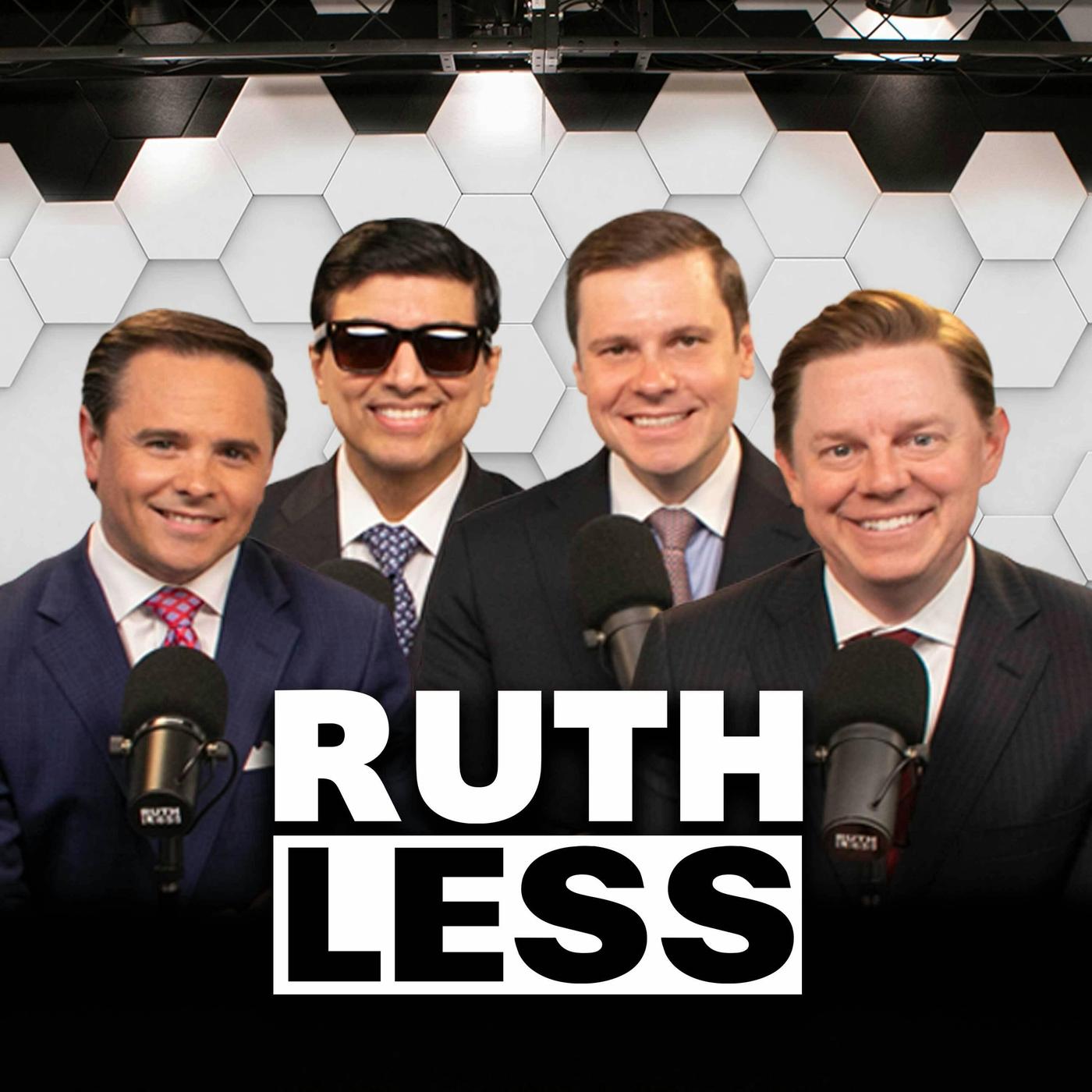
Oct 14, 2026 · 59 min
Early vote numbers obscure the midterm’s real battleground
The Early Vote Totals Are Not What You Expect: Midterm Update
The episode tests whether partisan early-voting advantages in four states reveal electoral momentum or merely reflect turnout and Election Day behavior.
- 1Early Democratic leads in Ohio, Michigan, North Carolina, and Florida may not predict final margins.
- 2Republican campaigns face a turnout challenge among rural and exurban voters despite competitive cost-of-living concerns.
- 3The hosts pair election analysis with scrutiny of Vicente Gonzalez’s travel and Sherrod Brown’s Vietnam-era record.
Don't miss
The hosts argue that Michigan’s large Democratic early-vote advantage could erode through candidate weakness and dissatisfaction among Detroit-area Democrats.
The brief
Josh Holmes and the Ruthless hosts open with a warning against reading too much into Democratic early-vote advantages across Ohio, Michigan, North Carolina, and Florida.
Their central argument is that party registration captures only part of the picture: turnout, persuasion, unaffiliated voters, and Election Day habits can reshape the final result.
Michigan receives the sharpest scrutiny, as the hosts argue that candidate weaknesses and dissatisfaction among Detroit-area Democrats could produce meaningful attrition despite a large early lead.
The discussion broadens to an Americans for Prosperity survey of 24,000 swing voters, where cost-of-living concerns and skepticism toward government-heavy solutions create an opening for Republicans.
The episode closes with opposition research on Vicente Gonzalez’s campaign-funded travel and Sherrod Brown’s Vietnam-era remarks, linking electoral strategy to candidate scrutiny.
What was said on this episode
35 statements · 19 positive · 8 negative · 1 mixed · 7 neutral
Early-vote models provide only part of the election picture.
“Early vote numbers, especially when they're based off a model, can tell you, is just a part of the overall equation.”
Listen at 0:03
Republican voters can change the election environment by voting.
“Do not blackpill. Everybody says the environment's terrible for Republicans. You can change that simply by going out and voting.”
Listen at 0:10
Ohio early-vote numbers are pleasantly surprising.
“I'll tell you my first initial reaction to these numbers is pleasantly surprised.”
Listen at 0:18
Ohio early ballots represent about 3.5% of expected midterm votes.
“That's about 3.5% of the expected votes cast here in this midterm.”
Listen at 5:45
Democrats typically hold an early-vote advantage over Republicans.
“Democrats typically in almost every state in the union have a pretty significant early vote advantage over Republicans.”
Listen at 6:08
Some campaign experts distrust early-vote models because they have failed previously.
“some of them don't really trust in what they're seeing in the models because the models have let them down over time”
Listen at 9:54
Early-vote numbers reveal only one component of the election outcome.
“what early vote numbers, especially when they're based off a model, can tell you is just a part of the overall equation.”
Listen at 10:35
Early-vote models can indicate which party has an existing-base turnout advantage.
“It can tell you, if you can read between the lines, who has a turnout of their existing voter base advantage”
Listen at 10:43
Early-vote models do not determine who will win the election.
“It's not the overall who's going to win or lose the election”
Listen at 10:53
Voters should cast ballots early when possible.
“if you are able to bank your vote early, do it.”
Listen at 11:49
Early voting makes Republican campaign resources more efficient late in elections.
“it helps make Republican campaigns way more efficient with their resources in the closing stretch of an election.”
Listen at 11:54
Ohio Democrats lead their 2024 early-vote position by four points.
“so far, at least in the early votes that have come in, it's four points ahead for Democrats than where we were in 2024.”
Listen at 13:49
Ohio has about 26% fewer requested mail ballots than in 2022.
“there was about 26% fewer ballots requested, mail ballots requested than there was in the last midterm”
Listen at 14:03
The Ohio election outcome remains uncertain.
“The issue is still in doubt.”
Listen at 15:06
Ohio remains winnable for Republicans despite the current projection.
“in a state like Ohio, with the Trump base there in that state, I have a hard time thinking this isn't winnable, even at this projection.”
Listen at 16:06
Republican early voting will significantly narrow the current Democratic margin.
“more Republicans are going to show up in this early voting window. That margin is going to narrow significantly.”
Listen at 16:21
The current Ohio early-vote advantage appears modest.
“Pretty modest to me.”
Listen at 17:24
Republican exurban and rural voters have lower midterm turnout likelihood than suburban voters.
“you're dealing with, as we've talked about a lot. a 57% likelihood to turn out in the midterm as a voting base compared to a 76% voting base for that suburban demographic.”
Listen at 18:31
Republicans will perform well if rural turnout matches suburban turnout.
“If that happens, don't worry about it. Republicans are going to be just fine here.”
Listen at 18:59
Republican Ohio campaign spending totals $60.6 million.
“The Republican total in the state of Ohio, $60.6 million.”
Listen at 19:47
Michigan early voting currently shows a 48%-29% Democratic lead.
“as of current, it's a 48-29% Democratic lead.”
Listen at 21:00
Michigan early voting shifted about 3.2% toward Democrats versus 2024.
“it shows a shift of about 3.2% towards the Democratic side from what we experienced in 2024.”
Listen at 21:56
Some Michigan Democrats remain unwilling to support El-Sayed.
“there is a population of Democrats who did not like El Syed after that primary and haven't turned his way since.”
Listen at 22:39
Harris was a much stronger Michigan candidate than El-Sayed.
“Kamala Harris in the state of Michigan in 2024, in my view, is a hell of a lot stronger candidate than El-Sayed in this particular Senate race.”
Listen at 23:56
Michigan Democrats expect greater base attrition because of El-Sayed.
“they expect more attrition out of the Democratic base in Michigan because of who Al-Sayed is as a candidate.”
Listen at 28:08
North Carolina historically has heavy Republican Election Day voting.
“there's a 30-point delta there from early vote to ultimately what you expect on Election Day, heavy Republican Election Day voting in that state”
Listen at 30:32
North Carolina in-person early voting begins October 15.
“early voting in person in North Carolina begins October 15th”
Listen at 31:11
North Carolina voters should bank early votes for Republicans.
“Bank those votes for the GOP.”
Listen at 32:28
Trump won Florida by 13 points despite losing its 2024 early vote.
“in 2024, the early voters, Harris had 60% and Trump had under 40% in a state that he ultimately won by 13.”
Listen at 33:46
Recent Republican performance provides electoral cushion in Florida and Ohio.
“there is a little bit of cushion there that makes you feel good based on our performance in recent elections.”
Listen at 36:18
MAGA Inc. mobilization will narrow the early-vote turnout gap.
“MAGA Inc. out there trying to mobilize the low propensity MAGA voters that will narrow this gap from a turnout advantage”
Listen at 36:27
Affordability is a top concern entering the midterm elections.
“affordability as top concern heading into the midterm election cycle.”
Listen at 38:34
Republicans can retain House and Senate majorities despite a difficult environment.
“Republicans can stave off what is a... Very, very difficult environment for them to hold majorities in the House and the Senate.”
Listen at 42:36
The Vicente Gonzalez race is currently winnable for Republicans.
“the polling shows it's within the margin right now. So it's a winnable race.”
Listen at 44:07
Voters should question Brown’s interests based on his past statements.
“It's fair game and it is a question that people should ask about what are his interests?”
Listen at 53:34
Statements are attributed to the speaker as said on the episode and reflect their view at the time, not PodLume's. They are not advice.
Books & mentions
Some links are affiliate links — PodLume may earn a commission if you buy.