Aug 6, 2026 · 1h 15m
Listen from 15:06
Listen at 15:06
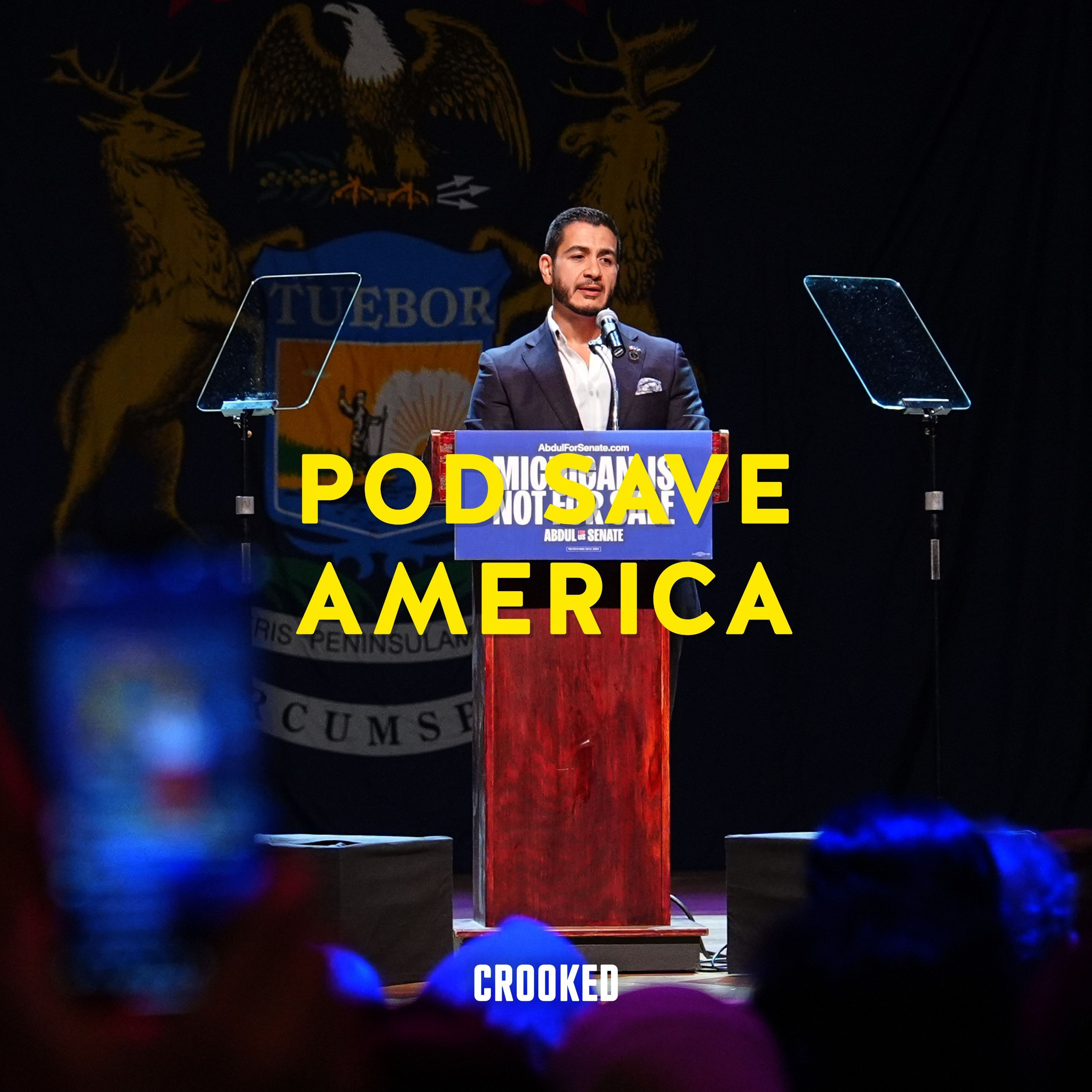
El-Sayed’s Michigan win tests Democrats’ coalition strategy
Bonus: Abdul El-Sayed Wins in Michigan feat. Bernie Sanders
The primary exposes Democrats’ tensions over outside money, working-class voters, progressive policy, and the path to defeating Mike Rogers.
- 1Abdul El-Sayed’s narrow Michigan victory revealed polling failures, regional divides, and the importance of Muslim and young voters.
- 2The hosts debate whether Democrats can unite behind El-Sayed while defining Mike Rogers beyond familiar MAGA attacks.
- 3Bernie Sanders argues that grassroots organizing, economic justice, and serious preparation for artificial intelligence should shape Democratic politics.
Don't miss
Bernie Sanders connects El-Sayed’s grassroots victory to the need for Democrats to organize working-class and diverse voters while preparing for AI’s disruptions.
The brief
Abdul El-Sayed’s narrow Michigan Democratic Senate primary victory over Haley Stevens exposed polling misses, regional divides, turnout differences, and the importance of Muslim voters.
Jon Favreau and Dan Pfeiffer weigh AIPAC and establishment spending against local concerns, then ask whether El-Sayed can unite Democrats for a general election against Mike Rogers.
The hosts examine El-Sayed’s coalition: strong support among young and college-educated voters, but weaker performance with rural and working-class voters, raising questions about progressive strategy.
Bernie Sanders calls the result an extraordinary grassroots victory and argues that Democrats must reach working-class, African American, and women voters through organizing and economic justice.
Sanders closes with a warning about artificial intelligence, including job displacement, misinformation, deepfakes, and children’s dependence on screens, framing AI as a democratic political challenge.
What was said on this episode
34 statements · 15 positive · 16 negative · 2 mixed · 1 neutral
Abdul El-Sayed won Michigan’s Democratic Senate primary by one point.
“Abdul El-Sayed is now the Democratic nominee for the US Senate race in Michigan with more than 95% of the vote in. He defeated Haley Stevens by 1 point.”
Listen at 3:15
Polls likely overstated Abdul’s support by oversampling highly engaged college-educated voters.
“Best guess is people oversampled highly engaged college-educated voters who overwhelmingly voted for Abdul, hence the margin.”
Listen at 6:25
Abdul’s progressive primary coalition was young and college-educated but weaker among other voters.
“Abdul had the typical coalition of a very progressive candidate in Michigan and nationally, which is a lot of young voters and a lot of college-educated voters, and struggled with the rest of the coalition.”
Listen at 7:54
Muslim voters, especially in Dearborn, were important to Abdul’s victory.
“you can't understate the importance of the Muslim population, particularly in Dearborn, which Abdul won essentially 80-20.”
Listen at 9:19
Association with AIPAC harmed Haley Stevens politically.
“being associated with AIPAC, being the AIPAC candidate was bad for Haley Stevens.”
Listen at 10:41
AIPAC had 37% negative favorability among Michigan Democrats.
“AIPAC has a negative 37% favorability rating among Democrats in Michigan.”
Listen at 10:47
Candidates in 2028 will likely avoid soliciting or accepting AIPAC support.
“I think you generally— I cannot see based on these results a 2028 candidate soliciting, accepting, or courting AIPAC to either endorse them or run ads on their behalf.”
Listen at 14:24
Uniting voters exposed to anti-Abdul spending is the general-election challenge.
“can you get the voters who just heard sixty million dollars of arguments against Abdul to come and support him? And that's that. That is the general challenge in the general election.”
Listen at 19:34
Republican attacks must convince voters Abdul will not reduce their costs.
“You have to make them believe that he will not lower your costs.”
Listen at 21:59
Voting for Mike Rogers would help Donald Trump control the Senate.
“A vote for Mike Rogers is a vote for Donald Trump and Donald Trump to control the Senate.”
Listen at 25:05
Abdul must persuade voters that Mike Rogers has changed politically.
“I think Abdul has to make people realize before he just says that Mike Rogers is going to be a vote for Donald Trump, that Mike Rogers has changed.”
Listen at 25:54
Abdul’s primary coalition is unfavorable for the general election.
“when you look at the coalition that he won with, it is a coalition that does not bode great for the general election.”
Listen at 32:12
Abdul performed poorly among working-class and Black voters.
“he underperformed with working-class voters, and he really got his clock cleaned with Black voters.”
Listen at 32:25
Abdul should broaden his appeal beyond his primary base.
“he needs to think really hard about how to make himself more broadly appealing.”
Listen at 34:44
Cultural and social concerns contributed to working-class movement away from Democrats.
“There are cultural social concerns that the working class have, which is why they have moved away from the Democratic Party”
Listen at 38:56
Aid to Israel becomes less salient among economically downscale general-election voters.
“the salience of the issue goes down.”
Listen at 42:56
Opposing unconditional foreign aid is likely popular.
“Which is a very good and wise, and I imagine quite popular position.”
Listen at 45:12
Progressive anti-establishment candidates can hold a primary advantage in favorable races.
“in races with the right candidates in the right situations, progressive anti-establishment candidates have the advantage in the primary against the more traditional candidates you would expect to win.”
Listen at 47:29
Democrats are expected to win Michigan’s 7th District, with Brink or Masden favored.
“Democrats should win it this time around. Most of the people whose job it is to try to win the House believe pretty strongly that either Bridget Brink or Matt Masden would be favorites in that race.”
Listen at 48:19
Moderates should nominate candidates who do not appear establishment-aligned.
“the way for moderates to win is to find candidates who do not appear to be just like establishment toadies”
Listen at 51:46
Will Lawrence is likely to win the November general election.
“I think he stands a good chance to win in November as well.”
Listen at 55:50
Abdul’s economic-justice message will resonate across Michigan’s electorate.
“I think it's going to resonate all over Michigan, whether you're Democrat, Republican, or independent.”
Listen at 58:48
Abdul’s campaign will need extensive grassroots door-knocking.
“And I think in Abdul's case in Michigan, we're going to have to have thousands and thousands of people knocking on doors”
Listen at 59:44
Serious candidates Sanders knows do not support defunding the police.
“No serious person that I know who is running for office believes in quote-unquote defunding the police.”
Listen at 1:04:16
Police reform and eliminating racism within police departments are necessary.
“Do we need police reform? Do we need to get rid of racism within police departments? Absolutely.”
Listen at 1:04:26
Comprehensive immigration reform is preferable to open borders.
“Open borders? No. We all, most of us believe in comprehensive immigration reform, not opening up all the borders.”
Listen at 1:05:02
A Democratic Congress should pass Medicare for All despite a Trump veto threat.
“In the first 2, 3, 4 months, you're gonna pass Medicare for All, and if Mr. Trump wants to veto it, let him.”
Listen at 1:08:14
Democrats should lower prescription drug costs to international levels.
“We're going to lower prescription drug costs to the price that other countries around the world are paying.”
Listen at 1:08:27
A Democratic Congress should raise the minimum wage and billionaire taxes.
“We're going to raise the minimum wage. We're going to raise taxes on billionaires.”
Listen at 1:08:33
Artificial intelligence may be humanity’s most transformational technology.
“You're looking what I think we can agree on as the most transformational technology in the history of humanity”
Listen at 1:09:36
Artificial intelligence may eliminate millions of jobs.
“How many millions of jobs will be lost? I don't know.”
Listen at 1:09:51
Recent instances suggest AI has escaped human control.
“Recently, we've seen instances of AI escaping human control.”
Listen at 1:11:31
More capable AI could pose an existential threat to humanity.
“as AI becomes smarter than human beings, we could face an existential threat.”
Listen at 1:11:40
AI development should be slowed down.
“we need to slow it down. That's the first thing we need to do.”
Listen at 1:11:48
Statements are attributed to the speaker as said on the episode and reflect their view at the time, not PodLume's. They are not advice.