Oct 10, 2026 · 1h 58m
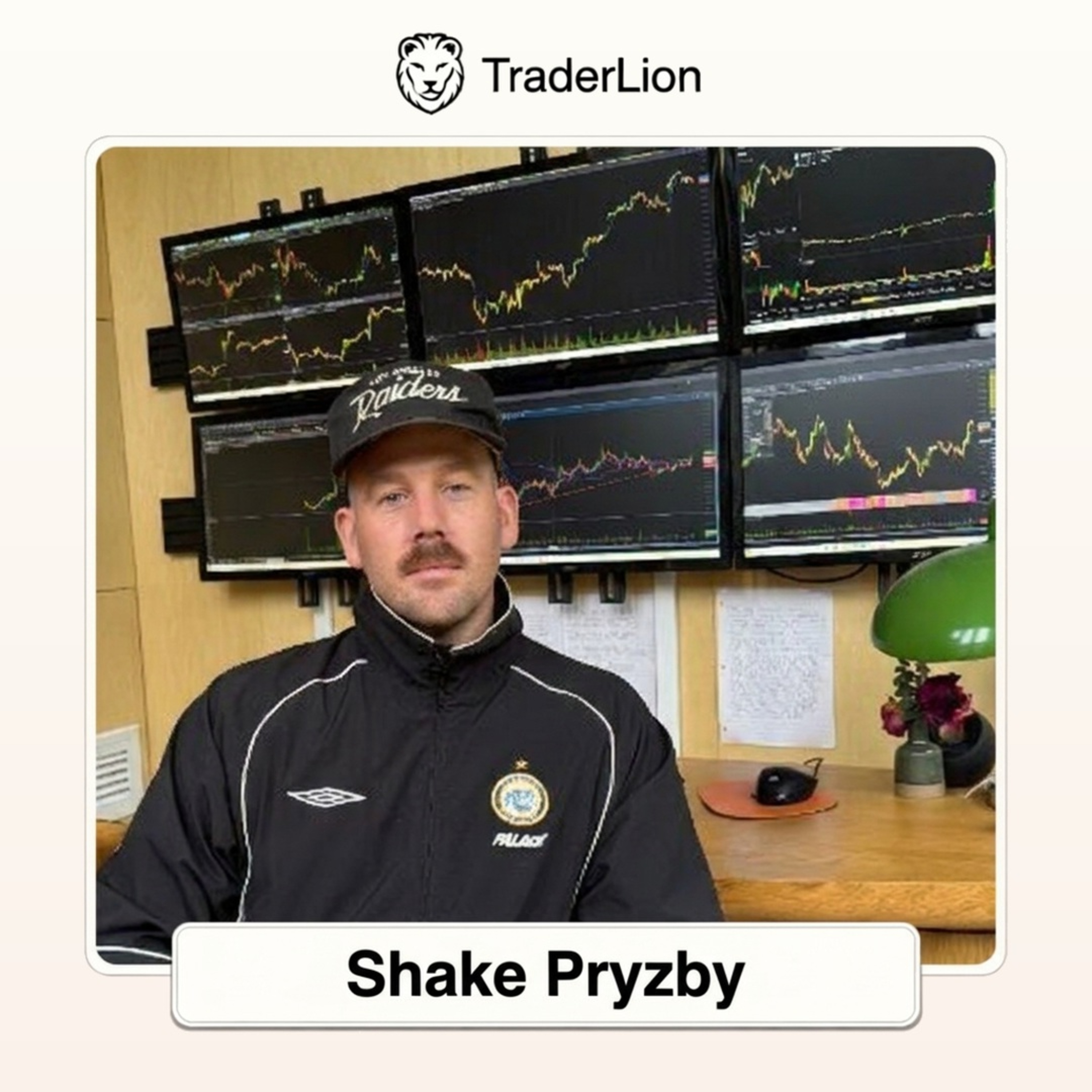
Shake Pryzby sizes risk by market regime
The Dynamic Sizing Strategy of a Top Swing Trader | Shake Pryzby
The episode presents a practical framework for deciding when to stay defensive, when to build exposure, and how to press winners without surrendering discipline.
- 1Pryzby adjusts exposure from cash to leverage according to market conditions, opportunity quality, and portfolio heat.
- 2He combines weekly breakouts with precise intraday entries, pre-positioning, and adds that depend on intact key levels.
- 3He manages momentum risk by taking profits in extended stocks, reducing activity as leadership fades, and avoiding FOMO.
Don't miss
Pryzby explains how a one-share feeler position keeps a promising setup on his radar while preserving optionality amid thousands of opportunities.
The brief
Shake Pryzby’s central argument is that position size should move with the market’s opportunity set, from cash to concentrated leverage rather than staying fixed.
His trade reviews connect weekly bases and earnings gaps to precise intraday entries, including pre-positioning and one-share feelers that preserve attention without forcing commitment.
The tension is between acting early and avoiding shakeouts: Pryzby leaves room for trades to develop, then adds only while the key level and broader thesis remain intact.
A Qualcomm review shows the other side of momentum trading: when a stock becomes extended from its moving averages, he takes profits while keeping re-entry possible.
The broader framework tracks breadth, sectors, leading themes, and index signals, while emotional discipline means letting high-quality setups arrive instead of chasing them.
What was said on this episode
19 statements · 8 positive · 3 negative · 1 mixed · 7 neutral
Shake’s momentum strategy targets 150% margin exposure concentrated in high-beta stocks.
“Strategy I'm going to tell you about today is just the pure momentum risk on strategy where I'm trying to be 150% invested on margin, concentrated in the highest of beta names.”
Listen at 1:10
Oversized trades increase traders’ emotional decision-making.
“Having too much size in a trade will only increase your emotional decision-making.”
Listen at 1:22
Shake will hold entirely cash during unfavorable trading periods.
“I'll hold 100% cash for weeks while other traders continue to enter stock.”
Listen at 2:07
The strategy should only be activated when its objective trend conditions are present.
“The trend filter is binary. This isn't feel, right? So I have to see these things out of the market in order to put this strategy on.”
Listen at 10:26
The strategy requires consistently low VIX conditions.
“The VIX has to be consistently low because this strategy relies a lot on moving average trading.”
Listen at 10:56
Higher VIX levels reduce the reliability of moving-average support.
“The higher the VIX gets, the less moving averages are respected, right?”
Listen at 11:00
Intraday entry tactics enable Shake to take larger portfolio positions.
“I'm utilizing intraday levels of entry tactics in order to have larger portfolio positions.”
Listen at 14:17
Shake uses 20–40% portfolio positions with roughly 0.5–1.5% account risk per trade.
“I'll quantify this at greater than 20% up to 40% while maintaining strict risk parameters, typically a half percent account risk per trade. up to one and a half percent.”
Listen at 14:21
A position must gain distance from entry on day one to justify a 40% weighting.
“I need that distance. I need to be up in the trade in day one to hold that 40% portfolio weighting.”
Listen at 15:08
Stock selection accounts for 75% of trading success.
“Name selection is 75% of the battle.”
Listen at 19:26
A stock’s movement is typically attributed 40% to market, 30% sector, and 30% company factors.
“A stock is typically 40% the market, 30% the sector, 30% itself.”
Listen at 20:28
Market and industry conditions determine 60% of a stock’s move before company analysis.
“The implication here is 60% of a stock's move is decided before you ever analyze the company.”
Listen at 21:32
Power earnings gaps usually initiate large stock moves.
“The power of power earnings gaps is it's usually the genesis of the start of a large move”
Listen at 22:26
Software stocks are expected to rise for the remainder of the year.
“I believe they're set to go higher the rest of the year.”
Listen at 23:14
Shake buys one share to keep promising stocks on his active radar.
“What I've begun doing the last few years is buying a single share of stock.”
Listen at 57:15
Achieving 150–200% annual returns requires tolerating roughly 10% down days.
“In order to have these 150, 200% years that all the best momentum traders are going to have, You have to be willing to have kind of these 10% down days”
Listen at 58:03
Shake reported a 73.5% portfolio gain and 7.74% maximum drawdown.
“I had a 73.5% portfolio gain. My max drawdown was only 7.74%.”
Listen at 58:19
Shake recommends fewer positions, fewer losses, and greater commitment to selected names.
“I want to be taking less losses. I want to be focused on less names, and I want to commit. commit more so to the names”
Listen at 1:08:39
Traders should eliminate FOMO-driven chasing from their process.
“ridding your life of FOMO is another message I'd really like to leave with traders.”
Listen at 1:56:17
Statements are attributed to the speaker as said on the episode and reflect their view at the time, not PodLume's. They are not advice.
Books & mentions
Some links are affiliate links — PodLume may earn a commission if you buy.

