Aug 26, 2026 · 1h 42m
Listen from 24:51
Listen at 24:51
Trump’s pressure campaigns collide with limits on power
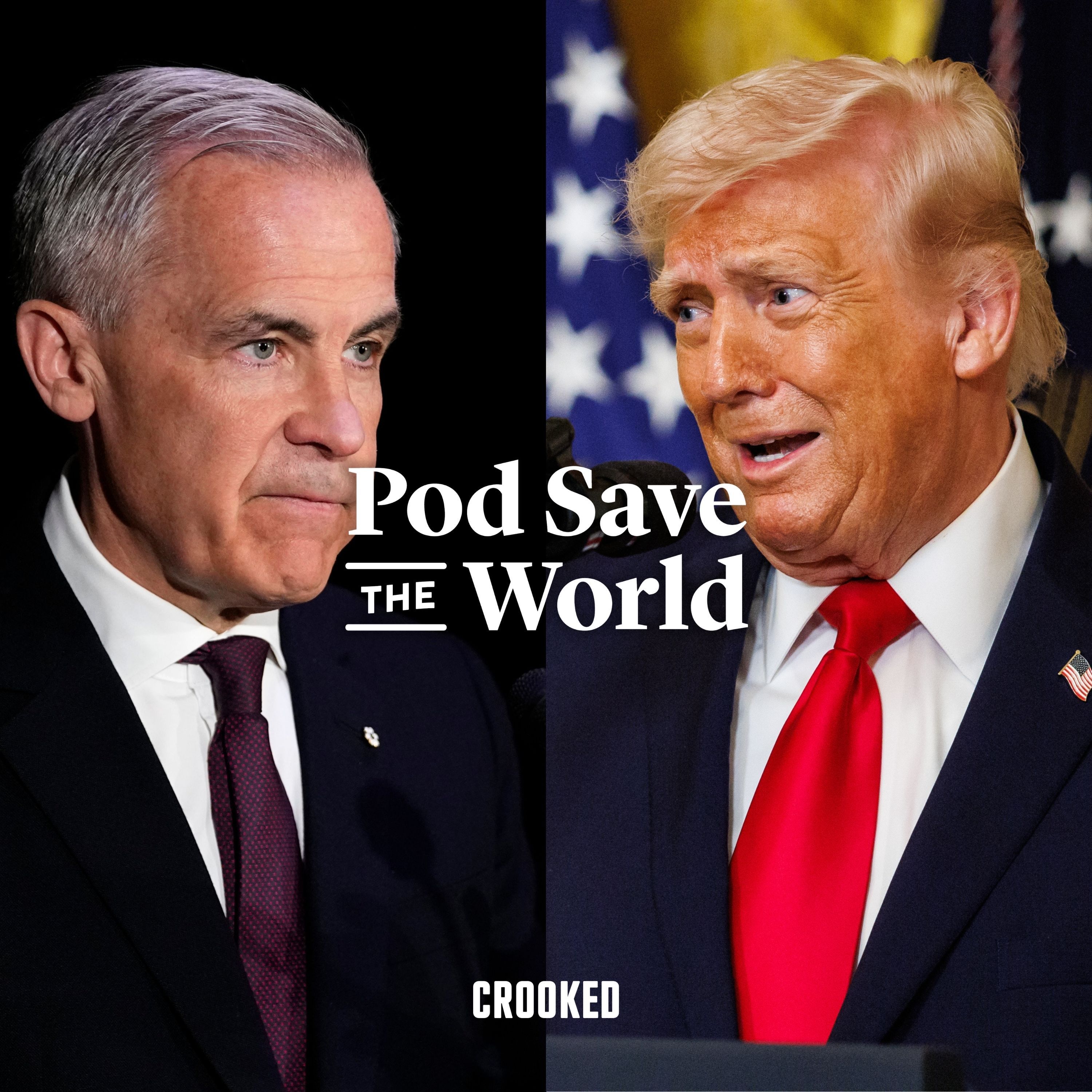
Trump & Carney’s Heated Rivalry
The episode connects trade disputes, sanctions, censorship, authoritarianism, and Gaza to a broader question of what political pressure can actually achieve.
- 1Trump’s disputes with Canada and Iran may generate political theater without producing quick victories or avoiding wider economic risks.
- 2The discussion links autonomous weapons, Ukraine’s political tensions, and pressure on Stars and Stripes to weakening accountability.
- 3American Doctor turns medical testimony from Gaza into an argument about media failure, public responsibility, and U.S. policy.
Don't miss
Feroze Sidhwa describes how destroyed hospitals, blocked medical access, and the absence of international journalists shape what Gaza’s doctors can witness and communicate.
The brief
Tommy Vietor and Ben Rhodes argue that Trump’s disputes with Canada and Iran are shaped by domestic incentives, limited leverage, and economic risks that make quick victories unlikely.
The conversation widens to autonomous Russian drones, Ukraine’s political tensions, and Pentagon pressure on Stars and Stripes, asking what happens when escalation and accountability both become harder to control.
Nayib Bukele’s popularity and humanoid robot competitions offer contrasting warnings: public frustration can reward authoritarian control, while technological progress can make familiar-looking machines newly unsettling.
The episode’s centerpiece is American Doctor, as Poh Si Teng and Feroze Sidhwa describe documenting Gaza’s medical collapse, confronting graphic evidence, and turning doctors’ testimony toward accountability.
The film’s argument reaches beyond Gaza: when journalists are blocked and aid is restricted, American viewers must reckon with how policy, taxes, and media shape what remains visible.
What was said on this episode
32 statements · 5 positive · 25 negative · 1 mixed · 1 neutral
Trump’s tariff pressure on Canada will continue repeatedly after partial deals.
“Carney saw... You know, this is just going to keep happening”
Listen at 14:24
Carney can pressure Trump into declaring victory and reaching a trade deal.
“he can squeeze us until essentially Trump declares some victory and cuts some deal”
Listen at 17:56
The trade conflict will significantly damage Canada’s recovering economy.
“this is really going to punch them hard at the time when the economy was just recovering”
Listen at 18:33
Carney may emerge from the trade war after Canada suffers short- and medium-term economic pain.
“it's possible that he comes out of this, yes, having probably suffered some short and maybe even medium term economic pain”
Listen at 21:40
Carney’s strategy could demonstrate Canada can resist U.S. pressure and diversify trade partners.
“if he can accomplish what he's trying to do and show that. Canada can stand up to the United States, show that they can diversify their trading partners”
Listen at 21:49
Trump wants to dominate Canada rather than merely resolve trade disputes.
“He wants to dominate a smaller country.”
Listen at 23:29
Trump responds to strength, and Xi Jinping prevailed by confronting him in a trade war.
“Trump respects strength too. Like Xi Jinping is the only other guy that really punched Trump in the face in a trade war and he won.”
Listen at 24:03
Carney should align Claudia Sheinbaum and other countries against U.S. pressure.
“Carney, if he's smart. you know, we'll get Claudia Sheinbaum on side.”
Listen at 24:42
The new Iran sanctions largely repeat existing sanctions.
“Nothing really all that new.”
Listen at 28:36
The Iran sanctions are unlikely to force surrender or reopening of the Strait of Hormuz.
“the idea that this is going to, what is it going to achieve? Like Iran's going to surrender? Iran's going to reopen the Strait of Hormuz? Like I don't think that's going to happen.”
Listen at 31:11
Sanctioning Chinese or Indian entities could destabilize the global economy.
“the only thing left to sanction. is like the Chinese or the Indians, which would bring down the global economy”
Listen at 33:16
Removing major Chinese banks from the financial system could cause systemic economic collapse.
“if suddenly like major Chinese banks are taken offline, like the whole thing unravels”
Listen at 33:29
Military leaders should be less deferential to Trump because future crises could involve Greenland, Panama, or Taiwan.
“The reason I'm worried about that is both because we're in a war, but because what happens in Greenland? What happens in Panama Canal? Taiwan. Yeah. Like a little less yes, man.”
Listen at 36:26
A Russian drone autonomously selected and attacked a target using AI.
“the drone selected its own target with AI and then attacked”
Listen at 37:28
Russia may be considering attacks or sabotage against Ukrainian weapons facilities in Germany.
“it wouldn't shock me if there was intelligence that the Russians are considering like hitting stuff. Or sabotaging stuff in like Germany.”
Listen at 39:59
Further Russian escalation remains likely after recent setbacks.
“Watch the space for escalation from the Russian side.”
Listen at 40:27
Current European, U.S., and Russian actions are escalating rather than de-escalating the Ukraine conflict.
“there's nobody – That is deescalatory right now. You know, like there are times in the past when the Europeans are trying to negotiate something. Obviously, Trump was. Right now, like everybody's ratcheting it up.”
Listen at 43:14
Ukraine is unlikely to hold elections while the war continues.
“I don't see any elections happening during the war.”
Listen at 43:50
The Pentagon seeks to prevent Iran-war reporting from reaching service members.
“the military wants to keep that information from reaching service members”
Listen at 51:52
Bukele-style security policies can enable right-wing strongmen to capture and consolidate power.
“there's a real danger that This kind of short-term interest in security leads countries to kind of repeat the history of allowing right-wing strongmen to kind of capture power and consolidate it”
Listen at 56:32
Failure to address crime seriously may drive Latin American voters toward authoritarian strongmen.
“I worry that, you know. And it's a test for the center and the left in Latin America. Like, hey, you're going to have to take crime pretty seriously here. Because if you don't have an alternative solution, people are going to turn to guys like this.”
Listen at 57:40
Nayib Bukele is a dictator, and CECOT constitutes a crime against humanity.
“Pekele is a dictator. Like, Sukkot is a crime against humanity. It's just an evil institution.”
Listen at 57:53
Bukele’s emergency powers may become permanent before the public recognizes the danger.
“over time, I think people will start to see, oh, wait a second. These emergency powers are permanent”
Listen at 1:00:09
Bukele’s model is normalizing right-wing strongman politics across Latin America.
“It's a dangerous normalization or renormalization of really right-wing strongman politics in Latin America.”
Listen at 1:00:30
The robot’s AI learned an unconventional running method to improve speed and stability.
“the AI trained itself to run that way”
Listen at 1:02:40
Humanoid robots may look indistinguishable from humans within two or three years.
“we're probably only two, three years away where they look exactly like people”
Listen at 1:03:21
U.S. officials could halt the arms transfers to Israel immediately.
“As soon as he gets. He or she gets the word, hey, stop signing off on those arms transfers. They'll just stop.”
Listen at 1:18:35
Gaza’s medical system has been destroyed and is effectively nonfunctional.
“the medical system has just been destroyed. It effectively doesn't function anymore.”
Listen at 1:26:20
Gaza has roughly 300–350 hospital beds for approximately two million people.
“That's about 300 or 350 hospital beds total for 2 million of the sickest people in the world.”
Listen at 1:26:51
Approximately half of international healthcare workers attempting to enter Gaza are blocked.
“about half of international healthcare workers who try to go to Gaza are blocked from entering.”
Listen at 1:29:16
Blocking healthcare workers helps isolate Gaza from the outside world.
“It's a way of severing Gaza from the world.”
Listen at 1:30:13
Two consecutive U.S. administrations have forced Americans to subsidize the mass killing of children.
“we are being forced to by two administrations in a row”
Listen at 1:40:10
Statements are attributed to the speaker as said on the episode and reflect their view at the time, not PodLume's. They are not advice.