Jul 1, 2026 · 1h 14m
Venture capitalists warn massive AI seed rounds threaten startup survival
Why the VC Hype Cycle Always Gets It Wrong | VC Roundtable | E2307
As venture liquidity dries up, the traditional playbook for scaling and exiting startups is being rewritten by massive AI valuations and private equity.
- 1Outsized early-stage valuations in artificial intelligence risk crushing startups under unrealistic growth expectations.
- 2Private equity acquisitions are emerging as a vital alternative exit route for pre-AI portfolio companies.
- 3Maintaining smaller fund sizes allows early-stage venture firms to remain disciplined and aligned with founders.
Don't miss
The panel dissects how massive AI seed rounds function as a 'king-making' exercise by multi-stage funds that ultimately hurts startup flexibility.
The brief
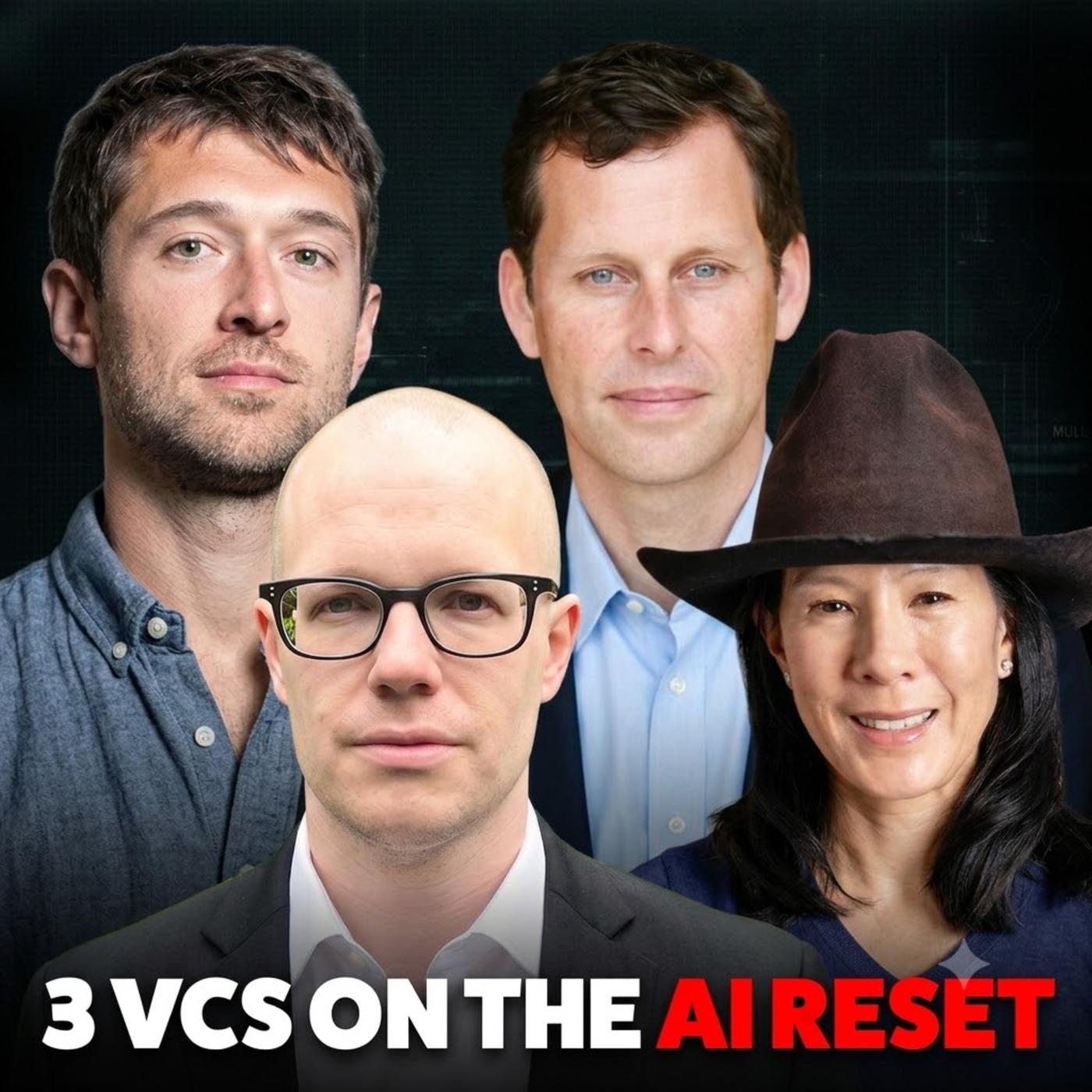
Host Alex Wilhelm convenes top venture capitalists Aileen Lee, Mike Maples, and Ben Lerer to dissect a shifting startup landscape where traditional growth metrics are collapsing and liquidity remains locked.
The panel warns that massive artificial intelligence seed rounds are creating a dangerous trap, saddling early-stage startups with bloated valuations that destroy future exit optionality.
As traditional initial public offerings remain rare, the investors point to private equity acquisitions of older, non-AI native companies as an increasingly vital liquidity path.
To survive the post-hype cooldown, the VCs argue that firms must maintain disciplined fund sizes and startups must prioritize capital efficiency over raw scale.
What was said on this episode
37 statements · 17 positive · 12 negative · 1 mixed · 7 neutral
Founder quality is currently exceptionally strong.
“founder quality is incredible right now”
Listen at 1:41
Social media is generally harmful or undesirable.
“in general, social media is, like, not great”
Listen at 3:42
AI has dramatically compressed business cycles.
“cycles of business have been compressed dramatically in the AI era”
Listen at 5:03
Building great companies generally takes substantial time.
“building great companies takes time”
Listen at 6:59
LP liquidity distributions will encourage additional venture commitments.
“it will help because they, I think some of them have been a little hesitant to commit more to venture when they weren't getting money out”
Listen at 7:47
Seed funds have more exit optionality than larger funds.
“seed funds can do is they have more exit optionality”
Listen at 8:45
M&A will become more active in 2027, creating exits for pre-AI companies.
“I assume that 27 will be maybe even more active and so there'll be more exit opportunities for what we call pre AI companies”
Listen at 9:41
Ignite’s sale to private equity was probably the right decision.
“in hindsight, he probably made the right call”
Listen at 13:54
Companies generally create better liquidity by attracting buyers than actively selling themselves.
“companies get bought, not sold”
Listen at 14:56
Passive efforts to make legacy companies adopt AI will likely disappoint.
“if you just sit around passively and look at your old companies and say, well, I hope these, I hope they figure out AI, we're going to be very disappointed”
Listen at 15:40
Companies receiving serious acquisition interest should investigate competing offers.
“if somebody really wants you, yes, you should of course go run a process and see what else is out there”
Listen at 17:24
Mutiny’s AI pivot produced an impressive new product suite.
“they basically, unfortunately had to cut a lot of the people went back to the drawing board, built a whole new product suite and are selling it now. And it's incredible.”
Listen at 20:07
Adopting a profit-first model probably kept KeepSafe in existence.
“that company, had they not done that, probably wouldn't exist anymore”
Listen at 23:48
Many startups’ growth is insufficient relative to their cash burn.
“a lot of people are growing not fast enough relative to their burn”
Listen at 24:57
AI has substantially raised enterprise software growth expectations.
“the bar has really changed”
Listen at 25:20
Current venture-backed software companies may need roughly 4.5–5x growth initially.
“right now it's probably one to five or one to four and a half”
Listen at 25:28
Fund size signals the maximum exit scale promised to LPs.
“your fund size is a commitment to your LPs about what your largest exit will be”
Listen at 31:51
Unfashionable startups cannot rely on Silicon Valley investors to rescue them.
“you can't count on the Silicon Valley echo chamber bailing you out”
Listen at 34:10
Huge seed and Series A rounds differ materially from traditional rounds in scale and accountability.
“they're calling it a seed or an A because it's their first institutional round or their second, but it's not a seed or an A in the sense of how much they're raising, the valuation, who's going to do the next round, and the metrics that people are eventually going to hold you accountable to”
Listen at 38:34
Open-weight models are becoming cheaper and substantially better.
“the number of models that are coming out that are going to be like the open source models, the open weight models, they're a lot cheaper and they're getting so much better”
Listen at 39:34
Within 12–36 months, highly funded AI startups will be exposed as either real or empty.
“At some point in the next 12 to 36 months, the rubber meets the road and we figure out what companies are real and what companies raised hundreds of millions of dollars and don't have anything.”
Listen at 41:32
Raising unusually large early rounds substantially reduces startup strategic optionality.
“you lose an amazing amount of optionality by raising rounds this way”
Listen at 43:26
The year’s hottest startup theme usually does not identify its best companies.
“the best companies that are actually founded in those years never match what the theme of the year is”
Listen at 47:56
Great companies often remain obscure during their first three to five years.
“it usually takes a long time for a great company to be built and a lot of these companies for the first three to five years, no one's heard of them”
Listen at 48:14
Investors should avoid AI productivity workflows lacking an increasing-returns mechanism.
“I would stay away from any type of AI productivity or workflows that doesn't embody some type of increasing returns mechanism at the core design”
Listen at 50:14
Generative AI increases the abundance of work products.
“AI creates abundance in terms of work products”
Listen at 52:38
AI-generated low-quality content will become widespread.
“there's going to be a lot of AI generated slop across the board”
Listen at 53:10
Correctness and verifiable correctness will be scarce amid abundant AI output.
“what's scarce is correctness and proof of correctness”
Listen at 53:54
Portfolio companies report GLM-1 achieving comparable results at much lower cost.
“they're saying they're getting equivalent results for a fraction of the cost”
Listen at 55:09
Companies can transfer frontier-model discoveries into cheaper production models.
“once people create new knowledge with the frontier models, they capture and transfer that knowledge with the cheaper models”
Listen at 59:56
Companies will emerge to provide AI model routing and evaluation infrastructure.
“there'll be a bunch of interesting companies helping with routing and evals”
Listen at 1:01:15
Restrictive AI regulation could weaken U.S. competitiveness against China.
“I think that would be very bad in terms of our competitive posture with China”
Listen at 1:04:18
Agents may enable continuous cyberattacks against systems.
“we can be trying to hack into systems 247 with agents”
Listen at 1:05:34
Proprietary data is strategically important for AI companies.
“Having proprietary data is really important”
Listen at 1:06:16
Social media should have been more heavily regulated.
“I certainly wish, looking back, that we had had more regulation of social media”
Listen at 1:11:05
AI access during learning years may discourage development of literacy and mathematical skills.
“giving people during their learning years access to tools as powerful as AI is going to encourage them in a lot of cases”
Listen at 1:12:03
Floodgate is investing in companies that complement generative AI abundance.
“I'm investing in companies that complement the abundance of generative AI”
Listen at 1:13:02
Statements are attributed to the speaker as said on the episode and reflect their view at the time, not PodLume's. They are not advice.