Sep 28, 2026 · 41 min
A $5,000 bounty tests whether annotation can become infrastructure
Jason’s Put a $5K Bounty on His Dream Chrome Extension | E2338
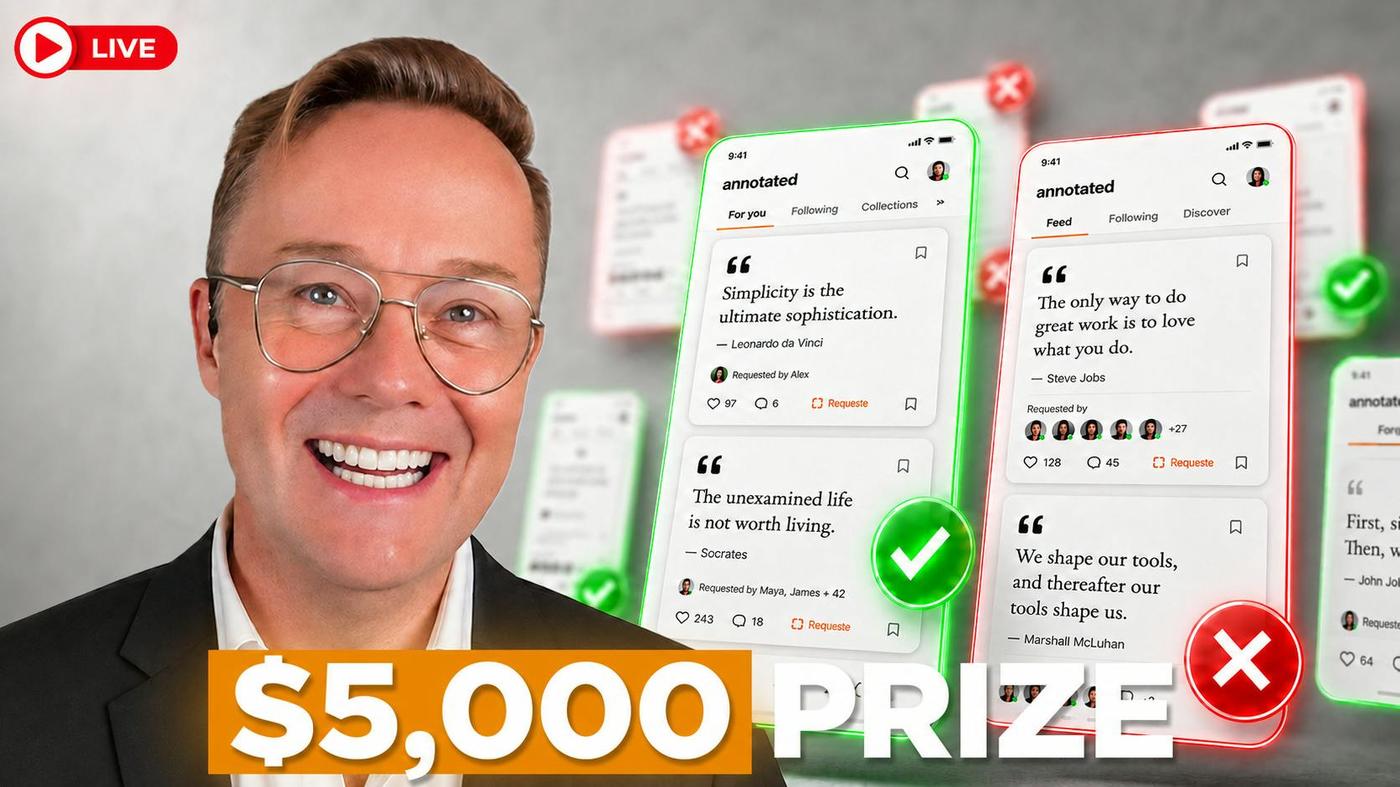
The episode links a hands-on product contest to a larger question about whether web annotations could power fact-checking, context, and valuable data for AI systems.
- 1The first Chrome extension submission wins on workflow, examples, sharing tools, and overall polish.
- 2The hosts see Annotated as a potential startup and data layer for fact-checking, expert context, and legal documents.
- 3Advice to a homeless aspiring founder puts safety, shelter, employment, and stability ahead of venture fundraising.
Don't miss
Jason and Lon shift from ranking three prototypes to considering Annotated as a startup and a valuable data layer for AI systems.
The brief
Jason Calacanis and Lon Harris review three Chrome extensions built for the $5,000 Annotated.com bounty, judging annotation workflows, sharing, examples, and polish.
The first submission leads with a strong sidebar workflow, clipping controls, source links, and sharing back to X; the hosts score it 8.5 out of 10.
The ranking turns on product demonstration as much as functionality: specific, persuasive examples make an annotation tool feel shippable, while weak examples expose unfinished thinking.
Jason then considers turning Annotated into a startup, with possible uses in fact-checking, expert context, legal documents, and training valuable data layers for language models.
The episode’s sharpest advice comes in response to a homeless aspiring founder: secure safety, food, shelter, employment, and a marketable skill before seeking venture capital.
What was said on this episode
20 statements · 13 positive · 4 negative · 2 mixed · 1 neutral
Vibe-coding users can build the Chrome extension within one or two weeks.
“vibe coding folks, people using these tools to build it in a week or two”
Listen at 1:33
Fair use permits clipping a small portion of a video.
“there is fair use, so you get to clip a little bit of a video these days.”
Listen at 6:35
Taking approximately two minutes from a podcast would generally be acceptable.
“taking, you know, I don't know, 2 minutes would be just fine with any podcaster.”
Listen at 7:32
Building Annotated’s initial product now takes two weeks or less.
“now it takes but 2 weeks or less.”
Listen at 11:23
Jason rates Submission 1 at 8.5 out of 10.
“I'm going to give this one, um, on a score, 8.5 out of 10.”
Listen at 12:45
Annotated is intended to function as a social network for annotations.
“this is supposed to be a social network of sorts for people annotating stuff.”
Listen at 16:53
Jason currently prefers Submission 3’s interface among the reviewed options.
“I kind of like this one best so far.”
Listen at 19:16
Jason rates the three submissions approximately 8.5, 8, and 6.
“The first one's like an 8.5. The second one's like a an 8, and this one's like a 6”
Listen at 23:47
Jason would currently allocate 80% of winning probability to Submission 1 and 20% to Submission 2.
“I probably would have given 80% to number 1 and 20% to number 2”
Listen at 24:19
Robert’s Chrome extension is intuitive, attractive, and professionally designed.
“The Chrome extension is so easy. Everything is just intuitive. It's really pretty. Like it really looks like it doesn't look vibe coded. It looks like a real professional website.”
Listen at 24:50
Jason plans to explore incubating Annotated as a startup within his venture firm.
“I actually want somebody to talk to the founders, see if anybody— I think what I want to do is take this and, uh, incubate it inside of our venture firm and see if we can make it into a startup.”
Listen at 25:20
Annotated could grow into a Reddit- or Twitter-like social network despite annual server costs.
“If you lose $250,000 a year in server costs, just let it grow and see if it becomes the next, you know, Reddit slash Twitter-esque kind of thing.”
Listen at 26:38
Lawyer annotations could provide valuable legal-case data to language-model companies.
“you could actually say to a large language model company, hey, Here's every legal case that got published on the web today, and we're just going to let lawyers publicly annotate them”
Listen at 27:29
Large language models are missing an expertise and context layer.
“it's that vital context that so many LLMs are missing.”
Listen at 27:50
All three Annotated submissions are nearly ready to launch on the web.
“I think all 3 of these are kind of ready to ship, at least on the web, maybe not on mobile, but they're ready to ship on the web.”
Listen at 29:10
A 700-page business plan is insufficient for raising startup funding today.
“That's not going to cut it in today's environment.”
Listen at 32:26
A homeless aspiring founder should use AI tools to obtain employment and stability before pursuing a startup.
“if you can use AI tools and get a job first and then get a small apartment and stabilize and be hireable for a specific skill, that would be step one before working on a startup.”
Listen at 32:50
A first-time homeless founder is unlikely to receive startup funding.
“not very likely.”
Listen at 35:05
Becoming a startup founder is currently easier than ever.
“It's never been easier to be a startup founder.”
Listen at 37:02
Venture capitalists will not fund someone who is homeless.
“They're not going to fund you if you're homeless.”
Listen at 37:29
Statements are attributed to the speaker as said on the episode and reflect their view at the time, not PodLume's. They are not advice.