Oct 29, 2026 · 1h 31m
A trader turns volatile markets into a reviewable process
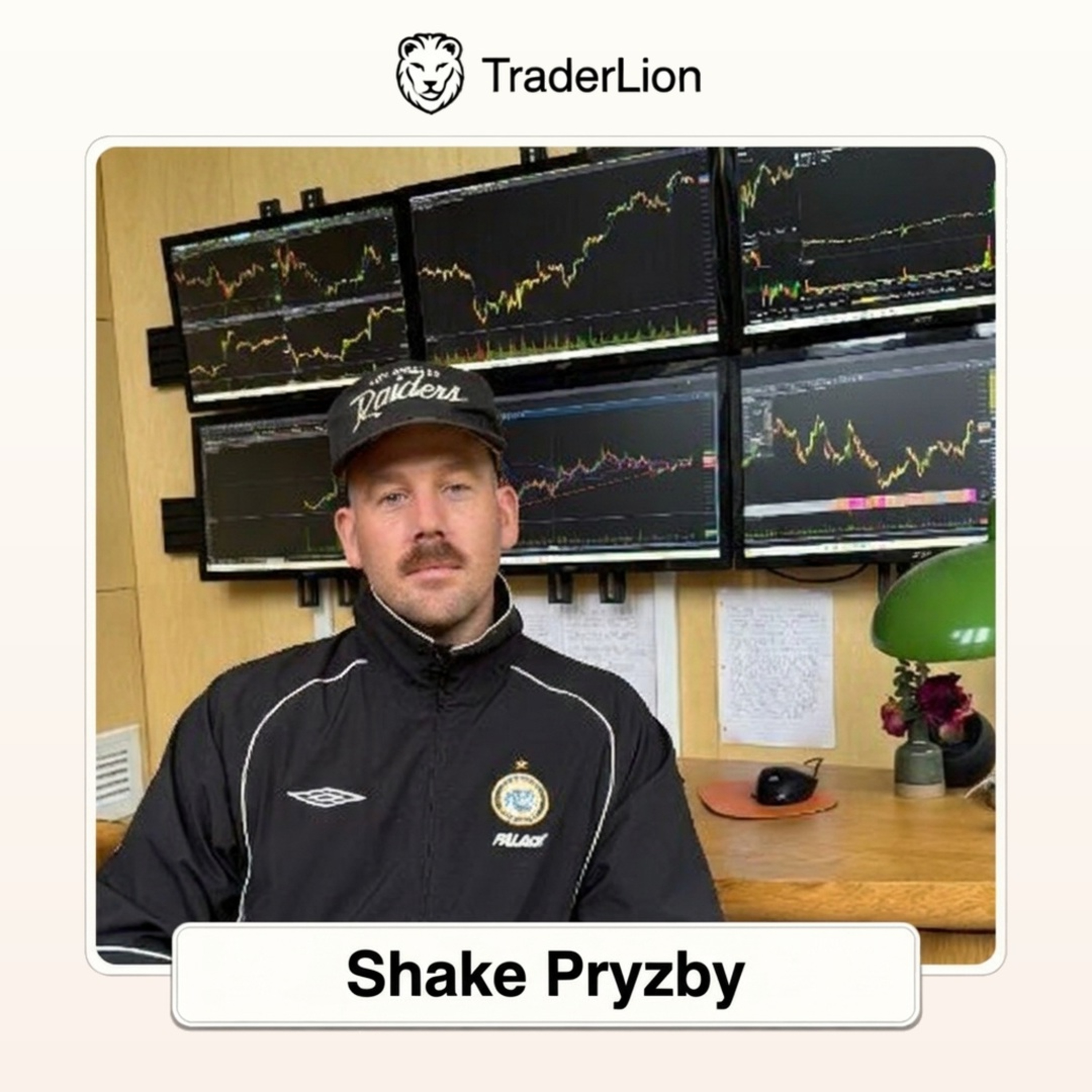
The Simple Trade Review System of a Top USIC Performer - Shake Pryzby
The episode shows how disciplined sizing, exits, and visual review can help traders adapt without mistaking favorable conditions for lasting skill.
- 1Shake Pryzby adapts entries and risk to market behavior instead of assuming every setup will work.
- 2Detailed PLTR and UPS reviews show how scaling out and responding to weakness can limit emotional mistakes.
- 3A durable trading identity develops through repeated market cycles, reduced outside noise, and honest review.
Don't miss
Shake’s PLTR review shows him reducing a large position, preserving a smaller swing position, and exiting after a double-top failure and weakening conditions.
The brief
Shake Pryzby and Richard Moglen frame trading as a creative, individualized process, then test that idea through detailed PLTR and UPS case studies.
In the PLTR review, Shake tracks an earnings reaction, a reclaim of the 200-day moving average, and a change in character before entering.
The trade becomes a lesson in adaptation: smaller entries, reduced risk, VWAP reclaims, and scaling out replace the assumption that a setup must work.
Shake exits PLTR after a double-top failure and weakening market and sector conditions, showing how price behavior can override a bullish thesis.
The broader argument is that mastery takes multiple market cycles; visual reviews, less outside noise, and humility help traders rebuild after drawdowns.
What was said on this episode
30 statements · 17 positive · 9 negative · 4 neutral
Shake’s strategy limits losses during choppy markets by taking positions off quickly.
“in chop, I'm not getting it killed as bad”
Listen at 1:17
Shake’s buying approach does not necessarily change during choppy markets.
“my buying isn't going to necessarily change at all in chop”
Listen at 1:22
Reviewing past trades teaches more than focusing on future trades.
“you're going to just learn so much more looking backwards than looking forward”
Listen at 2:00
Traders sometimes should observe markets without forming a short-term view.
“sometimes you just need to sit back and watch and not have a perspective”
Listen at 2:05
Slowing growth in a growth stock typically signals a short-term top.
“whenever a growth stock slows down their growth rate, that's typically a topping signal, at least in the short term”
Listen at 6:44
Accelerating growth is a major factor in evaluating stocks.
“accelerating growth is one of the most important parts of the equation”
Listen at 7:30
Traders should anticipate pullbacks rather than be caught unprepared by them.
“You want to be ready for a stress test versus being a victim of the stress test.”
Listen at 11:46
Shake identified $164 as the best entry level for Palantir.
“164 is the premier buy spot”
Listen at 12:03
A breakdown below Palantir’s support would likely require days or weeks of consolidation.
“if it breaks this area and doesn't hold these lows, it's going to need to consolidate a few days, maybe a few weeks”
Listen at 14:04
Entering alongside institutional buyers helps support a durable stop level.
“I want to have the first entry with the institutional buyers so that my stop is going to hold up.”
Listen at 25:55
Market confirmation is essential before taking a large position.
“I have to have the market's confirmation that that's really the biggest part of the trade”
Listen at 29:52
Shake avoids holding a 50% position through a pullback.
“I don't want to deal with a 50% position on a pullback”
Listen at 31:27
A market breakdown eventually converts a stock’s relative strength into relative weakness.
“if the market's going to break down, that relative strength's eventually going to turn to relative weakness”
Listen at 36:51
Shake’s long-term standard risk is 0.5% per trade.
“over the long term, it's simply half percent, half percent per trade”
Listen at 40:02
Longer holding periods do not necessarily produce greater returns in choppy markets.
“the longer amount of time you're in a trade, the more you're going to make. That is not true in ChopFest”
Listen at 43:46
Trade reviews contain the data needed to improve trading decisions.
“all the data, all of your answers to your trading is in your trade review”
Listen at 49:54
Traders sometimes benefit from stepping back and observing markets.
“sometimes you just need to sit back and observe”
Listen at 52:05
Shake currently views the market as bearish until stronger evidence reverses that view.
“the market's guilty until proven innocent right now”
Listen at 58:14
Chart evidence reveals whether a technical trade was executed correctly.
“the answers to the test are always on the screen”
Listen at 1:00:16
Shake found that entering trades about two hours after the open suited him best.
“my sweet spot to be like two hours off the open”
Listen at 1:03:03
Shake says mastering his trading strategy took five years and multiple market cycles.
“it really took me five years of, you know, getting everything down, seeing cycles, understanding different economic factors and such”
Listen at 1:08:39
Shake recommends having two years of living expenses saved before trading full-time.
“you have to have two years of money saved up”
Listen at 1:09:43
Trading performance and income are not guaranteed to persist into the next year.
“nothing's guaranteed next year”
Listen at 1:13:20
Trading strategies and market opportunities have not all been discovered.
“not everything's been figured out yet”
Listen at 1:16:39
Trading research and trade review should receive roughly equal time.
“Those should be almost 50, 50”
Listen at 1:18:31
Trading practice and reclaiming account highs build resilience and confidence.
“the more time you spend working on your game, and every time you reclaim new highs, you get a little bit more armor”
Listen at 1:24:51
Until conditions improve, Shake is seeking only one to three trades weekly.
“right now the way i'm trading until things clear up is like i'm telling i'm just looking for one to three opportunities every week”
Listen at 1:25:29
Trading in choppy conditions requires predefined profit targets.
“you have to have trading targets”
Listen at 1:26:34
The market structurally takes money from retail traders.
“the market was designed to take retail traders money”
Listen at 1:28:00
Trading is inherently difficult despite periods of favorable conditions.
“it's never easy”
Listen at 1:28:35
Statements are attributed to the speaker as said on the episode and reflect their view at the time, not PodLume's. They are not advice.
Weekly email
State of the Pod, every Monday
The week's most-discussed names and stories from podcasts, with the moments behind them. Free, five minutes, unsubscribe in one click.