Sep 30, 2026 · 43 min
AI and gene editing push biology toward programmable life
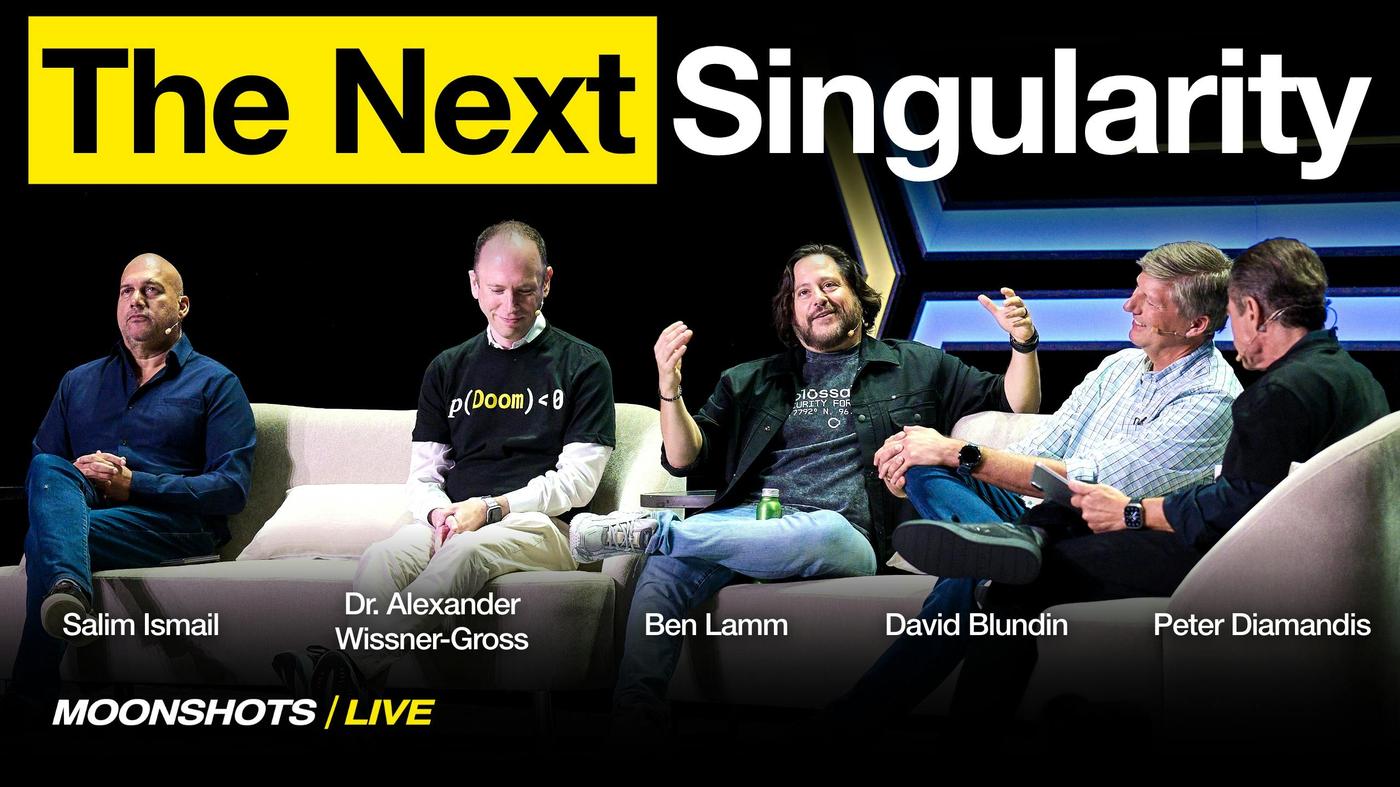
Why We're Living in a Biological Singularity With Ben Lamm | MOONSHOTS Live #297
The episode examines how rapidly converging biological tools could reshape conservation and organism design while outrunning ethical and regulatory safeguards.
- 1AI may matter less for biology through general models than through proprietary datasets and specialized biological infrastructure.
- 2De-extinction depends not only on genetic engineering, but also on ecological fit, animal welfare, regulation, and social legitimacy.
- 3CAD-like biological design, multiplex editing, DNA synthesis, and artificial gestation could enable novel organisms within a decade.
Don't miss
Ben Lamm predicts that Colossal could birth mammals fully ex utero within roughly 24 months, marking a major artificial-gestation milestone.
The brief
Ben Lamm describes Colossal Biosciences’ mammoth work as part of a broader convergence: AI, gene editing, DNA synthesis, and biological data are making life increasingly programmable.
The conversation shifts from general AI to biological infrastructure, including Colossal’s BioVault effort and specialized models designed around the complexity of genomes and living systems.
De-extinction is presented as a governance problem as much as a technical one: ecological roles, extinction causes, food webs, indigenous perspectives, and animal welfare all shape what should be attempted.
Lamm predicts biology will soon gain CAD-like tools for designing organisms with desired traits, while artificial gestation could produce mammals fully ex utero within roughly 24 months.
The mammoth project becomes a test case for ecological restoration, from grazing and grasslands to albedo and permafrost, but the practical question of where herds could live remains unresolved.
The episode closes on cautious optimism: AI-enabled biology could expand conservation and human ingenuity, but its power demands substantial public investment and responsible limits.
What was said on this episode
33 statements · 26 positive · 4 negative · 1 mixed · 2 neutral
Colossal is making good progress on its mammoth project.
“we are not working on that currently. Um, but we're making good progress on the mammoth project”
Listen at 1:18
George Church is arguably synthetic biology’s father and heads genetics at Harvard.
“George is the father of— arguably the father of synthetic biology. He's the head of genetics at Harvard.”
Listen at 3:37
Replicating published biological experiments can produce 40–60% failure rates.
“you're going to get like somewhere between 40% and 60% failure rate on published work”
Listen at 6:49
AI biology will focus on experiment simulation, design, and ideation over the next three to five years.
“running simulation, uh, design across a myriad of different experiments and helping creatively come up with the next experiment, I think that's where we're gonna see AI in biology for the next, you know, 3 to 5 years.”
Listen at 7:37
Large-scale comparative genomics data will enable useful biological conclusions.
“I do think that that amount of data from a comparative genomics perspective at scale, it is, will get you there.”
Listen at 9:30
In biology, datasets are more valuable than models.
“the dataset that is more valuable than the model.”
Listen at 9:42
Synthetic biology will produce close approximations of extinct organisms, not exact revivals.
“I do not. I think through DNA synthesis, prediction models, and, you know, some level or some components of synthetic biology, we will be able to get pretty close approximates.”
Listen at 11:25
Colossal will not use its technologies on humans.
“Colossal does not use any of our technologies at Colossal for humans, so we won't do that”
Listen at 11:43
Engineering novel life is more likely than reviving every extinct organism.
“it's more likely that we will be able to engineer life from a programmable life perspective, in the way that we want it than just bring back everything that ever existed”
Listen at 12:51
A genetically recreated Mozart could outperform the original under suitable conditions.
“your Mozart 2.0 could probably be better than the Mozart 1.0.”
Listen at 14:37
Human genetic applications face social, political, regulatory, and ethical concerns.
“it's more worries of social, political, regulatory concerns.”
Listen at 15:30
Synthetic biology, AI, computing, and quantum technologies will exceed all prior weapon systems in power.
“the technologies that are being developed with the kind of intersection of synthetic biology, compute, AI, and then eventually quantum will be more powerful than any weapon system that's ever been created. By far.”
Listen at 19:08
CAD-like biological design will arrive within ten years.
“So I think that world is less than 10 years out.”
Listen at 19:54
Engineering phenotypes and growing organisms ex utero will be possible within a decade.
“the technologies of being able to engineer key phenotypes on base-level organisms in different clades and be able to synthesize them or multiplex engineer them and then grow them ex utero is within a decade.”
Listen at 20:06
Colossal consistently delivers over 300 edits at over 90% efficiency.
“we are delivering 300+ at 90+% efficiency consistently”
Listen at 20:48
Colossal is testing deliveries involving 1,000 edits.
“We're now testing 1,000.”
Listen at 20:56
DNA synthesis has a higher and faster likelihood of success than multiplex editing.
“I think that has a higher likelihood of success faster.”
Listen at 22:01
Colossal will birth mammals fully ex utero within 24 months.
“within 24 months we will— Colossal will birth animal mammals fully ex utero from gestation through delivery.”
Listen at 22:34
Colossal’s fully ex utero mammal birth is highly likely within 24 months.
“I think that 24 months is highly likely.”
Listen at 22:53
Colossal’s next major milestone is revealing another extinct species.
“the next major inflection points are when we show the world the next extinct species”
Listen at 23:25
Traits such as coat color, size, scales, and feathers will soon be measurable and inducible.
“it's likely that like coat, coat color, sizing, you know, placate-like things that form skin, Scales, feathers, all of that will be highly measurable. Yeah. Um, and, and, and be able to be inducible very quickly.”
Listen at 26:15
The first publicly shown woolly mice involved eight gene edits.
“The first generation, which is what we showed the public, was 8.”
Listen at 27:02
Systems modeling for species conservation can also support human healthcare.
“that same system modeling that can be used to preserve species, bring back species, can also be used to do all kinds of work specifically in human healthcare.”
Listen at 28:26
Colossal’s conservation foundation has 75 global partners.
“We have 75 global partners.”
Listen at 29:21
Colossal plans to restore mammoths as social herds, not isolated animals.
“we're not going to bring back a mammoth. We're bringing back herds of them.”
Listen at 29:31
Ben Lamm wants to bring back tens of thousands of mammoths.
“Tens of thousands.”
Listen at 29:40
Grasslands are about six times more carbon-efficient and have a two-to-threefold albedo effect.
“it's about 6 times more efficient and a 2 to 3x albedo effect for light reflection to space.”
Listen at 32:12
Sufficient mammoth density could lower tundra summer temperatures by six to eight degrees.
“if you have this mammoth density at these places, uh, in, in the, in the tundra, they'll have this impact on the, uh, permafrost, a lowering of 6 to 8 degrees in the summer months.”
Listen at 32:48
Astromech is building specialized inflection models for biological data.
“we are trying to build like what are kind of inflection, we, we call 'em internally inflection models.”
Listen at 35:08
Astromech’s models can augment foundation models using millions of biological samples.
“it can plug into those so that when you do have global bio vaults and you have millions of samples that you can feed into a Mythos”
Listen at 35:55
Half of biodiversity will be lost within the next 25 years.
“we are going to lose half of biodiversity in the next 25 years”
Listen at 36:21
Governments should provide billions to preserve biological information and species.
“We have to have billions of dollars of federal funding across multiple governments working together to at least back up life.”
Listen at 36:37
Human ingenuity will overcome problems created by advanced technologies.
“I do believe in human ingenuity to work through those problems”
Listen at 42:10
Statements are attributed to the speaker as said on the episode and reflect their view at the time, not PodLume's. They are not advice.