Sep 15, 2026 · 19 min
AI prototypes need a production harness to survive
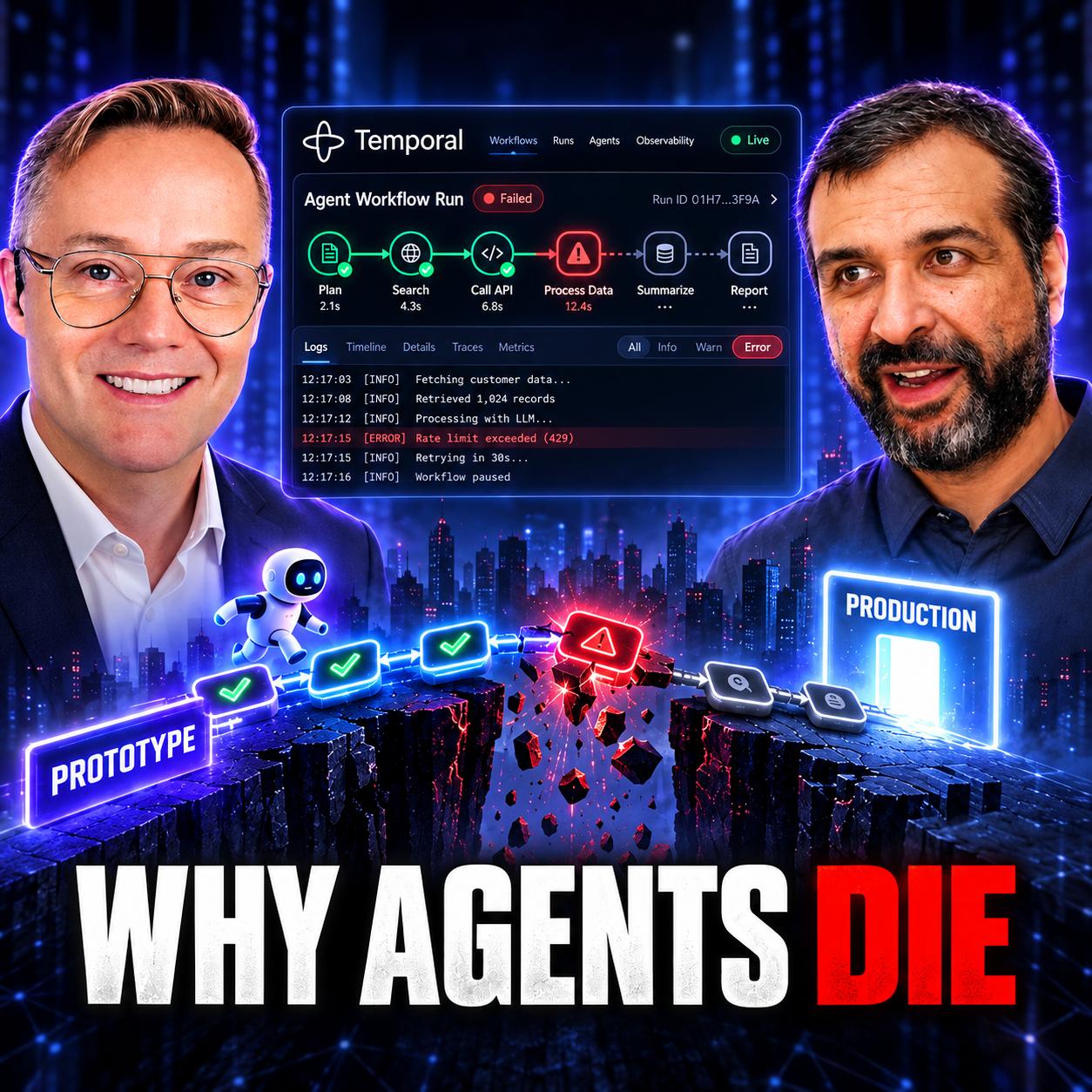
90% of AI prototypes never reach production (w/ Temporal's Samar Abbas) | AI Basics
The episode explains why impressive AI demos become unreliable business systems and what infrastructure makes long-running agent workflows dependable.
- 1AI prototypes often become brittle and difficult to reproduce when exposed to real production workloads.
- 2Orchestration, observability, security, recovery, and durable execution make agent behavior visible and resilient.
- 3Enterprise adoption requires guardrails and close collaboration between engineers and business teams, not merely better models.
Don't miss
Samar Abbas reframes the production challenge as building a reliable harness around the model, rather than simply improving the model itself.
The brief
This Week in Startups begins an AI Basics discussion about the gap between impressive prototypes and dependable products, with Temporal CEO Samar Abbas joining Jason to examine what changes in production.
Samar Abbas says AI applications and agents often become brittle, unstable, and hard to reproduce when they leave controlled proofs of concept and encounter real workloads.
Temporal’s approach centers on visibility into an agent’s actions, business logic, and intermediate steps, allowing teams to inspect and adjust systems rather than treat them as opaque demos.
The central distinction is between the model and its harness: orchestration, observability, security, recovery, and durable execution keep long-running agent tasks moving when failures occur.
The conversation’s practical test is organizational: agents are ready for enterprise workflows only when guardrails and embedded engineering support turn experiments into reliable business processes.
What was said on this episode
9 statements · 6 positive · 3 negative
Coding agents make software application development accessible to a broader population.
“coding agents are making those more accessible to everyone on the planet”
Listen at 2:08
About 90% of AI application ideas fail to progress beyond proof of concept.
“90% of those ideas die after a POC, essentially. They never see light of the day.”
Listen at 2:34
Longer-running agents taking more real-world actions create more value.
“the more longer they run, the more actions they take in real world, the more value they create”
Listen at 3:36
Temporal provides complete visibility into an agent’s execution.
“it gives you complete visibility into what your agent is actually doing to execute your task to get the right outcome”
Listen at 10:43
Temporal can intercept agent commands and apply guardrails before execution.
“it gives you an ability where you can intercept all of those commands and provide the necessary guardrails to secure that environment before it gets executed”
Listen at 12:50
Harnesses coordinate agentic loops in distributed architectures.
“harnesses are these brains which is separated outside of the agentic loop to drive these distributed architectures”
Listen at 15:12
Enterprises will not permit agents to run on laptops.
“none of the enterprises will ever allow these agents to run on a laptop”
Listen at 16:34
Running agents on laptops is no longer viable as agentic systems mature.
“running agents on your laptop is no longer even an option”
Listen at 17:17
Complex team-based agent operations require distributed environments.
“the only viable path is through running those things through an agent in a distributed environment”
Listen at 18:09
Statements are attributed to the speaker as said on the episode and reflect their view at the time, not PodLume's. They are not advice.
