Oct 31, 2026 · 34 min
AI spending tests Big Tech’s cash flows
Who Pays for the AI Boom? Big Tech’s Financing Problem
The episode examines whether hyperscalers can fund the AI buildout long enough to capture productivity gains without weakening their economics or social stability.
- 1Anthropic’s losses expose how much capital and uncertain pricing power the AI race demands.
- 2AI could raise productivity while disrupting employment, inequality, demographics, and established competitive moats.
- 3Netflix’s buybacks and content strategy remain attractive despite competition from YouTube and changing consumer habits.
Don't miss
The hosts use Anthropic’s losses to crystallize the question of whether AI productivity gains can justify the enormous capital required to compete.
The brief
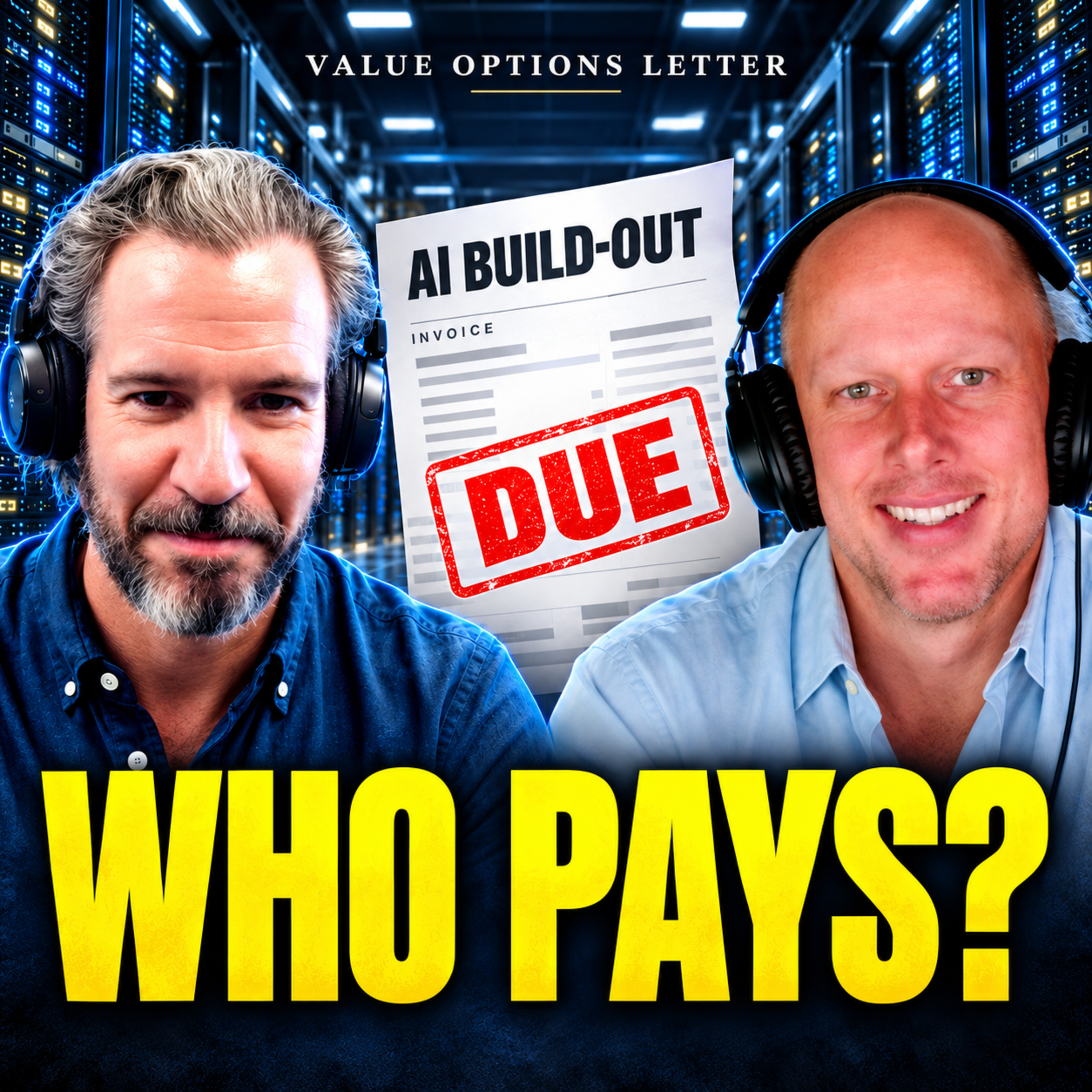
Tobias Carlisle and Bill Brewster begin with the rotation toward value stocks, asking whether Amazon and Meta can sustain the capital spending required by the AI boom.
Anthropic’s losses become a test case for AI economics: the hosts weigh financing needs, accounting treatment, pricing power, and the productivity gains that might eventually justify them.
The discussion broadens from technology to social change, considering AI’s effects on employment, inequality, demographics, immigration, and the durability of established business moats.
After discussing the resilience of casinos, the hosts turn to Netflix’s valuation, international content, live programming, buybacks, and competition from YouTube and short-form video.
The episode’s central tension is whether AI’s eventual productivity gains can arrive before its financing demands and social disruptions overwhelm the businesses funding its expansion.
What was said on this episode
26 statements · 11 positive · 8 negative · 1 mixed · 6 neutral
Debt-market financing has become substantially more expensive for hyperscalers.
“the debt markets have gotten a lot more expensive”
Listen at 1:51
Meta will raise approximately $100 billion or more in equity across two years.
“Meta now is raising a lot of money. I mean, I think it's going to be close to $100 billion, if not more, when it's all said and done between this year and next year in equity.”
Listen at 2:34
Amazon and Meta are compelling investments at current valuations.
“I think that Amazon's very compelling at the current valuations. Meta, very compelling.”
Listen at 3:11
Meta’s AI product Muse could be adopted by older Facebook and Instagram users.
“I could totally see it being adopted by older users of Facebook and Instagram”
Listen at 3:26
Google remains a leading company able to invest more than competitors.
“they're still so strong. I mean, they're leaders and they're able to invest the most.”
Listen at 4:40
The Magnificent Seven stocks are not overvalued at current levels.
“the MAG7 are not overvalued at these levels”
Listen at 7:18
Chip prices could decline as demand weakens and supply increases.
“I could easily see that if you get prices going down a little bit, a little less demand, a little more supply.”
Listen at 9:19
Micron and SK Hynix are vulnerable to weaker chip-market conditions.
“there's a lot of vulnerability there”
Listen at 9:38
Current AI financing and spending levels are likely unsustainable.
“it's not going to take long for people to realize that this is a little unsustainable”
Listen at 9:52
Competing in frontier AI requires substantial spending.
“to play in this field, I mean, you really have to spend a lot of money”
Listen at 11:31
AI will become dramatically more capable within five to ten years.
“give it five years or 10 years, it's going to be amazing”
Listen at 12:24
Service centers are highly vulnerable to AI-driven productivity improvements.
“those service centers and things like that are highly vulnerable”
Listen at 13:26
AI-driven productivity will continue improving.
“I think the productivity is going to get better and better for sure.”
Listen at 13:29
The technological singularity appears to be approaching.
“it looks to me like we're getting really close to it actually happening”
Listen at 14:30
AI may become the final major tool, followed by robots performing physical labor.
“we're close to this point where we build the last tool we'll ever have to build, which would be this AI. And then we're going to build robots that do the physical labor.”
Listen at 16:17
AI development cannot be stopped except by catastrophic events.
“you're not going to stop ai”
Listen at 17:49
Nvidia is cheap if its earnings are sustainable.
“if you believe in the earnings are sustainable, like Nvidia is cheap”
Listen at 18:38
AI will create new jobs while destroying many existing jobs.
“there's going to be new jobs created by it. There's going to be a lot of jobs destroyed by it.”
Listen at 20:02
High home prices exclude a large portion of the population from buying.
“houses that do trade trade at very high prices which locks out a huge portion of the population”
Listen at 21:54
AI and robotics are unlikely to reduce inequality between haves and have-nots soon.
“it doesn't seem like there's a mechanism that's going to, you know, bridge that gap between the haves and the have-nots in the near future”
Listen at 23:08
Future technological development will require enormous energy and power.
“We're still going to need enormous amounts of energy and power.”
Listen at 26:07
Netflix’s valuation is attractive at the current price.
“I think their valuation is pretty attractive toby”
Listen at 30:31
Netflix can recover its content performance at the current valuation.
“I think that at this price I think they can get back on content”
Listen at 30:34
Netflix will probably grow faster than GDP for an extended period.
“I still think that it's probably growing faster than GDP for a long period of time”
Listen at 31:39
YouTube is a stronger competitor for viewer time than Netflix.
“the main competitor for my time is YouTube. I would much rather watch YouTube”
Listen at 32:00
Netflix is a good stock with buybacks but no dividend.
“So it's a good stock. No dividend, but a little bit of a buyback going on”
Listen at 33:22
Statements are attributed to the speaker as said on the episode and reflect their view at the time, not PodLume's. They are not advice.
Weekly email
State of the Pod, every Monday
The week's most-discussed names and stories from podcasts, with the moments behind them. Free, five minutes, unsubscribe in one click.