Nov 19, 2026 · 1h 5m
AI’s capex boom faces a test of returns and resilience
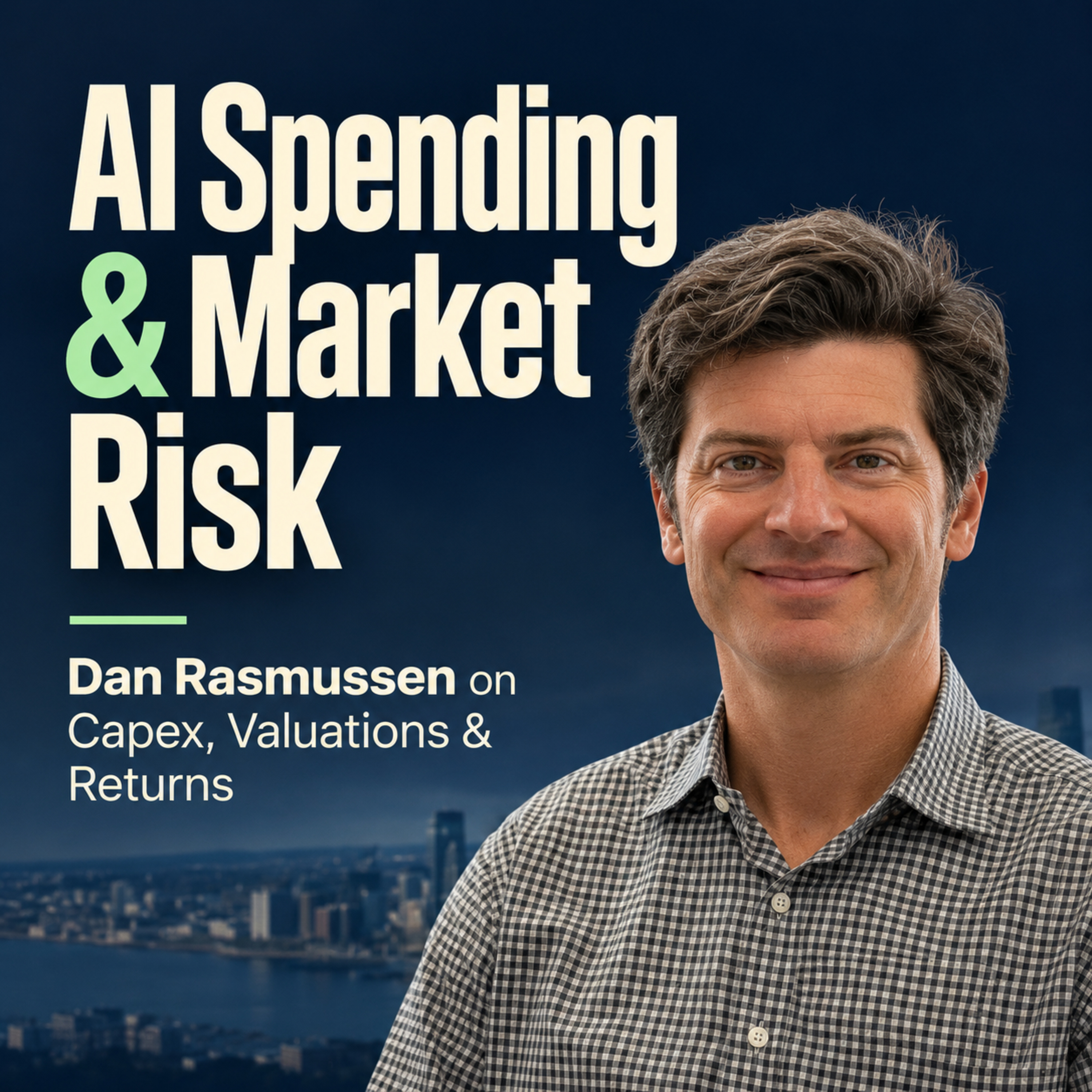
AI Spending & Market Risk: Capex, Valuations & Returns | Dan Rasmussen
The episode connects AI’s uncertain productivity payoff to overbuilding, financing stress, labor disruption, and value opportunities beyond technology’s largest companies.
- 1AI adoption may generate real productivity gains, but heavy depreciation and slow corporate uptake could weaken infrastructure returns.
- 2Korea and Japan offer value opportunities as governance reform and better capital allocation challenge entrenched market discounts.
- 3Tight credit spreads can mask fragility, while widening lower-quality spreads may signal stress across AI financing and the broader economy.
Don't miss
Rasmussen and Carlisle assess whether AI infrastructure spending could become a politically contested, debt-sensitive gold-rush overbuild.
The brief
Dan Rasmussen and Tobias Carlisle ask whether AI’s productivity gains justify its enormous infrastructure build-out, focusing on depreciation, slow adoption, and the risk of falling returns.
The central investment question is who captures AI’s value: model builders, infrastructure providers, or downstream users, especially if technology redistributes gains away from its inventors.
Rasmussen makes the case for Korea’s discounted small caps, holding companies, and preference shares, while governance reform and easier foreign access could draw more international capital.
Japan offers a slower transformation, as companies gradually reduce excess cash and cross-shareholdings through stronger capital allocation, buybacks, dividends, and governance changes.
The standout warning comes in the discussion of AI financing and data centers, where political resistance, private-credit exposure, and overcapacity could turn a gold rush into a classic overbuild.
The conversation closes with a broader portfolio lesson: own the economy, follow bottlenecks, respect valuation, and hedge the possibility that AI replaces labor.
What was said on this episode
40 statements · 12 positive · 24 negative · 2 mixed · 2 neutral
AI is not yet generating productivity improvements sufficient to support projected revenue.
“right now I don't see any evidence that it is.”
Listen at 2:56
AI has not yet produced enough profits, savings, or productivity gains to justify valuations.
“I'm not seeing any evidence in the real world of significant enough profit improvement, significant enough cost savings, significant enough productivity gains to make the numbers work.”
Listen at 3:06
AI proponents are underestimating corporate adoption inertia.
“the ai people are massively underestimating how much inertia there is in the world”
Listen at 3:35
Delays in AI adoption will reduce returns on chip investments through depreciation.
“the depreciation math on those chip investments means that delay works against them.”
Listen at 3:57
AI overvaluation could cause a major market correction.
“it could cause a major market correction”
Listen at 4:31
Real-world AI use cases are currently underperforming expectations.
“the real world use cases of AI are not yet working that well.”
Listen at 5:19
Big technology companies are currently more capital-intensive than industrial companies.
“the big tech companies are more capital intensive than industrials.”
Listen at 9:24
High capital expenditure tends to produce low future returns because firms overbuild and overestimate demand.
“high amounts of capex spend produce low future returns because people always overbuild and overestimate demand”
Listen at 9:35
AI revenue has not yet slowed materially.
“we've seen no slowdown in AI revenue”
Listen at 12:34
Data-center competitors may collectively build excessive capacity.
“they build five of them when they only should have built one.”
Listen at 13:49
Overbuilding in capital-intensive industries causes prices to collapse.
“Then the price collapses because they've overbuilt”
Listen at 13:52
Chinese competition may undermine AI infrastructure economics.
“the chinese angle makes this even more interesting because it's a commodity with a serious low-cost competitor”
Listen at 14:10
AI will not be deployed rapidly at scale across everyday businesses.
“do I think it really gets rolled out into everyday businesses at scale fast? No.”
Listen at 21:06
Korean stocks are currently unusually cheap.
“the stocks are so cheap”
Listen at 22:59
Korean stocks trade around eight times earnings and 0.4 times book value.
“I'm buying stuff there at like 10 times earning and 0.6 times book. And I go to Korea and it's like eight times earning as in 0.4 times book.”
Listen at 23:03
Korean holding companies often trade at roughly a 50% discount to underlying operating companies.
“these holdcos often trade at a, say, 50% discount to the value of the underlying operating company.”
Listen at 25:08
Korean preferred shares commonly trade at about a 50% discount to common shares.
“these preferreds have now traded down, in most cases, to a 50% discount to the common.”
Listen at 26:17
Korean governance reforms may revalue the market and its holding-company structures.
“there are all these interesting things that I think are going to be playing out over the next few years that are going to drive, hopefully, not only a revaluation of the Korean market in general, but a specific revaluation of these weird structures.”
Listen at 28:53
Easing Korean investment restrictions and governance reforms will attract more foreign capital.
“you're going to see more and more money flow into Korea.”
Listen at 30:38
Japanese corporate capital-allocation practices are changing.
“these things are changing.”
Listen at 34:52
Japanese governance reform will take several more years to mature.
“to get from here to where it needs to be it's going to take a few more years”
Listen at 35:25
AI profits will shift from chipmakers to other scarce inputs as chip constraints ease.
“When chips stop being the constraint, those profits will move again to power and land or to whoever owns the computer.”
Listen at 39:32
The S&P 500 cyclically adjusted price-earnings ratio is about 41.6.
“Today, the cyclically adjusted P on the S&P 500 is about 41.6.”
Listen at 40:06
Investors should own the broader economy rather than AI builders.
“Own the economy, not the builders.”
Listen at 40:28
Owning potentially labor-replacing capital can hedge employment risk from AI.
“Owning a share of the capital that might replace your work is the hedge.”
Listen at 40:46
Samsung and SK Hynix together comprise half of Korea’s benchmark.
“those two stocks are half the Korea benchmark.”
Listen at 44:59
An AI downturn could cause Samsung and SK Hynix to drag down Korea’s market.
“The negative scenario, worst case scenario is that when or if AI has a rough patch, those two stocks drag down the entire market.”
Listen at 45:33
A sharp widening in high-yield spreads signals a crisis.
“when that spread blows out, it tells you that you're in a crisis.”
Listen at 50:14
A high-yield spread around 600 basis points indicates crisis conditions.
“600 is crisis level.”
Listen at 50:55
A sharp widening in credit spreads will cause significant pain for weak borrowers.
“the minute spreads blow out, it'll be painful.”
Listen at 51:48
Widening credit spreads can accelerate an ongoing financial crisis.
“once spreads blow out, that itself becomes a driver of the crisis accelerating”
Listen at 52:16
Migration of weaker debt into private credit has improved the apparent quality of high-yield markets.
“the high yield spread has become higher quality because all the bad debt has migrated into private credit.”
Listen at 52:44
Investors should be very concerned when credit spreads widen sharply.
“when you see spreads blowing out, be nervous. Yeah. Be very nervous.”
Listen at 54:23
Oracle bonds yielding around 9% indicate elevated financing risk.
“Oracle's trading very wide, and I think that's an A-rated bond that's trading at like 9% on Oracle bonds, right? That's a little scary”
Listen at 56:12
AI financing structures could fail severely if markets turn downward.
“all well and good but gee if the market takes a turn for the like that stuff it's gonna blow up in their faces”
Listen at 56:48
AI infrastructure demand may stop abruptly because competitors act similarly.
“when the demand stops it'll stop all at once because everyone's doing the same thing”
Listen at 58:06
Data-center opposition is a real political risk that has motivated voters.
“I do think the political issue is real and it seems to have motivated people in the midterm elections”
Listen at 1:00:52
Anthropic is unlikely to become a winner-take-all company.
“I'll take the under on that bet.”
Listen at 1:01:06
AI substantially increases productivity at Dan Rasmussen’s firm.
“It's a massive productivity enhancer for us.”
Listen at 1:03:03
AI-driven productivity has led Dan’s firm to hire more employees.
“we're hiring more people because we're getting so much more done.”
Listen at 1:03:08
Statements are attributed to the speaker as said on the episode and reflect their view at the time, not PodLume's. They are not advice.
Weekly email
State of the Pod, every Monday
The week's most-discussed names and stories from podcasts, with the moments behind them. Free, five minutes, unsubscribe in one click.