Oct 10, 2026 · 32 min
AlphaFold opens biology’s harder questions
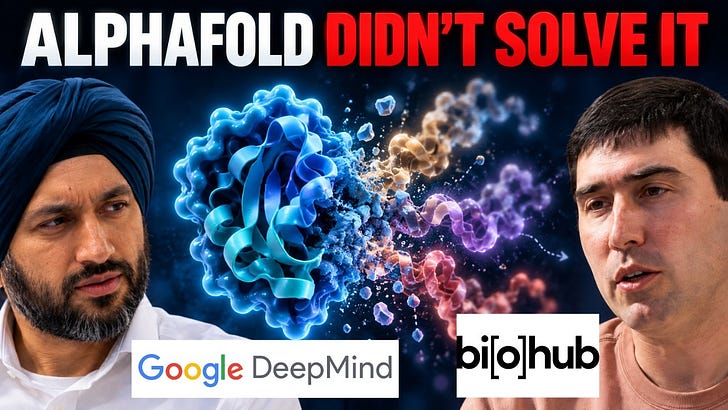
Why AlphaFold Didn't Solve Protein Folding — Pushmeet Kohli, Google DeepMind & Sal Candido, Biohub
The next advances in AI-driven biology may depend less on bigger models alone than on better problems, data, and measurements.
- 1Protein structures are only a starting point; function, dynamics, interactions, and design remain substantially harder.
- 2Scaling laws must be discovered for each biological problem, with data chosen for scientific and medical value.
- 3Useful systems need not reveal every mechanism, but their outputs must be trustworthy, calibrated, and actionable.
Don't miss
The panel reframes AlphaFold from a finished solution into evidence that function, dynamics, interactions, and design are the harder frontier.
The brief
Pushmeet Kohli of Google DeepMind and Salvatore Candido of Biohub argue that AlphaFold’s breakthrough marks a beginning: biology still demands models of function, dynamics, and interaction.
The panel challenges the idea that one scaling recipe fits every scientific problem, emphasizing that researchers must define the question before choosing data, compute, or a modeling strategy.
They weigh handcrafted scientific inductive bias against general scaling, especially when biological data is scarce, messy, or poorly matched to the medical questions researchers want answered.
The sharpest tension is between designing useful black-box systems and extracting scientific understanding from them; both speakers prioritize calibrated outputs that support trustworthy decisions.
AI already contributes across drug discovery, but major gains in human health depend on which part of the pipeline improves and whether better models produce meaningful clinical outcomes.