Aug 27, 2026 · 2h 46m
Amazonian tribe challenges Noam Chomsky and converts missionary to atheism
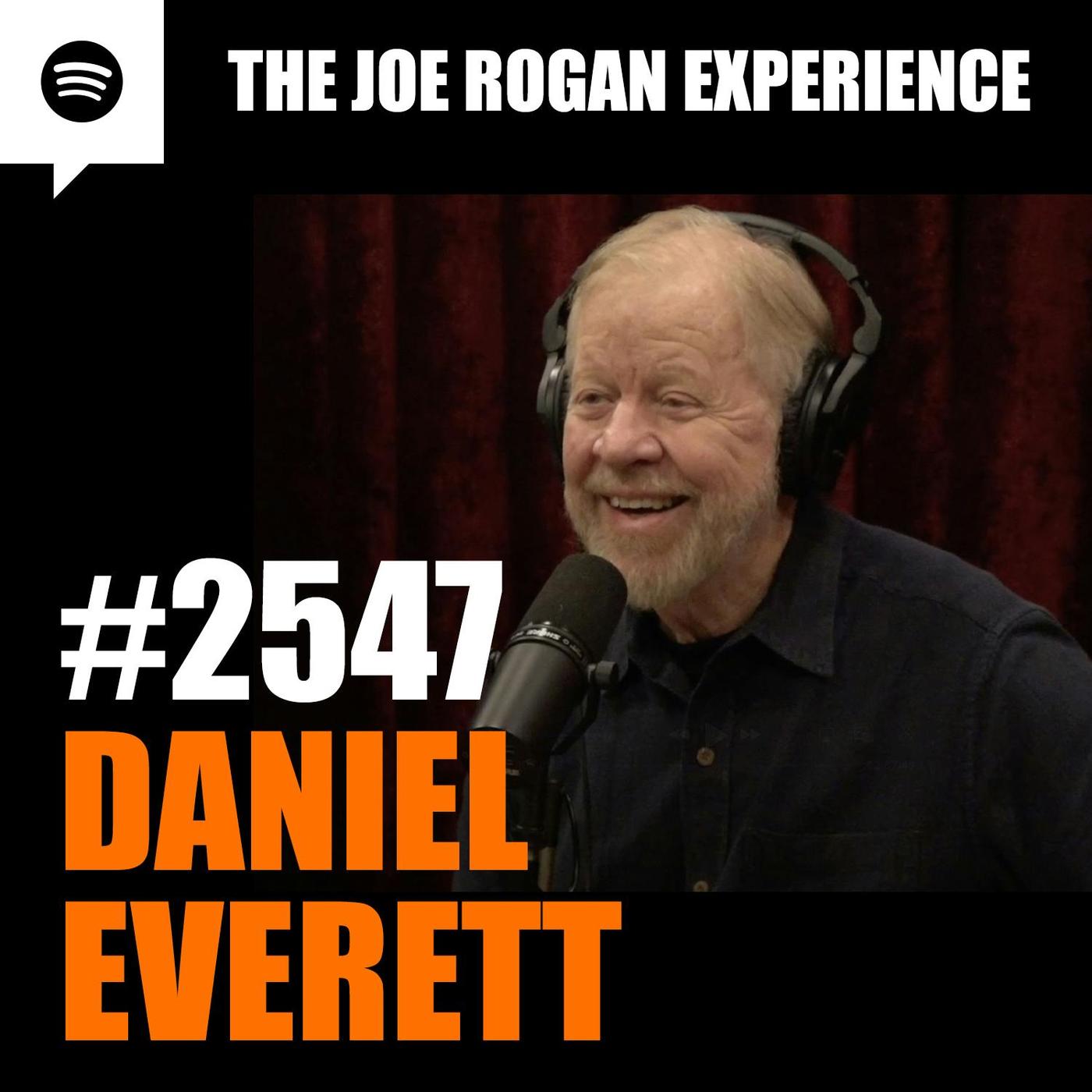
#2547 - Daniel Everett
This conversation explores how a remote culture can challenge foundational Western assumptions about language, religion, and human nature.
- 1The Piraha tribe's demand for empirical evidence led missionary Daniel Everett to abandon his Christian faith.
- 2The unique structure of the Piraha language directly challenged Noam Chomsky's foundational theories of universal grammar.
- 3Preserving endangered languages is critical because each represents a distinct and irreplaceable way of understanding human existence.
Don't miss
Daniel Everett explains how the Piraha's insistence on firsthand, empirical evidence for everything they believe ultimately destroyed his Christian faith.
The brief
Linguist Daniel Everett journeyed into the Amazon rainforest in 1977 as a Christian missionary, tasked with translating the Bible for the Piraha people. Instead, their radical commitment to immediate empirical evidence completely dismantled his own faith.
The Piraha language lacks numbers, color words, and recursion—the ability to nest clauses. This linguistic anomaly sparked a fierce academic war with Noam Chomsky, who dismissed Everett's findings because they challenged his theory of universal grammar.
Beyond academic debates, Everett adapted to extreme jungle survival. He learned to navigate jaguar encounters, keep fires lit with wet wood, and understand a unique tonal language that can be whistled or sung to communicate across dense canopy.
The tribe's worldview centers on extreme happiness, a community-focused purpose, and an absolute lack of fear regarding death. Their unique cultural framework offers a stark contrast to Western anxieties and traditional religious structures.
Every endangered language is a unique library of human knowledge. Preserving these fragile systems is not just an academic exercise, but a vital effort to understand the diverse ways the human mind can construct reality.
What was said on this episode
35 statements · 13 positive · 13 negative · 9 neutral
Brazilian dams have reduced Pirahã fish supplies enough to cause starvation.
“In recent years, that's changed because the Brazilian government has allowed the construction of dams across various rivers. Not their river, but they affect the water level so much that it's taken all the fish, most of the fish out of their river. So now they're starving.”
Listen at 16:44
Some languages lack the recursion Chomsky claimed all languages possess.
“So when I came along and said, they don't have it, and now I know there are other languages that don't have it, this was like saying, you're wrong.”
Listen at 35:30
Linguistic diversity makes universal language laws premature.
“So languages can vary so much that it's really premature, in my opinion, to be writing laws that languages are supposed to follow.”
Listen at 37:28
Evidence supports Homo erectus having language.
“And so I said that Homo erectus had language and I think the evidence supports that.”
Listen at 41:24
Building a boat requires language.
“And it turns out you've got to have language to build a boat.”
Listen at 44:04
No Pirahã converted because Everett’s Christian claims failed their evidence standard.
“Nobody. In decades. They weren't interested. They were so totally. Because my claims did not meet their standard of evidence. They have a high standard of evidence, and I didn't meet that standard.”
Listen at 57:53
The Pirahã population grew from under 200 to approximately 700–800.
“When I first got there, it was under 200, and now it's around 700 to 800.”
Listen at 1:08:57
Pirahã people can predict Everett’s behavior better than he predicts theirs.
“They're very intelligent people. They had me figured out before I had them figured out. And they can predict my behavior better than I can predict theirs even today.”
Listen at 1:12:05
Everett judged the Pirahã to have exceptionally high spiritual well-being.
“So first it was quality of the spiritual life. They seemed to me to have the highest quality of spiritual life.”
Listen at 1:14:22
A Pirahã hunter typically works about 15–20 hours weekly when conditions are favorable.
“How many hours a week does a hunter work? And I came up with about 15 or 20 hours a week, unless it's not going well.”
Listen at 1:28:18
Pirahã deliberately practice hardship to build resilience demanded by their environment.
“They learn to deal with pain. They learn to be tough. In fact, they have an expression for that. He wants to be hard. And that means you deliberately sleep, sometimes less than you need. You go hungry on purpose, and you put yourself in hard situations because you want to be tough, because that's what the environment demands.”
Listen at 1:32:16
Hunter-gatherer diets are healthier than agriculturalist diets.
“hunter gatherers, which they are, have healthier diets than agriculturalists”
Listen at 1:36:56
Introducing sugar cane caused near-universal cavities among the Pirahã.
“Well, then somebody introduced sugar cane into their fields from the outside world, and now it's almost 100% cavities. Everybody has cavities because they eat sugar cane.”
Listen at 1:38:30
Pirahã expertise enables them to perceive environmental patterns Everett misses.
“But my view now is that they simply have the ability to recognize and perceive things that they've grown up with that I miss entirely.”
Listen at 1:56:59
Pirahã spirit concepts function as a form of explanatory science.
“So in a sense, these separate entities are a primitive form. I shouldn't even use the word primitive. They're a form of science. Given what they have, they're reducing the unexplained to the explainable.”
Listen at 1:58:07
People using absolute directions navigate unfamiliar places better than people using relative directions.
“Many experiments have shown that people who don't have right and left, front and back, but use absolute directions, like upriver, down river to the jungle, away from the jungle, are better at finding their way in new places than we are.”
Listen at 1:59:53
Constant alcohol availability turns occasional drinking into a serious health problem.
“But once it comes in constant supply, then you do have to worry about it. And when these guys keep coming up, leaving this stuff off, then it becomes a serious health problem.”
Listen at 2:02:20
Constant alcohol availability creates a serious health problem for hunter-gatherers.
“when these guys keep coming up, leaving this stuff off, then it becomes a serious health problem”
Listen at 2:02:24
Pirahã people define life’s purpose as contributing to their community.
“The community is everything. You make a contribution to the community while you're alive, and that's your purpose.”
Listen at 2:04:24
Piraha teenagers become exceptionally skilled with bows through early training.
“these guys are using bows and arrows from the time they're two years old. So by the time they get to be teenagers, they're perfect. They are absolutely unmatchless in their skill.”
Listen at 2:06:51
Everett is unaware of documented disease transmission from eating monkey brains.
“I'm not aware of any diseases that are passed by eating monkey brains or other kinds of brains.”
Listen at 2:12:36
Limited reading suggests humans acquire prion disease by eating human brains.
“the superficial reading that I've done on it suggests that humans get it from eating human brains.”
Listen at 2:13:02
Animal brains and internal organs are rich in nutrients.
“Those are really tasty bits and probably rich in nutrients. Yeah, they are rich in nutrients.”
Listen at 2:13:37
A Brazilian churrascaria meal provides more nutrition than a McDonald’s Big Mac.
“you ate much more nutrition than having a McDonald's Big Mac or something like that.”
Listen at 2:15:41
Endocannibalism was understood as giving deceased relatives continued life through descendants.
“the purpose, as best I've been able to figure out, anthropologists have tried to answer this. So my answer might not be theirs, but it's based on interviews with the people, is to give your relatives eternal life because they live in you and you're going to live in somebody else.”
Listen at 2:20:06
Regular outside contact rapidly accelerates Amazonian groups’ incorporation into Brazilian society.
“most of the groups that have regular contact with the outside have undergone a very rapid process of enculturation into Brazilian society.”
Listen at 2:24:17
Some Piraha anthropological and linguistic dissertations are methodologically ridiculous.
“I've seen a couple of anthropologists and linguists go in and do doctoral dissertations on them that are like totally ridiculous.”
Listen at 2:26:42
Achieving fluency in an unfamiliar language takes approximately one year.
“It takes a year to get fluent in the language.”
Listen at 2:29:03
Much linguistic fieldwork is less reliable than researchers generally assume.
“this kind of field work is. Which is so vital, is not as reliable as we would like to think it is.”
Listen at 2:29:29
Linguistic field research should prioritize description before theoretical analysis.
“field research shouldn't be that theoretically motivated. It should be basically descriptive, and then you can do the theory later.”
Listen at 2:30:14
One year of fieldwork is insufficient for thoroughly learning an unfamiliar language.
“nobody who goes out for a year really learns it that well.”
Listen at 2:35:50
Approximately 8,000 languages exist, with about one disappearing every two weeks.
“there are 8,000 languages die out at the rate of about one every two weeks.”
Listen at 2:37:26
Over 1,000 language communities may have never been visited by researchers.
“There probably are over a thousand where no one's gone there”
Listen at 2:38:52
Language replacement by Portuguese causes culturally embedded knowledge to be lost.
“every language is like a library. It's a repository of information that is lost when they switch to Portuguese”
Listen at 2:39:27
An Amazonian group classifies birds by diet rather than anatomy.
“they don't classify them based on their anatomy like Western science. They classify them based on what they eat.”
Listen at 2:40:32
Statements are attributed to the speaker as said on the episode and reflect their view at the time, not PodLume's. They are not advice.
