Nov 23, 2026 · 1h 33m
Comedy tests the myths behind power, charisma and historical progress
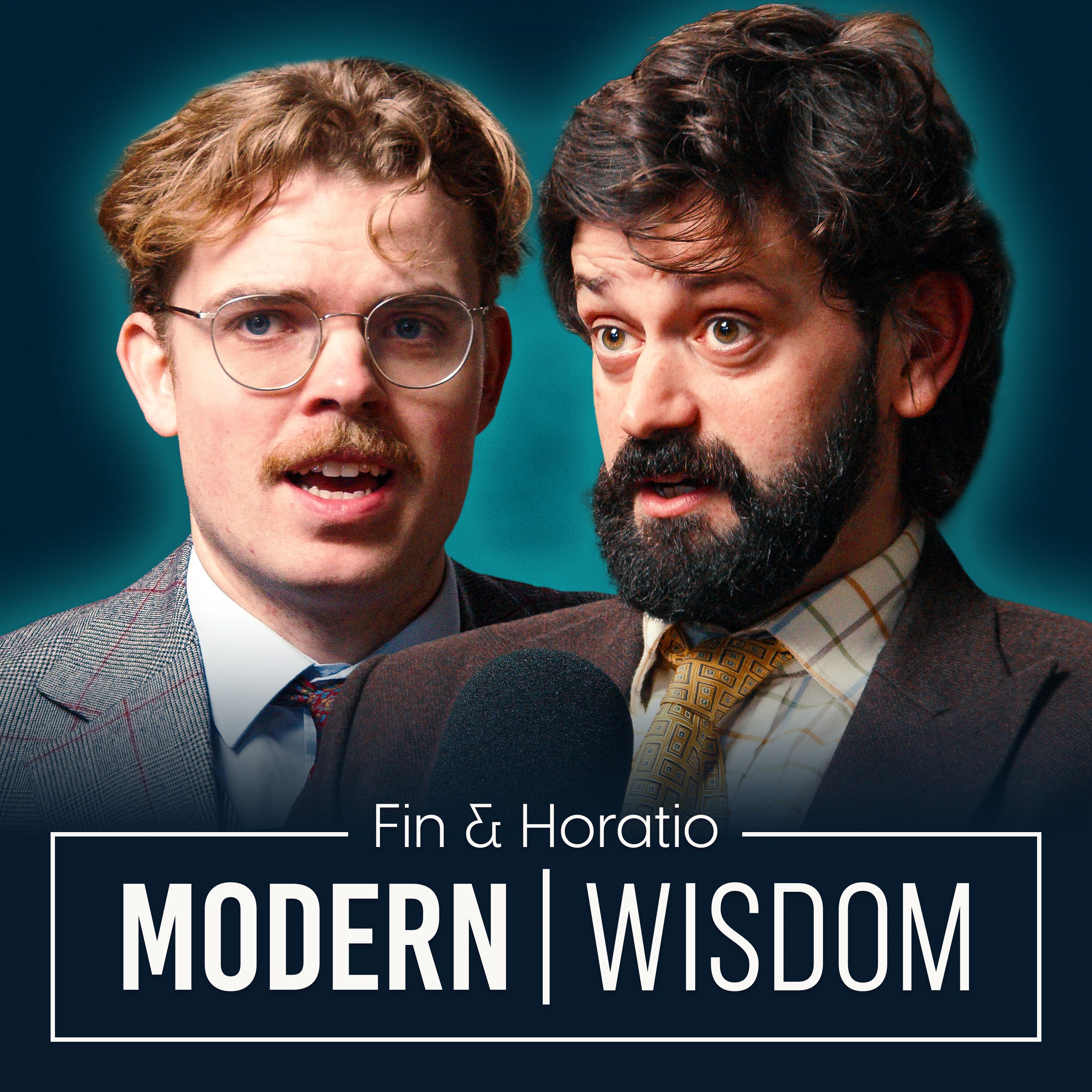
History Is Much Dumber Than You Think - Fin Taylor & Horatio Gould - #1180
The episode connects personal image and political charisma to the larger forces that shape states, wars and national identity.
- 1Beauty standards and online status games reveal how masculine competition changes with technology and culture.
- 2Stalin, Mao and Napoleon expose the gap between state-building ambition, strategic brilliance and catastrophic human costs.
- 3World War II narratives simplify a conflict that redistributed power from Britain to America and reshaped the modern world.
Don't miss
The sharpest historical argument arrives when Stalin’s industrial achievements are weighed against the repression and suffering that made them possible.
The brief
Fin Taylor and Horatio Gould begin with changing beauty standards, looksmaxxing and the pressure to perform masculinity on camera, linking internet slang to older status rituals.
Henry VIII becomes a case study in how personal appetites can redirect a nation’s religious and political identity, while English defiance stretches from Rome to Brexit.
The discussion turns to Stalin, Mao and Napoleon, separating charisma, industrial achievement and battlefield brilliance from the famines, repression and strategic disasters attached to them.
World War II is treated as a contest over memory as well as military power, with British, American and Russian narratives competing over who really won.
The episode closes by connecting empire’s decline, America’s rise and renewed conflict to a period when geopolitical history has become difficult to ignore again.
What was said on this episode
66 statements · 20 positive · 26 negative · 6 mixed · 14 neutral
- Horatio Gouldon Contemporary beauty standardsNeutral1:19
Current beauty standards favor aesthetic purity.
“So we're currently in a quite aesthetically purist phase.”
Listen at 1:19
- Horatio Gouldon Medieval beauty standardsNeutral2:00
Medieval beauty standards valued pale baldness and higher female hairlines.
“Well, in medieval times, it was bald. You wanted to be pale and bald. Yes. And the women, the higher the hairline, the more attractive.”
Listen at 2:00
- Horatio Gouldon Moroccan beauty standardsNeutral2:32
A Moroccan tribe force-fed women because larger bodies were considered beautiful.
“a tribe in Morocco force fed their women with like full fat milk and corn grits and stuff to plump them up because that was the beauty standard was to get as fast as possible.”
Listen at 2:32
- Fin Tayloron Male appearancePositive3:49
Men currently gain substantial advantages from improving their appearance.
“In the current age, a man gets a lot further looking better.”
Listen at 3:49
- Fin Tayloron Modern male appearance standardsNegative4:11
Modern men face greater pressure to look aesthetically appealing.
“So I think, you know, now you have to be a lot more aesthetic.”
Listen at 4:11
Cosmetic surgery increased significantly during COVID amid prolonged video-call self-scrutiny.
“There was a statistically significant increase in cosmetic surgery when COVID came around, and they called it Zoom Face because people were spending so long seeing themselves on video calls”
Listen at 4:30
- Fin Tayloron On-camera appearancePositive5:23
People appearing on camera should take care of their appearance.
“I do think there's a level of, I think it's quite rude to not take care of yourself if you're on camera.”
Listen at 5:23
- Horatio Gouldon Parenthood and skincare routinesNegative6:23
Having a child will reduce the priority of skincare and appearance routines.
“I'm predicting that should you have a child, will start to fade away from your priority list.”
Listen at 6:23
Chris’s company created the productivity-drink category on Amazon.
“We made the category on Amazon.”
Listen at 8:53
- Fin Tayloron Looksmaxxing ideologyMixed12:05
Looksmaxxing reframes incel ideology from fatalism toward personal agency.
“there was a real fatalism to the old incel ideology. And then this, the kind of weird warped way, it's sort of like, you can do it. You can, anyone can do it.”
Listen at 12:05
- Fin Tayloron Clavicular’s appearance theoryPositive12:34
Clavicular believes appearance can solve life problems and explains social hierarchies.
“everything in your life can be solved by looking better, basically. Basically, all problems and all hierarchies are based on looks.”
Listen at 12:34
- Horatio Gouldon Male status signalingNeutral14:20
Watches and cars function primarily as male-to-male status signals.
“They're really male-on-male signaling.”
Listen at 14:20
- Horatio Gouldon English EuroscepticismNeutral16:31
England’s break with Rome marked the birth of English Euroscepticism.
“The break from Rome is the birth of Euroscepticism.”
Listen at 16:31
- Fin Tayloron English historical identityPositive17:05
Major English historical victories express a recurring defiant rejection of foreign powers.
“if you look at the key moments in English history, they are all of us being proud of telling someone to fuck off. Hitler, fuck off. Napoleon, Waterloo, fuck off. Spanish Armada, fuck off.”
Listen at 17:05
- Fin Tayloron English mannersNeutral17:32
English refinement developed as a controlled expression of underlying defiance.
“the reason why the English gentleman or kind of the manners, it's so refined is because you have to. Because underneath it all is fuck off.”
Listen at 17:32
- Fin Tayloron Henry VIII’s break with RomeNeutral18:06
Henry VIII’s break with Rome profoundly shaped modern English life.
“henry the eighth one of those consequential kings has changed all of our lives from the break with the break of rome”
Listen at 18:06
- Horatio Gouldon Jackie Weaver authority disputePositive23:24
History will ultimately vindicate the man challenging Jackie Weaver’s authority.
“he was correct history will prove him”
Listen at 23:24
- Horatio Gouldon Brexit voteNeutral25:09
The Brexit vote can be traced to Britain’s historical resistance to external control.
“you trace the, I think you could trace the Brexit vote to that. being told what to do, being put in a cage, this idea of Britain standing alone”
Listen at 25:09
- Horatio Gouldon David StarkeyNegative27:47
David Starkey maintains controversial positions despite lacking defensible arguments.
“he will not back down. Even when it's like, there is no defense for this. And even just for convenience with your career, you're like, absolutely not. I think I'm right.”
Listen at 27:47
- Fin Tayloron NapoleonMixed32:10
Napoleon was charismatic but ineffective at charming women.
“Napoleon has a lot of charisma. I think he fails in the Riz front because he would, when it comes to women.”
Listen at 32:10
- Fin Tayloron Saddam HusseinPositive32:29
Saddam Hussein ranked highly in charisma and physical attractiveness.
“He's probably got great Riz. And he's the most attractive.”
Listen at 32:29
- Fin Tayloron Muammar GaddafiMixed32:35
Young Muammar Gaddafi was attractive, but later cosmetic surgery diminished his appearance.
“Young Gaddafi was good. He kind of did too much. He got a bit Michael Jackson with his medical surgery near the end.”
Listen at 32:35
- Horatio Gouldon Benito MussoliniNeutral32:58
Mussolini cultivated a physically demonstrative, masculine public image.
“Mussolini used to... just constantly walk around topless and just join in with like farmers just beating his chest”
Listen at 32:58
Taller American presidential candidates have usually won elections, with one exception.
“Almost every American president that's been taller, except for one. has won throughout history.”
Listen at 37:11
Donald Trump is a very effective communicator.
“he's a very good communicator”
Listen at 38:28
Declining Trump’s podcast appearance was retrospectively a strategically excellent decision.
“In retrospect, looks like a genius trade.”
Listen at 39:00
- Fin Tayloron Joseph StalinMixed40:53
Stalin rose from humble origins through ruthlessness and effective political maneuvering.
“he was his rise to power was one of the more inspiring ones in some ways because he came from sort of nothing and it was his ruthlessness and he played his cards perfectly played people off against each other”
Listen at 40:53
- Horatio Gouldon Stalin’s industrialization of RussiaPositive42:36
Stalin industrialized Russia in twelve years, reportedly faster than anyone else.
“He's industrialized Russia in 12 years, which is the fastest anyone's ever done it.”
Listen at 42:36
- Horatio Gouldon Human-rights constraints on infrastructureNegative42:55
Human-rights constraints impede rapid infrastructure construction in Britain.
“Because... of human rights.”
Listen at 42:55
- Fin Tayloron Russian historyPositive44:19
Russian history is the best historical subject.
“You should get on it. I'm a big... Soviet... Russian history always bangs, in my opinion. Russian's the best history for me.”
Listen at 44:19
- Fin Tayloron ChernobylNeutral45:30
Chernobyl probably could only have happened in the Soviet Union.
“Chernobyl couldn't have... Chernobyl... probably only would have happened in the soviet union”
Listen at 45:30
- Horatio Gouldon Two biggest nuclear disastersNeutral45:57
The two biggest nuclear disasters occurred in psychologically prepared countries.
“the two biggest nuclear disasters ever happened. They happened in the countries that are psychologically prepared to deal with them.”
Listen at 45:57
- Fin Tayloron Soviet response to ChernobylPositive47:12
The Soviet response prevented a continent-wide nuclear disaster.
“Stop it being a continent-wide nuclear disaster.”
Listen at 47:12
- Fin Tayloron HolodomorNegative48:42
The Ukrainian famine allegedly killed five to six million people.
“five, six million people died, allegedly.”
Listen at 48:42
- Fin Tayloron Mao's Great Leap ForwardNegative49:34
Mao’s Great Leap Forward was probably the worst policy ever.
“Great Leap Forward was probably the worst. I would argue the Great Leap Forward, Mao's Great Leap Forward, is the worst policy ever.”
Listen at 49:34
- Fin Tayloron Great Leap ForwardNegative50:23
The Great Leap Forward caused 50 million deaths through poor agricultural management.
“But instead, 50 million people died. from bad agricultural management.”
Listen at 50:23
- Horatio Gouldon Great Sparrow CampaignNegative51:17
Killing sparrows caused locusts to worsen the famine.
“they killed all the sparrows in a kind of frenzy and then suddenly there was a plague of locusts which was making the actual famine way worse”
Listen at 51:17
- Fin Tayloron China's industrializationNegative52:24
China’s industrialization was not caused by communism.
“it was not... because of communism that happened, would be my argument.”
Listen at 52:24
- Fin Tayloron Deng Xiaoping's reformsPositive52:43
Deng’s reforms created China’s hybrid system and reduced poverty on an unprecedented scale.
“Deng Xiaoping, is arguably the most consequential man of the 20th century because he opened China up and made a hybrid of communism and capitalism that is China now. brought more people out of poverty than has ever been brought out of poverty in a shorter span of time. Over 40 years.”
Listen at 52:43
- Fin Tayloron Deng XiaopingPositive53:27
Deng Xiaoping deserves credit for China’s success.
“I would give Deng his flowers. If I'm going to say one thing on this podcast, it's give Deng Xiaoping his flowers.”
Listen at 53:27
- Horatio Gouldon Napoleonic warfarePositive54:09
Napoleonic warfare is unusually understandable to non-military people.
“The reason the Napoleonic Wars is so great is because... I think we said this. It's like the sweet spot where it's warfare that you can, as a non-military person, you can understand.”
Listen at 54:09
- Fin Tayloron NapoleonPositive59:24
Napoleon was probably history’s greatest battlefield tactician.
“Tactically, he's probably the GOAT, to be honest.”
Listen at 59:24
- Fin Tayloron NapoleonMixed1:00:19
Napoleon was tactically brilliant but strategically poor.
“He was tactically a genius, but strategically wasn't a genius.”
Listen at 1:00:19
- Fin Tayloron Napoleon's invasion of RussiaNegative1:00:41
Napoleon’s invasion of Russia was an exceptionally costly strategic blunder.
“there's few worse strategic blunders or more costly strategic blunders than invading Russia when he did.”
Listen at 1:00:41
Russia’s strategic depth makes it effectively impossible to invade.
“The reason Russia can never really be invaded is because it's got that hinterland it can always retreat to.”
Listen at 1:01:49
- Horatio Gouldon Arthur Wellesley, Duke of WellingtonPositive1:03:03
Wellington was probably history’s best defensive general.
“Wellington was probably the best defensive general there's ever been.”
Listen at 1:03:03
- Horatio Gouldon Cricket in AmericaNegative1:07:29
Cricket is unlikely to become popular in America because it lacks English moderation.
“the reason I don't think it'll take off in America is it's the, you know, the mildness and the moderation of English culture. is not something that America has.”
Listen at 1:07:29
- Horatio Gouldon English cricketPositive1:07:56
English cricket values pauses between action as much as the action.
“the English cricket is about kind of enjoying. the spaces in between the action as much as the action itself”
Listen at 1:07:56
- Fin Tayloron 1934 FIFA World CupNegative1:10:25
The first World Cup was controlled by Mussolini’s regime.
“the first world cup was the mussolini world cup”
Listen at 1:10:25
Mussolini rigged the 1934 World Cup.
“So he really rigged the World Cup, the first one.”
Listen at 1:10:59
- Horatio Gouldon Josef MengeleNeutral1:11:37
Josef Mengele escaped to Argentina and was never captured.
“he escapes Argentina and is never... found”
Listen at 1:11:37
- Horatio Gouldon Catholic Church ratlinesNegative1:13:14
The Catholic Church helped Nazis escape to South America.
“the Catholic Church helped a bunch of Nazis escape.”
Listen at 1:13:14
- Horatio Gouldon Stalin's postwar buffer zoneNeutral1:14:28
Stalin established Eastern Europe’s postwar alignment by demanding a buffer zone.
“that's how eastern europe basically starts is that he just demands it”
Listen at 1:14:28
- Horatio Gouldon Pearl Harbor attackNegative1:19:47
Churchill and Japan allegedly planned Pearl Harbor as a false flag.
“I think Churchill actually did Pearl Harbor. That's my opinion. I think it was a false flag that Churchill and the Japanese planned to get America into the war”
Listen at 1:19:47
- Horatio Gouldon Nazi Germany's declaration of war on the United StatesNegative1:20:07
Nazi Germany declared war on America without strategic necessity.
“the Nazis declared war in America for no reason”
Listen at 1:20:07
- Fin Tayloron Britain after the World WarsNegative1:22:37
The two world wars bankrupted Britain and ended its empire.
“the two world wars. So all we have are the stories, right? That's what we've got. That was the trade-off, right? How so? Well, it bankrupted Britain. It ended the empire.”
Listen at 1:22:37
- Horatio Gouldon Britain after World War IINegative1:23:16
America effectively bankrupted Britain after World War II.
“America basically bankrupts Britain.”
Listen at 1:23:16
- Fin Tayloron Anglo-American postwar power transitionNegative1:23:26
America wanted Britain bankrupt to replace it as global superpower.
“America wanted us to be bankrupt because they've taken over our role as the global superpower.”
Listen at 1:23:26
- Horatio Gouldon 1933–1945 historyPositive1:24:55
The period from 1933 to 1945 is the best historical period to study.
“you have the kind of, the peak history is 33 to 45. It just doesn't get better than the rise of the Nazis and then World War II is the best history is to study.”
Listen at 1:24:55
- Horatio Gouldon Russia-West conflictNeutral1:26:02
The current Russia-West conflict is essentially a Cold War.
“that's essentially a Cold War.”
Listen at 1:26:02
The president started a foreign war that could never be won.
“you get in and you... to start a foreign war that you would never have won.”
Listen at 1:26:38
- Horatio Gouldon Argentinian-Israeli axisNegative1:27:50
An Argentinian-Israeli axis is opposing Britain and Hamas.
“now there is an Argentinian-Israeli axis against Britain and Hamas.”
Listen at 1:27:50
- Fin Tayloron Current Middle East conflictNegative1:28:17
The current conflict could lead to global catastrophe.
“Obviously, it could lead to the end of the world”
Listen at 1:28:17
- Horatio Gouldon Port StanleyNegative1:28:25
A world-ending battle would appropriately be fought over Port Stanley.
“if there is one battle that is going to end the world, it should be over Port Stanley.”
Listen at 1:28:25
- Fin Tayloron Netanyahu coalitionNegative1:29:03
The Netanyahu coalition is following an Old Testament script literally.
“They are following word for word.”
Listen at 1:29:03
- Horatio Gouldon Revisionist ZionismMixed1:29:57
Revisionist Zionism holds that strength and conflict enable return to the promised land.
“There's a much more aggressive, fatalistic view of Zionism, which is that only with strength and conflict can we return to the promised land.”
Listen at 1:29:57
Statements are attributed to the speaker as said on the episode and reflect their view at the time, not PodLume's. They are not advice.
Weekly email
State of the Pod, every Monday
The week's most-discussed names and stories from podcasts, with the moments behind them. Free, five minutes, unsubscribe in one click.