Sep 2, 2026 · 2h 45m
Ethan Ewing and Joe Rogan break down the science of fighting longevity
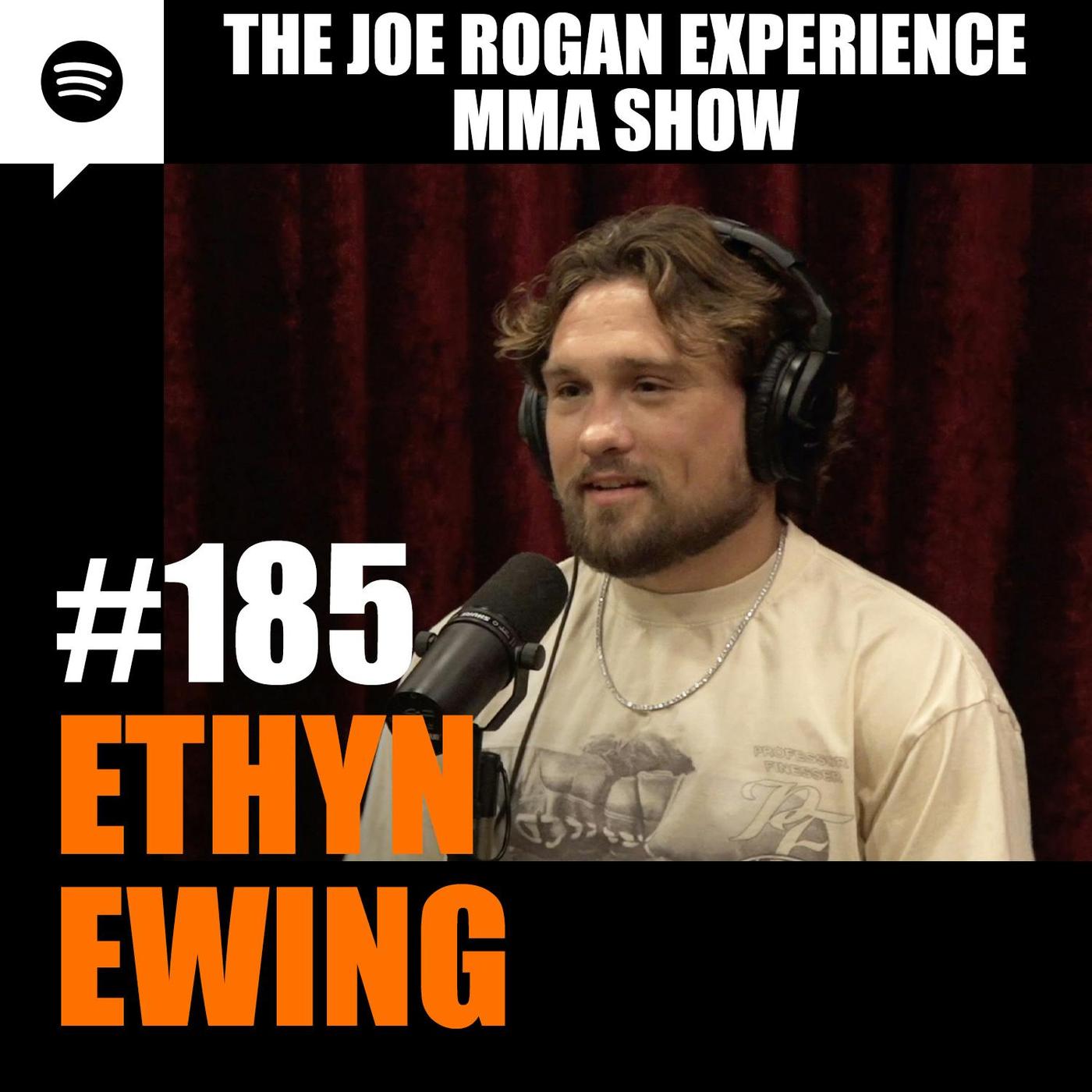
JRE MMA Show #185 with Ethyn Ewing
This episode pulls back the curtain on the hyper-technical physical and mental preparation required to survive and thrive in elite mixed martial arts.
- 1Technical finesse and calculated pacing are far more critical to fighter longevity than relying on chaotic brawling or natural explosive power.
- 2Mismatched sparring partners pose severe injury risks that threaten professional MMA careers far more than structured boxing training.
- 3Domestic pigs undergo a rapid physical metamorphosis when they go feral, contributing to massive ecological damage across the United States.
Don't miss
Ethan Ewing shares his personal journey of rebuilding his career, recovering from knee injuries, and shifting his lifestyle after his first professional losses.
The brief
UFC bantamweight Ethan Ewing joins Joe Rogan to dissect the fine line between chaotic brawling and technical mastery, tracing his own evolution from a high-pressure wrestling background into a highly calculated striker.
The duo argues that true longevity in combat sports belongs to fighters who prioritize finesse over raw power, analyzing how natural power can become a curse that compromises a fighter's pacing, cardio, and career longevity.
Beyond the octagon, the conversation shifts to the unexpected realities of nature, exploring the ecological devastation caused by feral pig populations in states like Texas and the bizarre physical transformations domestic swine undergo.
Whether mastering the warrior mindset through ancient samurai philosophy or adapting to the physical toll of mismatched sparring, peak performance requires a deliberate balance of mental discipline and joint preservation.
What was said on this episode
50 statements · 26 positive · 15 negative · 2 mixed · 7 neutral
Champions preserve longevity by avoiding return fire
“champions don't take return fire”
Listen at 2:36
Face-first fighting shortens careers and produces worse endings
“your career will be shorter and the end will be bad”
Listen at 3:25
MMA primarily rewards intelligence rather than toughness
“it's a smart man's game. Yes, it's not a tough man's game.”
Listen at 7:11
MMA fighters can improve dramatically over four or five professional years
“in MMA in particular, you see dramatic improvement in fighters over the course of 4 or 5 years”
Listen at 13:54
Improvement requires directly confronting weaknesses without ego
“Kill the ego, engage Full head-on into what you're bad at. That's the only way to get good at anything.”
Listen at 17:06
Unseen strikes can cause knockouts without exceptional raw power
“It's the shot that you don't see coming that knocks you out.”
Listen at 23:01
Conor McGregor’s cardio declined after leaving the featherweight division
“As soon as he left that weight class, his cardio waned.”
Listen at 25:10
Boxers generally control distance better than MMA fighters
“if we're coming and we're looking at distance control, I think the boxers do it better”
Listen at 31:56
Fighters should compete only when ready and uninjured
“I'm fighting when I'm ready. I'm not fighting injured”
Listen at 43:11
Sparring partners should be no more than ten pounds heavier
“10 pounds is probably a maximum above you, you know. You shouldn't be going with anybody more than that.”
Listen at 45:28
MMA injuries are more common because the sport has more attack options
“it's much more abundant in the MMA world because there are more weapons”
Listen at 46:36
Many MMA fighters inadequately defend calf kicks
“I don't see a lot of guys defend the calf kick. I see a lot of guys willingly eat them.”
Listen at 57:18
A clean unprotected calf kick can effectively disable the leg
“You take one good one with no shin guards on, it's a completely different game. It takes, you know, you're— that leg away from you.”
Listen at 57:40
A tall, lean fighter who strikes well is an ideal MMA build
“the tall, long, like skinny guy. Yeah, that can strike well. Like, that's the perfect like MMA build.”
Listen at 1:01:20
Shorter fighters can counter reach advantages by fighting inside
“the shorter guy is gonna negate the long guy by getting inside”
Listen at 1:02:42
Lifestyle changes after two losses enabled Ethan Ewing’s ten-fight winning streak
“It wasn't until I— that I erased all the negatives and then filled it with all the positives that I'm able to be on a 10-fight win streak”
Listen at 1:07:50
Rehabilitation appears preferable to meniscus surgery for some patients
“it shows that rehabilitation seems to be the better path”
Listen at 1:18:14
Low-resistance cycling improves knee circulation and strengthens supporting tissues
“It's really good for getting the blood flow to the knees and really good for strengthening up the tendons and the ligaments and everything, but without load”
Listen at 1:19:07
An elite MMA gas tank requires years of conditioning
“that's something that takes literal years to develop”
Listen at 1:25:51
Wrestling is the best foundation for MMA and combat sports
“it's the best foundation for combat sports, for sure, for MMA”
Listen at 1:28:54
Point karate teaches movement that can make MMA fighters difficult to hit
“if you could learn how to move the way those guys move”
Listen at 1:29:39
Overheating during weight cuts is more dangerous than dehydration
“the body gets dehydrated and it has more of a capacity to deal with that than it does to overheat. If you overheat, you're done for.”
Listen at 1:36:17
Moses Itauma’s inexperience caused him to exhaust himself against Hrgović
“He just was inexperienced and he emptied the gas tank.”
Listen at 1:40:33
Moses Itauma remains capable of becoming a world champion
“I still think he's got potential to be a world champion for sure. I mean, the kid's only 21 years old.”
Listen at 1:43:27
The UFC is the pinnacle promotion for MMA fighters
“UFC is, is the pinnacle”
Listen at 1:46:12
Kickboxing has unusually high untapped potential as a sport
“I think it's the most it has the most possibility in terms of like a sport that is not being taken advantage of, like that it has the most potential by far.”
Listen at 2:21:28
MMA benefits from having more organizations and competitive options
“The world needs more organizations. The MMA world needs a bunch of options”
Listen at 2:22:01
The UFC will not participate in champion-versus-champion cross-promotion fights
“the UFC would never do that”
Listen at 2:23:01
A superfight needs two champions with Conor McGregor-level drawing power.
“it has to be a Conor McGregor level champion”
Listen at 2:24:18
Conor McGregor is likely to fight again.
“It sounds like he's going to.”
Listen at 2:24:39
Conor McGregor will fight once more and then retire.
“I think he does the one more and then he's done with it.”
Listen at 2:24:43
Conor McGregor realistically has about two competitive years remaining if disciplined
“Realistically, he's got 2 years left, maybe, you know, if everything— if you really take care of yourself.”
Listen at 2:25:21
Conor McGregor realistically has about two years of fighting remaining.
“Realistically, he's got 2 years left, maybe”
Listen at 2:25:21
Conor McGregor probably will not regain his former training intensity and mindset.
“I don't think he's gonna get back to that level of training and like mindset to it though.”
Listen at 2:25:30
Conor McGregor should realistically fight no heavier than 155 pounds.
“55 is really probably as heavy as he should be fighting at realistically”
Listen at 2:29:15
McGregor probably should not fight if unwilling to cut weight.
“if he doesn't want to do that, he really probably shouldn't be fighting.”
Listen at 2:29:25
McGregor should choose a 170-pound fight against Michael Chandler.
“Maybe just pick the real fight, is 170 with Michael Chandler. Like, have that fight.”
Listen at 2:29:46
McGregor faces serious trouble against Max Holloway after two rounds.
“If he doesn't get Max out of there in the first 2 rounds, then good luck with that.”
Listen at 2:29:58
Michael Chandler is a favorable comeback opponent for Conor McGregor.
“I think that's a great fight for Conor. I think that's a good one for him to come back on.”
Listen at 2:30:55
Few fighters can beat Mauricio Ruffy in a pure striking match without taking him down.
“If you don't take him down to the ground, there's not a lot of people that beat him on a pure striking match right now anyway.”
Listen at 2:32:38
Mauricio Ruffy must prevent takedowns against Arman Tsarukyan.
“he's got to like make sure he doesn't get taken down Against someone like Arman Tsarukyan.”
Listen at 2:33:38
MMA strikers need strong takedown defense.
“you do need to be really good at defending takedowns.”
Listen at 2:36:09
Ciryl Gane’s heavyweight movement makes him difficult opponents to track.
“if you can do that at heavyweight, you're that big and you move like that, yeah, it's gonna be very difficult for a lot of those guys to track you.”
Listen at 2:37:33
Basketball training benefits a heavyweight fighter’s footwork.
“that would definitely benefit you with footwork.”
Listen at 2:38:01
Ciryl Gane is the UFC’s gold standard for mobile heavyweight fighters.
“he's the gold standard for like elite moving heavyweights in the UFC.”
Listen at 2:38:12
Ciryl Gane combines elite heavyweight mobility with exceptional knockout power.
“Ciryl Gane is like a new level, a new level of like elite mobile heavyweight who also has ridiculous knockout power.”
Listen at 2:38:30
Trash-talking creates psychological pressure that affects MMA fighters.
“If you have that added pressure, it's a psychological effect.”
Listen at 2:39:42
Fighting angrily can prevent athletes from using their technical skills.
“when you fight angry, then you're— you had all this skill and your emotion could take it like right out of you.”
Listen at 2:40:18
Emotional control should receive dedicated practice in fighter training.
“it's got to be its own practice, its own training for the day.”
Listen at 2:43:23
Elite fighters can absorb strikes without emotional escalation or changing their game plan.
“The best fighter can get hit and just not even think about it, not even get riled up”
Listen at 2:43:54
Statements are attributed to the speaker as said on the episode and reflect their view at the time, not PodLume's. They are not advice.
