Aug 3, 2026 · 11 min
Frontier AI scaling risks driving compute prices tenfold
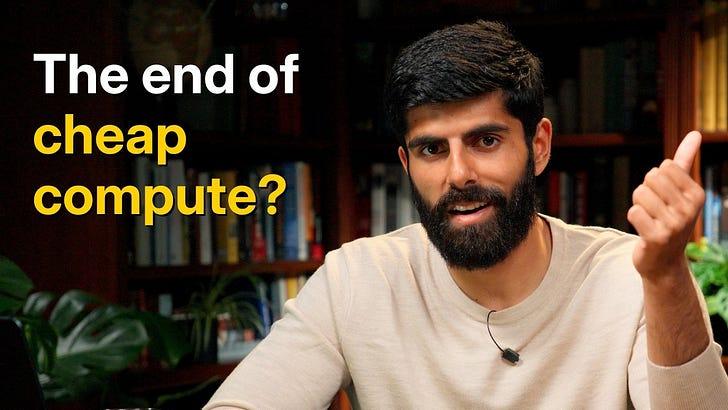
Why smarter AI models could drive up compute prices 10x
As AI labs chase human-level performance, the staggering capital and hardware requirements threaten to trigger a severe compute pricing crisis.
- 1AI labs face an unprecedented demand for capital as they transition from billions to trillions in revenue.
- 2The massive scale of required compute for frontier models could drive up hardware and processing prices tenfold.
- 3Physical infrastructure bottlenecks will ultimately dictate the scaling limits of the next generation of artificial intelligence.
The brief
Leading artificial intelligence labs are on a steep revenue growth trajectory, but scaling from billions to trillions in revenue will require an unprecedented injection of capital and physical infrastructure.
As labs like Anthropic push toward the next generation of frontier models, the sheer volume of compute required is expected to outpace current capacity, potentially driving up compute prices tenfold.
This impending infrastructure bottleneck means the AI industry must confront harsh economic realities, where capital constraints and hardware availability dictate the true limits of model intelligence.
What was said on this episode
36 statements · 22 positive · 11 negative · 3 neutral
Anthropic revenue will likely increase tenfold again this year.
“For the last three consecutive years, Anthropics revenue has 10x'd year over year and it's likely to do so again this year.”
Listen at 0:04
Anthropic revenue will grow tenfold again in 2026
“it's likely to do so again this year”
Listen at 0:08
Anthropic will generate $100–150 billion in revenue this year
“I think they'll probably end this year with somewhere between $100 billion to $150 billion in revenue.”
Listen at 0:12
Continuing the trend would require Anthropic to reach $1 trillion revenue next year.
“Now, for this trend to continue, Anthropic would need to make $1 trillion in revenue by the end of next year.”
Listen at 0:16
Anthropic would need $1 trillion revenue by end of next year to sustain growth
“Anthropic would need to make $1 trillion in revenue by the end of next year.”
Listen at 0:18
AI lab compute currently increases only threefold year over year.
“Now. The other big trend in AI is that lab compute only 3x's year over year.”
Listen at 0:36
AI lab compute capacity grows threefold annually
“lab compute only 3x's year over year”
Listen at 0:37
Higher lab margins are required to reconcile revenue and compute growth
“lab margins have to increase”
Listen at 0:51
Higher compute prices are required to reconcile revenue and compute growth
“the price of compute has to increase”
Listen at 0:54
Labs must shift more compute from training toward inference
“the percentage of compute that labs spend on inference rather than training has to increase”
Listen at 0:56
Compute spot prices are over 40% above their February trough
“the spot prices for compute are more than 40% higher than they were in the February trough”
Listen at 1:14
AI labs expect models within a year to greatly outperform current models.
“They think that within a year they'll have built models that make the current ones look extremely shitty”
Listen at 2:05
Compute prices will rise, transferring surplus to infrastructure providers
“the price of compute has to increase so that everybody in the stack below the lab gets the surplus”
Listen at 2:32
Over-90% AI margins require a leading model far ahead of competitors
“that would require the leading model to be so far ahead of the competition”
Listen at 2:48
Smarter AI models will generate more value from the same compute
“as AI models get smarter, they'll be better able to monetize the same amount of compute”
Listen at 4:08
A human-level software-engineer AI on an H100 should rent for over $250,000 annually.
“If a true human level software engineer could run on an H100 equivalent, then at today's prices for software engineers, that H100 should rent for over 250k a year.”
Listen at 4:13
A human-level software engineer on an H100 would justify over $250,000 annual rent
“that H100 should rent for over 250k a year”
Listen at 4:21
A human-level software-engineer H100 would be worth over fifteen times spot price
“That's over 15x the current spot price for an H100.”
Listen at 4:25
Ten million additional software engineers could reduce marginal engineer value
“the marginal value of a software engineer would decrease”
Listen at 4:38
Standard economics implies labor and compute marginal value remain extremely high
“the marginal value of labor, and thus the marginal value of compute, should stay astonishingly high”
Listen at 5:14
Higher compute costs and top-lab efficiency will make competition harder for others.
“as the top labs get better and better at monetizing computer and the cost of compute increases, it becomes harder for anybody else to compete against them”
Listen at 5:24
Rising compute costs and efficiency make competition harder for other AI firms
“it becomes harder for anybody else to compete against them”
Listen at 5:29
Training the most efficient model will enable substantially higher margins.
“if you can train the best, most efficient model, then you'll be able to charge much higher margins than you can today.”
Listen at 5:43
The most compute-efficient model can command substantially higher margins
“you'll be able to charge much higher margins than you can today”
Listen at 5:46
Labs can charge larger premiums for models that use scarce compute efficiently
“labs will be able to charge a much larger premium if they can train a model that better economizes this scarce input”
Listen at 6:03
Many current AI applications will become uneconomic as token prices rise
“a lot of current popular applications of AI will probably get priced out”
Listen at 6:22
Major AI labs will outbid ordinary users for tokens used in AI research
“Google or anthropic or OpenAI will be willing to pay more for the tokens to automate AI research than you or I will be willing to pay”
Listen at 6:35
Compute supply is relatively inelastic and cannot easily absorb demand shocks
“the supply of compute is much less elastic and much less capable of absorbing large demand shocks”
Listen at 7:34
Moore’s Law may be difficult to sustain for more than a few years
“I think it'll be a miracle if we can just keep it going for a few more years”
Listen at 8:05
New-fab expansion will be bottlenecked by ASML EUV machine production through 2030 or later
“This process is ultimately going to be bottlenecked up to 2030 and potentially even beyond by just building new ASML EUV machines.”
Listen at 8:11
AI wafer allocation at leading-edge TSMC nodes will hit a limit by end of next year
“This is probably going to hit a wall by the end of next year”
Listen at 8:32
Maintaining threefold annual compute scaling may be difficult over the next few years.
“So I don't know how we get even to continue to do 3x compute scaling year over year for the next few years, much less go beyond that.”
Listen at 8:47
Future robots will manufacture chips, reducing compute prices toward raw-input and tooling costs.
“At some point we'll just have robots that can convert shores of silica, sand and mines of copper into new computer chips. And then the price of COMPUTE is basically the raw inputs and the tools required to do this processing.”
Listen at 10:09
After automated chip manufacturing, compute prices will approach raw-input and tooling costs
“the price of COMPUTE is basically the raw inputs and the tools required to do this processing”
Listen at 10:17
Current compute growth is insufficient to offset rising AI value
“AI compute merely 3x's year over year, which is not enough to offset how much more valuable AI is becoming over time”
Listen at 10:25
Anthropic’s revenue growth exceeding compute growth demonstrates strong model-business economies of scale
“the fact that anthropic revenue has been 10x ing year over year, whereas their compute has only been 3xing year over year I think illustrates how strong the economies of scale are in the model business”
Listen at 10:32
Statements are attributed to the speaker as said on the episode and reflect their view at the time, not PodLume's. They are not advice.
Weekly email
State of the Pod, every Monday
The week's most-discussed names and stories from podcasts, with the moments behind them. Free, five minutes, unsubscribe in one click.