Aug 31, 2026 · 3h 6m
Geopolitical experts warn internal divisions and regional conflicts threaten global stability
WW3 Debate: “We’re On the Brink of Global Collapse” - #1144
As regional conflicts intensify and domestic divisions deepen, understanding the shifting balance of global power helps make sense of an increasingly volatile international landscape.
- 1The transition to a multipolar world order is accelerating as regional conflicts in the Middle East and Asia challenge historical alliances.
- 2America's internal political polarization and violent populism pose a structural risk to its long-term global hegemony.
- 3A leaderless global system increases the risk of nuclear proliferation and catastrophic targeting of critical civilian infrastructure.
Don't miss
Robert Pape details the rising threat of violent populism in America and debates whether the nation is facing normalized political violence.
The brief
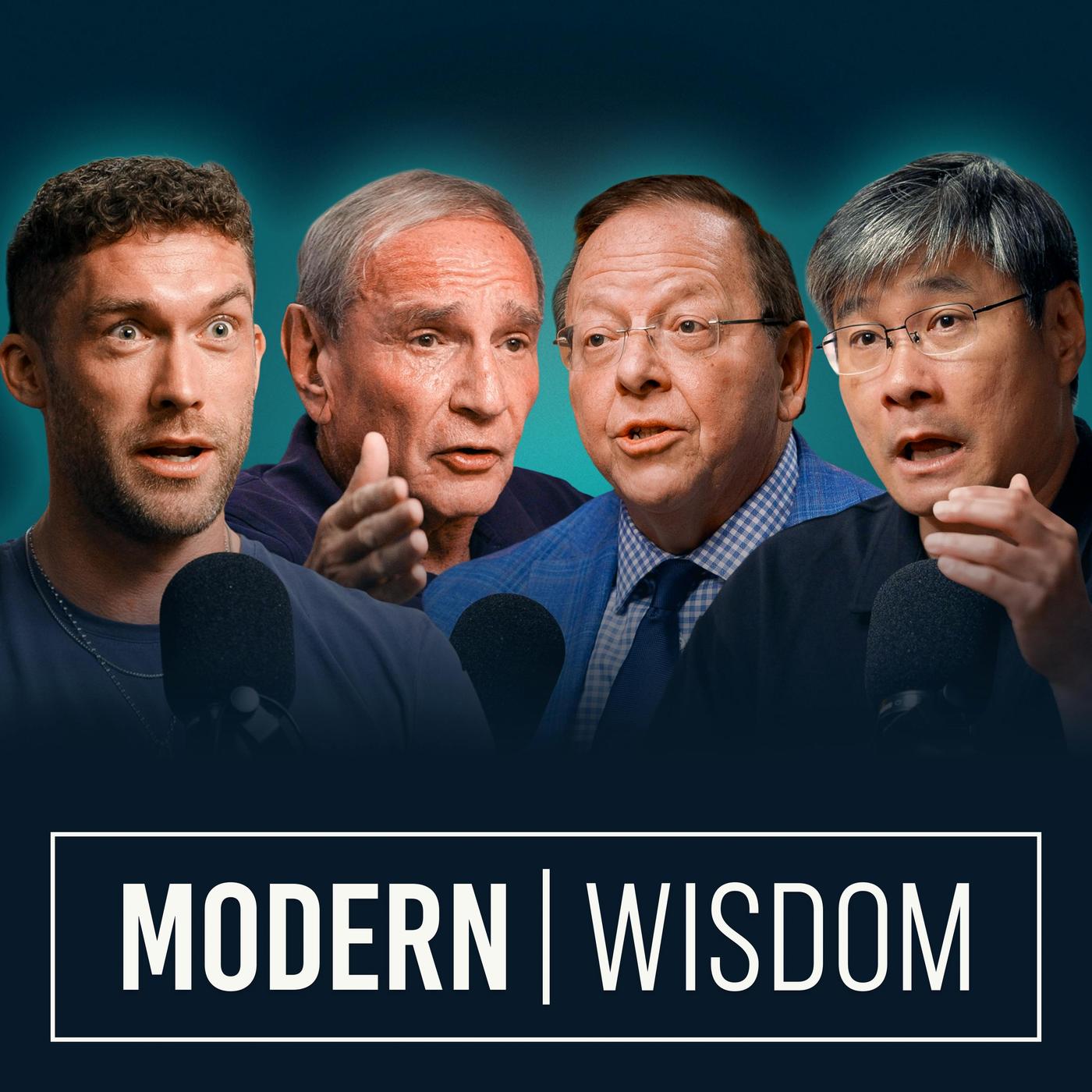
Host Chris Williamson convenes geopolitical experts Robert Pape, Jiang Xueqin, and George Friedman to debate whether the era of Pax Americana is giving way to a volatile, multipolar world defined by regional conflicts and internal political strife.
The panel compares the long-term trajectories of the United States and China, analyzing how economic integration, domestic political divisions, and technological competition will shape the balance of global power over the next two decades.
The discussion dives deep into immediate flashpoints, examining the strategic realities of a potential Chinese maritime blockade of Taiwan and the complex geopolitical escalation risks surrounding the ongoing conflict involving Iran.
Robert Pape introduces his research on violent populism, sparking a debate on whether America's current domestic polarization is a historical cycle or an unprecedented slide toward normalized political violence and civil instability.
As global leadership becomes increasingly decentralized, the panel warns that the erosion of the post-Cold War order significantly increases the incentives for nuclear proliferation and attacks on critical civilian infrastructure.
What was said on this episode
46 statements · 9 positive · 34 negative · 3 mixed
U.S. internal divisions during the midterms are the biggest threat to global peace.
“The biggest threat to global peace we're about to see in our midterm elections. It's the internal divisions in the United States.”
Listen at 0:39
The United States is currently the greatest threat to global peace.
“I think the United States right now is the greatest threat to global peace”
Listen at 1:44
Global conflict is unlikely, but regional conflicts are likely during systemic restructuring.
“I don't see a global conflict coming. Many regional conflicts are coming because the global system is restructuring itself.”
Listen at 2:03
Separate regional conflicts could produce an economic crisis worse than the Great Depression.
“even if those remain 3 separate arenas, Chris, we might be heading to something far worse than the 1930s Depression.”
Listen at 3:47
Current regional conflicts are already producing global consequences unseen since World War II.
“we are already seeing global consequences in ways we haven't seen since World War II.”
Listen at 4:11
American decisions have caused or fundamentally driven the Russia-Ukraine and Iran wars.
“American decisions have been at the taproot of both of these wars, the war with Russia and Ukraine, and the Iran war that we're experiencing right now.”
Listen at 6:28
The United States no longer wants its previous global leadership role.
“The United States is no longer doing it. It no longer wants the role it had for the past 80 years.”
Listen at 11:27
The United States is losing the next industrial revolution to China.
“we are losing the next industrial advance, the next economic revolution, and we're losing it to China.”
Listen at 12:00
China cannot domestically consume all the products it produces.
“The fundamental problem that China has is it cannot consume the products it produces.”
Listen at 15:05
China is vulnerable because it requires continued access to global markets.
“The Chinese get into trouble because they must have access to the global market”
Listen at 18:46
China’s one-child policy has caused rapid aging and a workforce shortage.
“China's aging rapidly because of the one-child policy. China has no workforce.”
Listen at 21:33
The United States has stronger demographic and resource fundamentals than China.
“the United States is a self-sufficient, resource-rich economy with a very vibrant, energetic, young population. China has the opposite problem”
Listen at 22:01
China is not currently collapsing economically.
“So China's not collapsing.”
Listen at 25:58
China is building core technological infrastructure capable of surpassing the United States.
“They're building the core infrastructure to be able to beat us.”
Listen at 26:42
China can rise peacefully while maintaining relations with the United States.
“I think that China can rise peacefully with the United States.”
Listen at 30:56
The United States and China will avoid war if their leaders act wisely.
“I don't think we're heading to a war with China if we're smart”
Listen at 31:52
The United States will remain the only global power, while China remains regional.
“The United States is the only global power China's a regional power.”
Listen at 32:29
China and the United States could reverse their relative GDP shares within twenty years.
“this could easily flip-flop in 20 years.”
Listen at 33:39
The United States is heading toward violent populism rather than civil war.
“we're not heading to civil war. We are heading to violent populism, and we're in the middle of violent populism.”
Listen at 42:54
Perceived downward mobility increases support for political violence on both political sides.
“the more you think you won't be as prosperous as your parents, the more you support political violence on the right and on the left.”
Listen at 50:05
U.S. territorial expansion could occur if MAGA’s electoral strength increases.
“there's a very good chance that what Zhang is talking about will come to be”
Listen at 1:03:41
Continued Chinese growth will make China increasingly dwarf Taiwan economically and politically.
“if China just continues to grow, then what's going to happen is it will eventually dwarf Taiwan even more than it does today.”
Listen at 1:07:08
Iran is America’s most difficult strategic challenge since Germany in World War II.
“Iran is the most difficult challenge we've had since Germany in World War II.”
Listen at 1:12:29
U.S. bombing would have a ninety-percent chance of destroying Fordow’s enrichment capability.
“Once we did that, we would be 90% likely to destroy the centrifuge industrial, the enrichment capability of the facility of Fordow.”
Listen at 1:13:54
The Iran conflict is entering a serious escalation phase imminently.
“we are coming now to a serious stage of the escalation trap that's going to start next week and the following week.”
Listen at 1:16:28
Economic pressure alone has never won a major war since World War I.
“since World War I, even heavy economic pressure alone, I mean alone without other military force, has never won a major war.”
Listen at 1:21:42
The Iran war will continue and draw China, Russia, and other powers into the conflict.
“It doesn't end. It— what's going to happen is eventually the Ukraine War and the Iran War Already we're seeing that after Zelensky bombed an Iranian cargo ship in the Caspian Sea, and Zelensky was very proud of this. Like, you see, I can do this for the Americans. So it is very likely that all the world powers are brought in. China is brought into the war. Russia is brought into the war.”
Listen at 1:31:15
January 2027 will be a decisive opportunity for the United States, China, and Iran to reset relations.
“January 2027 will be a focal point moment where all the actors The United States, China, Iran have a chance to reset.”
Listen at 1:32:07
Congressional Republicans and Democrats broadly favor ending the Iran war.
“Congress tends to do what's popular, and ending the war is popular not only in the Democrats but with the Republicans.”
Listen at 1:42:16
U.S. Middle East policy may be intended to advance the Greater Israel project.
“It seems like this is all to achieve the Greater Israel project. I believe.”
Listen at 1:55:02
Normalization of political violence underlies President Trump’s domestic and foreign conduct.
“Normalization of political violence. It is the thing that is underneath everything.”
Listen at 1:56:39
Complete U.S. withdrawal from the Middle East would leave Israel in severe strategic difficulty.
“if you have American power withdraw completely from the Middle East with the way Iran wants it to be, and that may end up being the outcome, then Israel's in deep trouble.”
Listen at 2:08:22
The Iran war is uniquely damaging to Americans because it directly affects household finances.
“This war is different. And the reason it's different is not just it's another war in a long period of time. It's different because this is the war that Americans are feeling it in their pocketbook for real.”
Listen at 2:18:15
The analysis predicting global economic collapse is credible and difficult to refute.
“I am really concerned with his analysis because I can't chip away. I brought Jeff Currie on, uh, my Substack to do these, you know, sort of like what you do here, uh, here, because I think he's just an amazing economist and so forth. He's right there. I mean, so here's— so he's right. Can you give me— can, can you—”
Listen at 2:21:32
Trump is more likely to escalate force than voluntarily end the Iran war.
“He is more likely to use force, and it's starting with economic force to get a symbolic victory”
Listen at 2:24:23
The Iran war is dismantling America’s role as guarantor of global commercial stability.
“what's happening with the Iran war is America as protector of the global rules of power, meaning stability for commerce, is simply coming unglued.”
Listen at 2:29:43
A year-long loss of much global fertilizer supply would cause mass starvation.
“if a quarter to a third of the world's fertilizer goes offline, line for a year, then you're going to have millions of people starve to death.”
Listen at 2:37:03
Mass starvation from Middle Eastern disruption is already effectively inevitable.
“I think it's baked in already.”
Listen at 2:37:22
A fragmented emerging anarchy will replace the current American-led international order.
“I think you're going to see— you might even call it an emerging anarchy that's going to occur.”
Listen at 2:38:14
The Iran war will increase incentives for nuclear proliferation among other states.
“incentives for nuclear proliferation. For example, with greater incentive, and you already saw that with Saudi, Iran, Saudi Arabia, you will see these incentives start to spread as a result of this war.”
Listen at 2:39:31
The world is becoming more prone to war.
“we're moving to a more war-prone world.”
Listen at 2:41:21
Nuclear war will not occur.
“nuclear war will not happen.”
Listen at 2:52:44
Nuclear weapons will not be used, including tactically.
“I don't see any scenario where nuclear weapons are used, even tactically.”
Listen at 2:53:02
Pape has doubled his estimated nuclear-use probabilities as the conflict’s actors have changed.
“I've now essentially been doubling those over time because the nature of the players.”
Listen at 2:53:24
A disrupted 2026 election and congressional transition would sharply worsen America’s political crisis.
“if that goes south, all of these issues are going to get much, much, much worse.”
Listen at 2:59:08
U.S. attacks on Iranian power plants would trigger Iranian attacks on Middle Eastern energy infrastructure.
“If the United States targets Iranian power plants, Iran will target in any way, in Anyway, Iran will target all of the Middle East energy infrastructure”
Listen at 3:00:02
Statements are attributed to the speaker as said on the episode and reflect their view at the time, not PodLume's. They are not advice.