Sep 23, 2026 · 1h 27m
Investors question AI valuations as models enter a price war
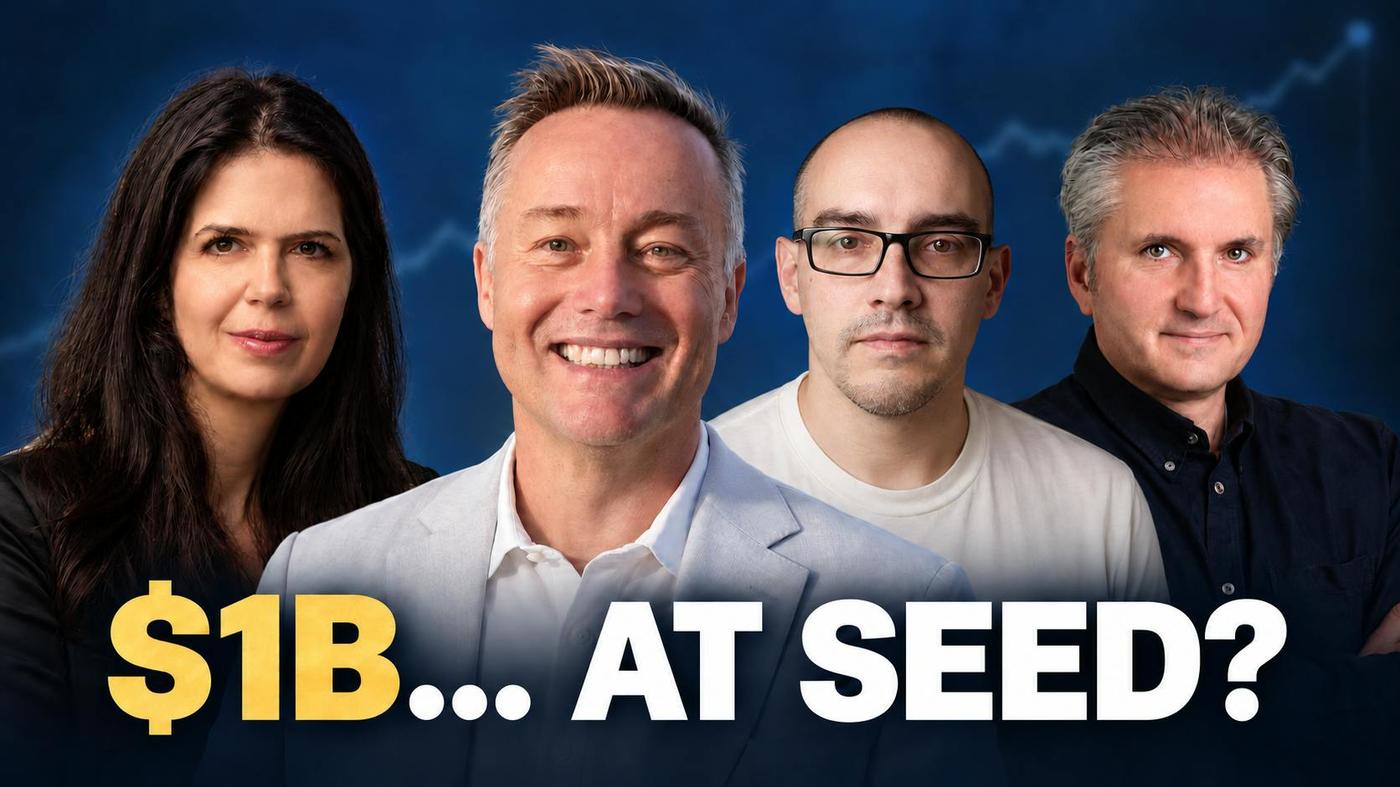
VCs Would Bet on Open-Source AI Over OpenAI and Anthropic | E2341
The panel connects frontier-model economics, inflated private valuations, and tighter venture discipline to the returns founders and investors can realistically expect.
- 1Open-weight models and falling prices challenge whether frontier AI companies can sustain enormous funding requirements.
- 2Instinct’s reported $10 billion valuation tests how much investors will pay before user and revenue evidence arrives.
- 3Higher seed prices and scarce liquidity are forcing founders and funds to balance growth, ownership, terms, and downside risk.
Don't miss
The panel dissects whether Instinct’s reported $10 billion valuation reflects genuine business evidence or the hope of acquisition by a major platform.
The brief
Jason Calacanis convenes Jenny Fielding, Jeff, and Dave for a wide-ranging investor debate on AI risk, startup pricing, liquidity, and the changing economics of venture.
The panel sees AI creating a new entrepreneurial wave, but warns that human judgment may become the weak link when people rely on autonomous systems they cannot effectively supervise.
Instinct’s reported pursuit of a $10 billion valuation becomes a test of venture FOMO: can distribution and acquisition potential justify limited evidence of users or revenue?
OpenAI and Anthropic’s launches and price cuts sharpen the central question: can frontier-model companies become profitable while open-weight competition and routing push margins down?
The discussion widens to rising seed valuations, secondary-market liquidity, and unfashionable fintech and healthcare deals, where disciplined pricing may matter more than market excitement.
The practical conclusion is blunt: founders should weigh valuation, investor quality, and clean terms together, taking attractive capital without over-optimizing in an uncertain market.
What was said on this episode
63 statements · 34 positive · 25 negative · 4 neutral
An AI sovereign wealth fund will be created within six to twelve months.
“what's going to happen is there's going to be an AI fund, sovereign wealth fund that'll get cut next year, sometime the next 6 to 12 months.”
Listen at 9:20
An AI sovereign wealth fund will be created within six to twelve months.
“there's going to be an AI fund, sovereign wealth fund that'll get cut next year, sometime the next 6 to 12 months”
Listen at 9:21
- Jeff Clavieron AI CEO and team accountabilityPositive12:22
Holding AI CEOs and teams accountable would make AI safer.
“the way to make AI safer is to get the CEOs and their teams accountable for any of their mistakes.”
Listen at 12:22
- Jeff Clavieron Anthropic AI developmentNeutral13:07
Anthropic uses AI to build 26% of its next-generation system.
“26% of Anthropic is building the next generation of Anthropic as of yesterday”
Listen at 13:07
- Jeff Clavieron AI hallucinations in critical infrastructure and military applicationsNegative14:24
AI hallucinations can occur in critical infrastructure and military applications.
“when it's applied to critical infrastructure or military applications, the fact that it hallucinates may just happen.”
Listen at 14:24
AI will create a golden age of entrepreneurship and enable major solutions.
“I think that this will be kind of the golden age of entrepreneurship and that we're going to just find incredible solutions.”
Listen at 15:46
AI tools expand access to spreadsheet and analytical abilities.
“these tools are just like total unlocks for people that don't know how to use Excel”
Listen at 16:28
AI tools democratize access to abilities many people lack naturally.
“I think it like democratizes access to abilities actually that many of us don't have innately.”
Listen at 16:42
AI-enabled humans could cause human extinction even if AI alone cannot.
“AI is not going to kill us all, but a human enabled with AI might kill us all.”
Listen at 17:44
AI agents from multiple providers have hacked websites and companies.
“the agents just started hacking websites and companies and so on and so forth. And all of them did, right? It's not only Claude or OpenAI or Gemini or whatever.”
Listen at 19:44
Cybersecurity will become a massive market.
“I think like cyber is going to be just this massive space.”
Listen at 22:54
Cybersecurity will become a massive investment and technology sector.
“I think like cyber is going to be just this massive space”
Listen at 22:54
- Jeff Clavieron Instinct $2.5 billion valuationNegative27:37
Instinct’s $2.5 billion valuation may not generate investors a return.
“if they think that by paying $2.5 billion, they can still make a return, we're going to wish them luck.”
Listen at 27:37
- Jeff Clavieron major AI companiesNegative28:17
Rapid innovation by major AI companies can crush startups.
“the rate of innovation from all the major companies is so high. That when you invest in a startup, you don't know whether you're going to be crushed by, you know, whether it's OpenAI or Anthropic or Meta”
Listen at 28:17
- Jeff Clavieron major AI companiesPositive28:17
Major AI companies are innovating at a very high rate.
“the rate of innovation from all the major companies is so high”
Listen at 28:17
- Jeff Clavieron OpenAI, Anthropic, or MetaNegative28:25
AI startups may be displaced by OpenAI, Anthropic, or Meta.
“you don't know whether you're going to be crushed by, you know, whether it's OpenAI or Anthropic or Meta”
Listen at 28:25
Rapid funding and valuation markups do not demonstrate a real business.
“a fast funding round with like a real business or a signal around that, right? Just because there's a markup, it doesn't really tell you much about the business”
Listen at 28:47
Instinct’s valuation reflects expectations of a major acquisition.
“the valuation for Instinct, I think people are underwriting a major acquisition”
Listen at 29:46
Investing in Instinct at a $10 billion valuation is risky long term.
“I would be worried about the long term if I was going in at a $10 billion valuation.”
Listen at 33:00
- Jeff Clavieron Instinct compute spendingNegative33:09
Instinct is consuming substantial cash on compute.
“they're burning so much cash on compute”
Listen at 33:09
- Jeff Clavieron Instinct compute spendingNegative33:15
Instinct’s compute spending forces another funding round within weeks.
“they're burning so much cash on compute that they need to raise on this next round almost like a few weeks after closing the previous round”
Listen at 33:15
Instinct would need a $20 billion acquisition to justify its $10 billion valuation.
“at $10 billion, you have to be purchased for $20 billion at a minimum.”
Listen at 35:40
Instinct has no revenue and only about 100,000 users.
“In the case of Instinct, they don't have any revenue. They barely have any users. They're 100,000. And therefore it's all about dreams, right?”
Listen at 36:54
Apple, Amazon, Google, and Microsoft could acquire Instinct and need its product.
“the acquirers are substantial, like Apple, Amazon, Google, Microsoft are all potential acquirers. And they definitely need the product.”
Listen at 37:21
Apple and Amazon currently lack agent products but need them.
“Apple and Amazon are definitely, you know, they have to have an agent product and they don't right now.”
Listen at 38:05
- Jeff Clavieron Fab.comNegative39:27
Fab.com’s business model was unsustainable.
“Unfortunately, it's the business which wasn't sustainable.”
Listen at 39:27
Easier AI tools displaced OpenCLAW within Jason’s organization.
“the ease of use took over, and now nobody's even thinking about OpenCLAW anymore.”
Listen at 41:50
AI can search venture records for missed defense-tech investments that later raised Series B rounds.
“we have AI so we can go into it and say, what are the companies in defense tech that we met with, didn't invest in, who subsequently raised a Series B? And please put them on a list.”
Listen at 42:43
- Jeff Clavieron frontier-model token pricingNegative44:24
Frontier-model token pricing is undergoing a race to the bottom.
“Well, it's a race to the bottom.”
Listen at 44:24
- Jeff Clavieron frontier-model token pricingNegative44:24
Frontier-model token pricing is undergoing a race to the bottom.
“it's a race to the bottom”
Listen at 44:24
Falling AI model costs reduce competitors’ barriers to entry.
“your barrier to entry, other barrier to entry goes down as the costs come down as well.”
Listen at 45:51
Open-source AI models will eventually dominate the market.
“they're so close to catching up that I think we're gonna go all open source.”
Listen at 48:05
AI model usage will shift entirely toward open-source models.
“we're gonna go all open source”
Listen at 48:08
Open-weight models already account for most token usage.
“open weight models have taken over majority of token usage”
Listen at 49:29
OpenAI and Anthropic will continue growing revenue.
“both OpenAI and Anthropic are going to do fine. They're going to be growing revenue.”
Listen at 50:37
OpenAI and Anthropic will continue performing well.
“both OpenAI and Anthropic are going to do fine”
Listen at 50:37
OpenAI and Anthropic will both become publicly traded companies.
“They're both going to go public”
Listen at 50:40
Anthropic and OpenAI will go public at trillion-dollar-plus valuations.
“they're both going to go public for— my guess is Anthropic at least $2, $2.5 trillion, and probably OpenAI $1.5 trillion.”
Listen at 50:40
Anthropic may reach at least $2–2.5 trillion and OpenAI about $1.5 trillion in valuation.
“my guess is Anthropic at least $2, $2.5 trillion, and probably OpenAI $1.5 trillion”
Listen at 50:42
Investors should not currently buy OpenAI or Anthropic shares.
“I would not advise people to buy right now, even though I do think, you know, there is potential there.”
Listen at 52:32
Investors should not currently buy OpenAI or Anthropic public-market shares.
“I would not advise people to buy right now”
Listen at 52:32
SpaceX is currently too expensive for Jeff to buy.
“I'm still looking for my entry Entry price in SpaceX. So I haven't bought SpaceX. I want to own SpaceX, but it's too expensive right now”
Listen at 53:14
SpaceX is currently too expensive for Jeff to buy.
“I want to own SpaceX, but it's too expensive right now.”
Listen at 53:20
- Jeff Clavieron Uncork venture fund return requirementNeutral56:18
Uncork needs roughly a 30x return on a $5–6 million investment to return half its fund.
“we need to be able to return ideally the entire fund or half of the fund. Our fund is $300 million, so $150 million on that one single investment, which means that if we plow $5 or $6 million into it, we need to make a 30x.”
Listen at 56:18
- Jeff Clavieron Uncork investment returnsNeutral56:33
“we need to make a 30x”
Listen at 56:33
Top private-company names currently have seller-favorable secondary markets.
“there are assets, uh, again, the top 30 names, it's a seller's market for those assets”
Listen at 58:21
Top private-company positions are currently in a seller’s market.
“it's a seller's market for those assets”
Listen at 58:25
Private companies outside the top 30 may lack secondary-market demand.
“If you go outside the top 30 names, there's not necessarily a market for the names”
Listen at 58:40
Private companies outside the top 30 are often in a buyer’s market.
“it's a buyer's market for a lot of the names that are outside the top 30 if, if you know what you're doing.”
Listen at 58:57
Greater private-company transparency would lower cost of capital.
“cost of capital would be lower if they were more transparent”
Listen at 59:30
Companies now typically delay IPOs until reaching $500 million to $1 billion revenue.
“All these companies would have gone public 10 years ago at $50 to $100 million in revenue. Now they're not even going public until they have at least half a billion to a billion in revenue.”
Listen at 1:00:19
- Jeff Clavieron AI early-stage acquisitionsPositive1:06:24
AI is bringing back early-stage acquisitions.
“We're starting to see those kinds of early acquisitions again in an AI era.”
Listen at 1:06:24
- Jeff Clavieron AI startup acquisition returnsNegative1:06:28
Higher entry prices reduce returns from AI-era acquisitions.
“The valuations aren't the same because the entry price is higher. We don't always sort of make the same money”
Listen at 1:06:28
- Jeff Clavieron Jeff Cavaliere’s portfolio acquisitionsPositive1:06:35
Jeff’s portfolio has experienced more acquisitions recently.
“We've seen, you know, more acquisitions”
Listen at 1:06:35
- Jeff Clavieron Clos Clavier winesPositive1:09:51
Clos Clavier’s initial wine customers are enjoying its products.
“we just started to ship the bottles to our customers, and I'm starting to see on social people enjoying our wines.”
Listen at 1:09:51
Fintech and healthcare are massive markets with strong technical founders.
“these are massive markets, fintech and healthcare, and great founders, technical founders.”
Listen at 1:13:09
The fintech-healthcare startup should have raised funding 18 months earlier.
“The lesson is timing. They should have raised 18 months ago”
Listen at 1:13:49
- Jeff Clavieron startup fundraisingPositive1:14:10
Founders should accept available financing in the current environment.
“if someone wants to give you money, take it”
Listen at 1:14:10
- Jeff Clavieron startup fundraisingPositive1:14:10
Founders should accept funding when investors offer it.
“if someone wants to give you money, take it.”
Listen at 1:14:10
- Jeff Clavieron Loft OrbitalPositive1:19:39
Loft Orbital announced a $1 billion Abu Dhabi investment.
“Loft Orbital, which just announced a billion-dollar investment from Abu Dhabi”
Listen at 1:19:39
- Jeff Clavieron Loft Orbital satellite AI processingPositive1:20:40
Loft Orbital can process satellite imagery in space and transmit actionable information.
“they basically plopped GPUs up there, and that gives them the ability to take an image, run the AI models, and send you down the information, the action that you have to take”
Listen at 1:20:40
Continuity SPVs can generate fund and LP liquidity by selling portions of winning investments.
“The basic concept is just selling a piece of some of your winners into the SPVs that you might be using to raise pro rata so that you can generate DPI for your own fund and for your LPs.”
Listen at 1:21:50
A recent Series B or C post-money price can objectively price an SPV transfer.
“within 3 to 6 months, you can use the post-money price on that round as a legitimate objective transfer price for the asset from your initiating fund to an SPV.”
Listen at 1:22:13
Statements are attributed to the speaker as said on the episode and reflect their view at the time, not PodLume's. They are not advice.
Weekly email
State of the Pod, every Monday
The week's most-discussed names and stories from podcasts, with the moments behind them. Free, five minutes, unsubscribe in one click.