Nov 20, 2026 · 1h 27m
Iran war tests Rubio and Vance as Congress cuts rushed deals
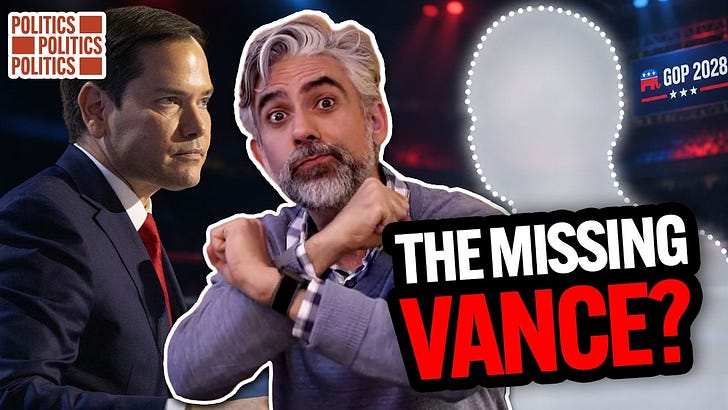
Is JD Vance Sitting Out in 2028? Digging Into the Lame Duck Session (with Jen Briney)
The episode connects an overseas conflict, an uncertain Republican succession fight, and a lame-duck Congress where major legislation can move with limited accountability.
- 1The Iran war could define or damage Marco Rubio and J.D. Vance’s prospects for the 2028 Republican nomination.
- 2Lame-duck sessions bundle must-pass legislation with controversial provisions while departing lawmakers and exhausted coverage weaken scrutiny.
- 3Democrats face competing pressures to deliver tangible policies, preserve a broad coalition, and avoid ineffective shutdown tactics.
Don't miss
Justin and Jen dissect why lame-duck legislation can move through Congress before its provisions are fully understood or publicly scrutinized.
The brief
The episode frames Marco Rubio and J.D. Vance’s possible 2028 rivalry around a central uncertainty: whether the Trump administration’s unpopularity and Iran war will strengthen or destroy their prospects.
Justin and Jen Briney explain why lame-duck sessions invite rushed deals: must-pass funding and defense bills create vehicles for controversial provisions as departing lawmakers face little voter accountability.
Their permitting-bill discussion tests the tradeoffs among green energy, data centers, environmental regulation, lobbying, and legislation moving faster than its contents can be understood.
The conversation turns to shutdown strategy, Republican and Democratic leadership contests, and what Democrats should do with a majority spanning states that traditionally vote Republican.
The closing cyberattack discussion distinguishes ransomware, digital theft, and state-sponsored disruption, showing how online attacks can serve criminal, political, and military purposes.
What was said on this episode
28 statements · 8 positive · 14 negative · 1 mixed · 5 neutral
Marco Rubio will not leave the State Department while Cuba remains under communist rule.
“I don't believe that Marco Rubio is going to leave his perch as secretary of state as long as there is a lack of American flags flying over Havana.”
Listen at 6:17
Marco Rubio would choose overthrowing Cuba’s Communist Party over becoming president.
“he could be the man that brought down the Communist Party in Cuba, or he could be president of the United States, would pick the former over the latter 10 times out of 10.”
Listen at 6:40
Continued Trump administration unpopularity would hurt its associated candidates.
“If the Trump administration remains the level of unpopular that it is right now, then it will be something that will be a liability.”
Listen at 8:20
Donald Trump will retain at least 20% support among Republican voters.
“Donald Trump will retain an ironclad hold over conservatively 20% of Republican voters.”
Listen at 8:58
Rubio and Vance’s political futures depend on the Iran conflict.
“the fate of both of these candidates is entirely intertwined with Tehran.”
Listen at 11:55
Failure to explain the Iran war would damage Rubio and Vance in debates.
“if somebody can just say, oh, yeah, well, you're so smart. Why'd you go to war with Iran? And they don't have a good answer for it. And that's going to be a big problem.”
Listen at 12:35
Iran will retaliate against Middle Eastern oil refineries if fired upon.
“If they are fired upon, which they will be, then that is going to be their sign. that they can hit oil refineries in the Middle East.”
Listen at 15:02
Iranian attacks on oil refineries would trigger renewed regional fighting.
“This will essentially kick off another round of fighting”
Listen at 15:15
Congress has completed the NDAA on time every year for 65 years.
“The National Defense Authorization Act is the only thing that Congress has finished on time every year for the past. 65 years.”
Listen at 26:53
Controversial provisions can be secretly inserted into large must-pass bills.
“it's really easy to slip things into law in secret onto those bills.”
Listen at 28:35
The permitting bill is likely to pass the Senate.
“It looks like it's going to pass the Senate.”
Listen at 32:33
Reducing Endangered Species Act requirements shifts decisions to Trump’s administration.
“you're basically handing the decision to the Trump administration.”
Listen at 33:41
Modern data centers generally do not create the noise and water-use problems attributed to older facilities.
“The misinformation is that they're loud and they use a lot of water. And it's like the ones that did that were built 15 to 20 years ago and don't do that anymore.”
Listen at 35:15
Government shutdowns are ineffective and should not be used for political priorities.
“you do not hold the basic function of government. hostage for your political priorities. And oh, by the way, it has never worked.”
Listen at 43:38
Congress may defer government funding decisions to the next Congress.
“they might just kick government funding into the new Congress.”
Listen at 45:21
The War Powers Resolution legally required the Iran war to stop already.
“according to that law, the Iran war should have stopped already.”
Listen at 45:56
Prioritizing judicial confirmations leaves no time for reconciliation legislation.
“if that's the priority, there is no reconciliation bill.”
Listen at 48:33
Mike Johnson and John Thune lack a unified policy agenda.
“I don't think Mike Johnson is that. I don't think John Boone is that.”
Listen at 49:50
John Thune used unprecedented procedures to accelerate confirmations.
“Thune did pull some procedural tricks that were unprecedented to ram a lot of them through.”
Listen at 51:20
Chris Van Hollen could still defeat Chuck Schumer in the Senate leadership election.
“I don't think this is what's going to happen, but it's still a maybe. It's not a. impossibility”
Listen at 57:57
Chris Van Hollen communicates Democratic priorities better than Chuck Schumer.
“I think Chris Van Hollen is a better representative in front of the cameras to say, this is what we're trying to do and why.”
Listen at 1:01:33
Paid family leave has broad support in parts of the country Democrats often overlook.
“there is wide ranging support for some of the things that the Democrats say that they support, paid family leave, that type of stuff.”
Listen at 1:06:55
Democrats should create a public health-insurance option competing with private insurers.
“I would go public option, allow people to buy into it and have a government competitor for the private health insurance market”
Listen at 1:14:01
A minimum-wage increase could be attached to government funding legislation.
“I think raising the minimum wage as a dingleberry to government funding is possible.”
Listen at 1:14:18
Congress should ban gerrymandering and stock trading by senior officials.
“Ban gerrymandering. We all hate it. Ban stock training by members of Congress and cabinet level secretaries.”
Listen at 1:14:48
Criminal ransomware attackers lock systems to demand payment for restoring access.
“if some hacker gets access to your systems and locks up your ability to take reservations at your hotel, process payments, run your casino games that are electronically networked, then they want a ransom to give all that back to you.”
Listen at 1:21:03
China, Russia, and Iran use cyberattacks to damage America’s economy or morale.
“If you're China or you're Russia or you're Iran and you are looking to disrupt American systems, it is... probably more likely that you are looking to destabilize systems so you can either hurt the American economy or destroy morale in America.”
Listen at 1:22:01
The United States is a prime cyberattack target because its wealth makes payment more likely.
“the United States is a... very ripe target for cyber attacks. And it's the same reason why we're a very ripe target for scams in general is because we're rich and we are more likely to pay because of it.”
Listen at 1:23:09
Statements are attributed to the speaker as said on the episode and reflect their view at the time, not PodLume's. They are not advice.
Weekly email
State of the Pod, every Monday
The week's most-discussed names and stories from podcasts, with the moments behind them. Free, five minutes, unsubscribe in one click.