Sep 3, 2026 · 2h 36m
Listen from 1:09:02
Listen at 1:09:02
Jared Diamond argues leaders need the right moment
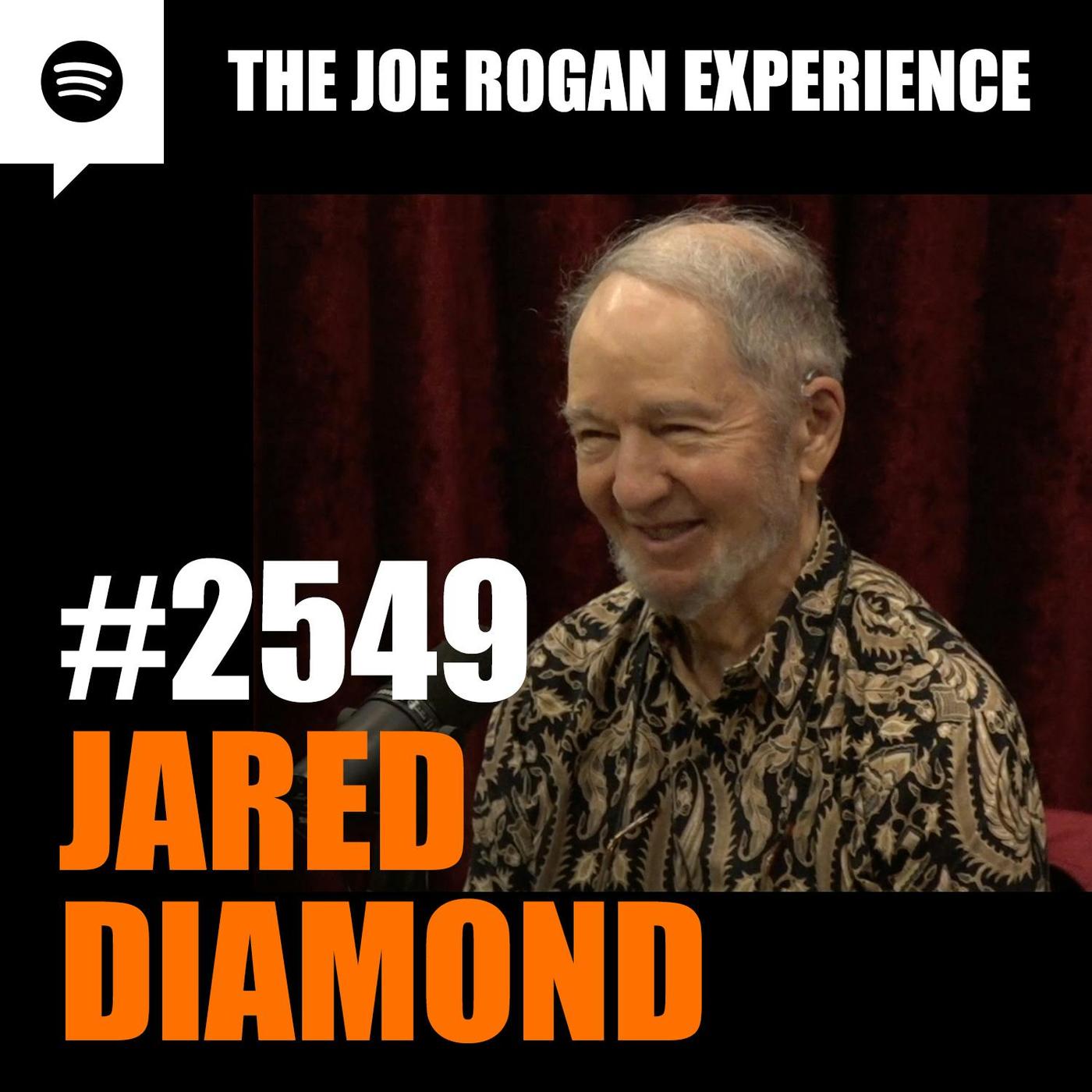
#2549 - Jared Diamond
The conversation tests whether history turns on exceptional individuals or on the geography, institutions, and circumstances that make their influence possible.
- 1Leaders shape outcomes most decisively when personal abilities meet favorable timing, place, institutions, and chance.
- 2Religions spread through organization, community, literacy, demographic advantages, and care networks as much as through doctrine.
- 3Languages, writing systems, and cultural practices reveal how societies construct meaning—and how easily outsiders misread it.
Don't miss
Diamond explains how Seretse Khama helped Botswana turn diamond wealth into broadly shared prosperity rather than a source of national dysfunction.
The brief
Jared Diamond’s central question is deceptively simple: when does one person change history? His answer combines individual qualities with timing, geography, institutions, and chance.
Genghis Khan, religious founders, Bezos, Jobs, and Botswana’s Seretse Khama illustrate different versions of the same argument: leaders shape possibilities, but rarely create them alone.
The conversation then turns to language, from failed machine translation and ambiguous religious texts to writing systems and Tok Pisin, showing how meaning changes across cultures.
Diamond’s account of the Fore people and kuru links cultural difference to biology, while raising a broader question: which customs seem normal only because a society makes them so?
Botswana provides the clearest payoff: Seretse Khama used political authority and diamond wealth to build shared prosperity, suggesting leadership matters most when it strengthens institutions.
What was said on this episode
52 statements · 30 positive · 11 negative · 4 mixed · 7 neutral
Leaders make a difference when they emerge at the right time and place.
“A leader has to be at the right time and place.”
Listen at 6:18
Genghis Khan was born during Mongolia’s wettest decade in 2,000 years.
“the wettest time in the last 2,000 years. Was the decade of Genghis Khan's birth.”
Listen at 8:24
Rainfall supported Mongol livestock and enabled Genghis Khan’s military campaigns.
“with all that rain, that meant hay to feed sheep and goats to feed Mongol babies and it also meant hay to feed Mongol horses to ride into battle.”
Listen at 8:42
Genghis Khan’s success required favorable circumstances and exceptional personal qualities.
“It took 2 things together. The second thing— the first thing was that he was at the right time and place, but he also had to be an extraordinary person.”
Listen at 12:30
Historical opportunities require both favorable circumstances and exceptional personal qualities.
“At a given time and place, That may be the occasion for someone to emerge, but who emerges depends upon the personal qualities.”
Listen at 12:48
Christianity’s spread required Jesus’s message and Paul’s organizational leadership.
“Jesus had a particularly good message, but it took— a good message isn't enough. It took St. Paul as the organizer.”
Listen at 16:23
Mormonism spread partly because of strong organization and socially attractive practices.
“the Mormons were very well organized under Brigham Young and the social features of the Mormon religion”
Listen at 20:09
Mormonism spread through charisma and leadership more than Joseph Smith’s theology.
“the Mormon religion, I would say, has spread not because of Joseph Smith's theology, but because he was charismatic, and because Brigham Young then was an outstanding leader.”
Listen at 20:53
Early Christians outbred pagans during the first centuries of the Roman Empire.
“The Christians outbred pagans in the first couple of centuries of the Roman Empire”
Listen at 23:27
Early Christians had lower mortality and longer lives than Roman pagans.
“when you look at tombstones from the first couple of centuries of the Roman Empire, Christians lived longer and they were less likely to die than were pagans”
Listen at 24:10
Islam spread mainly through organization, motivation, military power, social ties, and possibly weather.
“the organization, the motivation, the military spirit, the family and social connections, and maybe, although we don't know, something about the weather in Saudi Arabia during Muhammad's lifetime. Those rather than theological beliefs I see as the reason behind Islam's spread.”
Listen at 25:41
Jesus and Muhammad’s beliefs have had effects lasting roughly two millennia.
“The beliefs of Jesus and the beliefs of Muhammad, those individuals had a long-lasting effect.”
Listen at 29:52
Worldwide religions require an economic and demographic engine to spread.
“religion, to become worldwide, religion needs what one could call an economic and demographic engine”
Listen at 31:39
Books were an ideal initial online retail product because they are standardized.
“books were an ideal thing to start out with. All books are uniform.”
Listen at 34:59
Everything stores would have emerged even without Jeff Bezos.
“Without Jeff Bezos, we would still have everything stores.”
Listen at 36:48
Alternative paths to developing everything stores existed before and after Bezos.
“what we know for sure is that there were before and there were afterwards other ways to develop an everything store.”
Listen at 37:42
Jeff Bezos distinguished Amazon by prioritizing customer satisfaction.
“What Jeff Bezos did was to put his stamp on how to do it by prioritizing customer satisfaction.”
Listen at 37:51
Stock markets would have developed even if they had not initially emerged.
“if we didn't have a stock— if stock markets hadn't developed, stock markets would have developed.”
Listen at 40:47
Cell phones would have emerged, but Steve Jobs shaped their distinctive design and simplicity.
“cell phones certainly would have emerged. But Steve Jobs put a distinctive face on cell phones”
Listen at 42:38
Steve Jobs distinguished Apple phones through emphasis on appearance and simplicity.
“Steve Jobs put a distinctive face on cell phones and that he cared a lot about appearance and he cared a lot about simplicity”
Listen at 42:42
Jared Diamond recommends using a 0.7-millimeter pencil for writing.
“I really recommend this pencil.”
Listen at 49:34
Diamond’s typed prose is wordier, while handwritten prose is more compressed.
“my style, my English prose style is different if I type it than if I write it. When I type it, I notice that my style is more wordy, whereas if I write it down, my style is more simplified and compressed.”
Listen at 52:51
Xerox PARC failed to develop simultaneous automatic translation in the 1970s.
“The goal of Xerox PARC, which was well-funded, was to develop a device that would do simultaneous translation. They failed.”
Listen at 56:46
Xerox PARC’s 1970s simultaneous-translation effort failed because language and translation technology were insufficiently understood.
“The reason was there were 2 things that were complicated that were not understood in the 1970s.”
Listen at 56:59
The Greek term logos denotes both “word” and “rational system.”
“The Greek word logos means word, but it also means rational system.”
Listen at 59:32
More expansive AI translation could preserve meaning but lose the Iliad’s condensed power.
“one would lose the power, the condensation of the Iliad.”
Listen at 1:07:04
Guns, Germs, and Steel has been translated into 45 languages.
“Guns, Germs, and Steel has been translated into 45 languages”
Listen at 1:09:02
Perfect translation between languages is impossible.
“we know that you cannot translate perfectly from one language into another language.”
Listen at 1:09:59
Korean Hangul enables Koreans to read faster than anyone else.
“Koreans can read faster than anybody else in the world because of this wonderful writing system.”
Listen at 1:19:58
Writing was independently invented in Mesopotamia, Mexico, and China.
“we have 3 independent inventions of writing. Writing, namely cuneiform in the Fertile Crescent, Mexican writing, and then Chinese writing”
Listen at 1:28:46
The causes of the Bronze Age collapse remain uncertain, with invasion, climate change, and weapons proposed.
“we don't know whether the collapse of the Bronze Age was because of invaders from the sea. Or whether it was because of climate change or whether it was because of invention of new weapons.”
Listen at 1:31:46
Egyptian hieroglyphs may reflect diffusion of the writing idea, not copying of cuneiform.
“We suspect that hieroglyphs were idea diffusion, that Egyptians got the idea of writing from the Fertile Crescent and then they developed their own writing system.”
Listen at 1:34:42
“King Sejong invented Han-gul himself at a bang.”
Listen at 1:36:46
King Sejong’s writing system has endured for six centuries.
“a leader devising a writing system that has carried on.”
Listen at 1:38:17
Military conscription fostered national identity in many countries.
“In many cases, that national identity was fostered by the draft.”
Listen at 1:40:05
Italy’s national identity was fostered by national schooling and a national army.
“In Italy, the unification of Italy in 1862. The development of Italian national identity depended heavily on a national school system but also on a national army.”
Listen at 1:40:10
Universal education and military conscription reduced Italy’s dialect diversity.
“those dialects now have been fading because of universal education plus the draft.”
Listen at 1:44:11
Children of pidgin-speaking workers spontaneously develop more complex creole languages.
“The children of these workers who now want to talk with each other and have a normal life, the pidgin language is not adequate and the children spontaneously made the pidgin more complex.”
Listen at 1:54:48
Tok Pisin is a full, complex language capable of expressing anything.
“New Guinea Talk Pidgin, which is actually what's called the Creole language, is a full complex language. Language with prepositions. You can say anything.”
Listen at 1:55:46
Tok Pisin can express complex subjects, including the second law of thermodynamics.
“with New Guineans, they and I can discuss anything in pidgin.”
Listen at 1:59:00
Kuru is essentially the human equivalent of mad cow disease.
“The Fore were the people who had kuru, which is basically mad cow disease.”
Listen at 1:59:53
Kuru was the Fore people’s most common cause of death during Diamond’s fieldwork.
“the first tribe that I worked, the Fore tribe, they were the people who had kuru, which is basically mad cow disease and the commonest cause of death among the Fore when I was there.”
Listen at 2:05:44
Kuru transmission is associated with eating uncooked brain tissue.
“That's right, eating the uncooked brain.”
Listen at 2:06:01
Prions can survive temperatures of a couple hundred degrees.
“they certainly survive a couple of hundred degrees.”
Listen at 2:06:16
Kuru likely spread among the Fore after one person’s Creutzfeldt-Jakob disease entered cannibalistic transmission.
“it's all thought to have arisen with one foray person who had quite full Yakut and died of it in around 1910, but was then eaten by others who were in turn eaten still by others, so that kuru, Kwetschuel jakob, then exploded among the Fore.”
Listen at 2:09:40
Kuru occurred only among the Fore after one infected person was consumed around 1910.
“nobody in the world, no human population in the world had Kuru except for the Fore as a result of that accident of one person with Creutzfeldt-Jakob evidently getting eaten around 1910.”
Listen at 2:11:53
The last kuru funeral feast occurred in 1959 and the last death in 2009.
“The last death due to Kuru was in 2009. The last funeral feast was 1959.”
Listen at 2:14:46
Kuru can have a latency period of 50 years after exposure.
“So the latency— it took 50 years for that person who had been infected by eating or licking the brain in 1959.”
Listen at 2:15:14
Seretse Khama uniquely could abolish Botswana’s chiefly political power.
“Seretse Khama as the chief of the most powerful tribe, he was the only person in Botswana who could have abolished the power of the chiefs because he was the most powerful chief.”
Listen at 2:30:19
Seretse Khama nationalized Botswana’s underground resources for the entire nation.
“Seretse Khama proclaimed that all underground resources in Botswana, wherever they are, are the property of the Botswana nation, not of the individual tribe.”
Listen at 2:31:16
Seretse Khama was uniquely positioned to nationalize Botswana’s diamonds.
“he was the only person who could have nationalized the diamonds.”
Listen at 2:31:29
Botswana invests diamond revenues in a long-term sovereign fund.
“the money from the diamonds go— as in the case of Norway, goes into a sinking fund. It's not spent as you go but it's invested on a long-term basis.”
Listen at 2:33:43
Statements are attributed to the speaker as said on the episode and reflect their view at the time, not PodLume's. They are not advice.
Books & mentions
Some links are affiliate links — PodLume may earn a commission if you buy.

Weekly email
State of the Pod, every Monday
The week's most-discussed names and stories from podcasts, with the moments behind them. Free, five minutes, unsubscribe in one click.