Oct 15, 2026 · 1h 50m
Midterm math collides with AI’s political reckoning
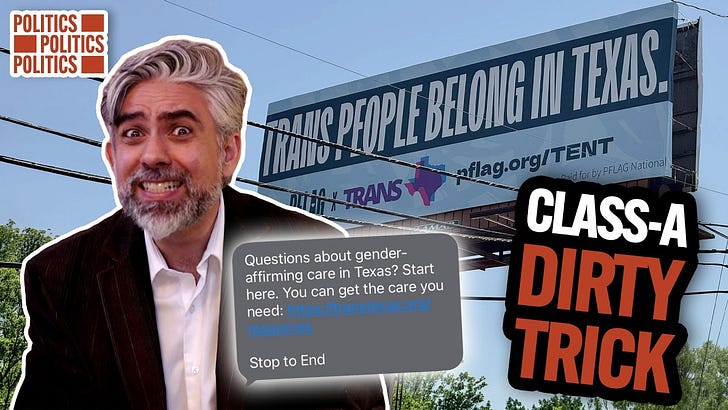
A Class-A Dirty Midterms Trick. The Story Behind ‘The Social Reckoning’ (with Karol Markowicz and Katie Harbath)
The episode connects a volatile Texas Senate race and national midterm fundamentals with the unresolved governance problems inherited from social media.
- 1Republican enthusiasm, factional conflict, and state-level voter math may matter more than individual candidate quality in 2026.
- 2Katie Harbath argues that digital campaigning changes constantly while persuasion, political incentives, and institutional responsibilities endure.
- 3The Social Reckoning captures Facebook’s scale and internal conflicts but compresses the messy realities of moderation, elections, and whistleblowing.
Don't miss
Katie Harbath explains how Facebook’s Brazil election war room exposed the difficulty of translating political language and applying global rules locally.
The brief
Justin and Carol Markowitz assess a difficult midterm landscape for the party in power, weighing Republican enthusiasm, factionalism, redistricting, and the limits of polling.
The Texas Senate race becomes a test of political fundamentals: Ken Paxton’s vulnerabilities, James Tallarico’s campaign, voter registration, and whether strong candidates can overcome state-level headwinds.
Katie Harbath brings a different lens, tracing digital politics from early online experiments through Facebook’s election work and the policy dilemmas created by global scale.
Her account of Brazil’s 2018 election shows why translation, moderation, and political advertising rules become harder when one platform operates across distinct cultures.
The film The Social Reckoning simplifies Facebook’s internal debates and whistleblower story, but the discussion uses those distortions to frame the harder governance questions now facing AI.
What was said on this episode
50 statements · 17 positive · 24 negative · 1 mixed · 8 neutral
Polls, projections, and prediction markets indicate a Democratic blue wave.
“Everything around us, all the crystal balls, all of the projections, all the polls, all the prediction markets say one thing. Azul. Blue wave.”
Listen at 1:20
Donald Trump is currently doing a great job as president.
“I think he's doing a great job.”
Listen at 13:55
The Trump administration solved the border problem very quickly.
“my big issue was the border. Top issue going into the last presidential election. It got solved overnight.”
Listen at 14:12
James Fishback lost his election by a very large margin.
“he lost in a gigantic landslide.”
Listen at 16:18
Nick Fuentes is a communist.
“I don't like that he is a communist.”
Listen at 17:12
Tucker Carlson supports Sharia law.
“Tucker Carlson going all in on I love Sharia law.”
Listen at 18:57
Tucker Carlson’s faction does not represent real Republican voters.
“I just I don't see this. in any part of the Republican Party in real life in any way.”
Listen at 19:24
Republicans will retain control of the Senate.
“I do think Republicans hold the Senate.”
Listen at 20:06
James Tallarico winning Texas remains unlikely.
“I still find that a stretch, even if Ken Paxton is not super popular.”
Listen at 20:19
Taking ten or eleven campaign days off is highly unusual for a Senate candidate.
“nobody takes, what, 11 days off, 10 days off from the campaign.”
Listen at 20:37
James Tallarico took ten days off while running for Senate in Texas.
“He's running for U.S. Senate in a state that he might win. And he took 10 days off.”
Listen at 21:25
James Tallarico’s flu explanation is not credible.
“I don't buy flu at all.”
Listen at 21:41
Kamala Harris struggles with friendly questions because she is rarely challenged.
“Kamala Harris being incapable of answering even friendly fire questions is because she's never challenged.”
Listen at 26:24
The Texas Senate race is close because Ken Paxton is a poor candidate and campaigner.
“The only reason why this is even close is because Ken Paxton is running. a legit, just bad campaign. He's a bad candidate running a bad campaign.”
Listen at 28:04
Bruce Blakeman is a serious Republican candidate.
“Bruce Blakeman, I think, is a real serious candidate.”
Listen at 29:23
The Republican candidate opposing Letitia James will likely lose badly.
“She's probably going to get absolutely destroyed.”
Listen at 30:19
Steve Hilton is running a more dynamic campaign than Xavier Becerra.
“Steve Hilton's running a much more dynamic campaign than Xavier Becerra”
Listen at 30:59
Steve Hilton has no realistic chance of winning California governor.
“Hilton has no shot.”
Listen at 31:11
Voter registration fundamentals are the primary battlefield in these campaigns.
“the voter reg is the voter reg. And ultimately, you fight these campaigns first on that battlefield”
Listen at 31:49
Candidates generally cannot overcome a large partisan voter-registration advantage.
“you just can't overcome that voter advantage.”
Listen at 32:15
Florida is more likely to elect a Democratic senator than governor.
“I believe that Florida would vote for a Democratic senator before a governor”
Listen at 33:20
Byron Donalds will win Florida’s Senate race comfortably.
“I think Byron Donalds runs away with it.”
Listen at 34:22
Scott Singer deserves to win his congressional race.
“I think Scott Singer deserves to win.”
Listen at 34:35
Republicans retain both chambers of Congress in this scenario.
“They hold the House. They hold the Senate.”
Listen at 35:59
Democrats win the House by fewer than fifteen seats in this scenario.
“the Democrats win the House, but it is under 15 seats.”
Listen at 36:35
Democrats narrowly win the House while Republicans retain the Senate.
“I think it'll be tight in the House, and I think Republicans keep the Senate.”
Listen at 39:00
Brandon Gill will eventually become governor or senator.
“He will eventually be governor or senator.”
Listen at 41:04
Ken Paxton is politically toxic.
“Ken Paxton is poison.”
Listen at 41:17
James Tallarico is unlikely to win the Texas Senate race.
“I don't think Tallarico is that guy.”
Listen at 42:25
Trump’s Latino support advantage has reversed to favor Democrats.
“the Trump-Latino connection lasted less than a year. It has now not only softened, it's flipped back to being a Democratic advantage.”
Listen at 44:33
Higher government spending increases inflation, especially under Democrats.
“It's spending that increases inflation and that happens more under Democrats.”
Listen at 45:36
Direct payments to people are highly effective at winning votes.
“sending people money is a very powerful vote getter.”
Listen at 45:48
Democratic policies raise gasoline prices through gas taxation.
“Democrats tax gas and they make the prices higher.”
Listen at 47:00
Voters do not trust Democrats on economic issues.
“Democrats are running on the economy. No one trusts Democrats on the economy.”
Listen at 48:02
Republicans have historically motivated voters through fear of losing.
“Republicans have always been like that.”
Listen at 49:34
Consumer AI adoption by most people will take considerable time.
“we have a long way to go for that to be adopted. by the vast majority of people”
Listen at 1:03:49
Change is the enduring feature of political communication.
“change has endured.”
Listen at 1:06:28
Political manipulation and exaggeration persist, now increasingly using AI-generated content.
“that has not changed. And so now we're just seeing it where campaigns and super PACs and others are now just using AI in which to create that content”
Listen at 1:07:20
Platforms should generally leave disputed content online rather than remove it.
“I would rather err on the side of leaving something up versus down.”
Listen at 1:19:42
Every major online platform will eventually face political issues.
“no platform can run away from politics because if you're irrelevant, politics will find you.”
Listen at 1:19:58
Platforms should proactively develop policies for political-content crises.
“Don't stick your head in the sand until it becomes a problem. Think about it proactively”
Listen at 1:20:21
AI developers cannot anticipate and mitigate every harmful use before release.
“there is not a world where we can have a bunch of smart people in the room think through every bad way somebody could use AI and mitigate that before we put it out to the masses.”
Listen at 1:23:50
AI companies need processes to address known and unknown risks as they emerge.
“you need to have a process in place for figuring out all three when they happen.”
Listen at 1:24:18
Facebook’s reshare weighting promoted more anger-provoking and emotional content.
“what ended up happening was that that did help to, you know, the stuff that people ended up wanting to share was stuff that made them more angry and made them more emotional”
Listen at 1:27:47
Katie Harbath still supports Facebook’s decision not to fact-check political ads.
“I still agree with that decision.”
Listen at 1:28:33
Good intentions and organizational scale do not ensure safe outcomes.
“good intentions are not safeguards and scale is not a strategy.”
Listen at 1:39:24
Good intentions do not guarantee decisions produce expected outcomes.
“you have to be willing and understanding that maybe still the decision you made didn't have the outcome that you expected it to have.”
Listen at 1:39:44
AI’s political effects should be analyzed over a three-year horizon.
“I'm really trying to think about this stuff in a three year arc right now”
Listen at 1:41:02
A major wave of global elections will occur in 2029.
“we will have in twenty twenty nine another big wave of global elections”
Listen at 1:41:25
AI will transform politics and elections substantially.
“the amount that AI is going to change everything.”
Listen at 1:41:34
Statements are attributed to the speaker as said on the episode and reflect their view at the time, not PodLume's. They are not advice.
Books & mentions
Some links are affiliate links — PodLume may earn a commission if you buy.
