Jul 19, 2026 · 1h 12m
Netflix tech chief warns AI requires stronger systems thinking and craft excellence
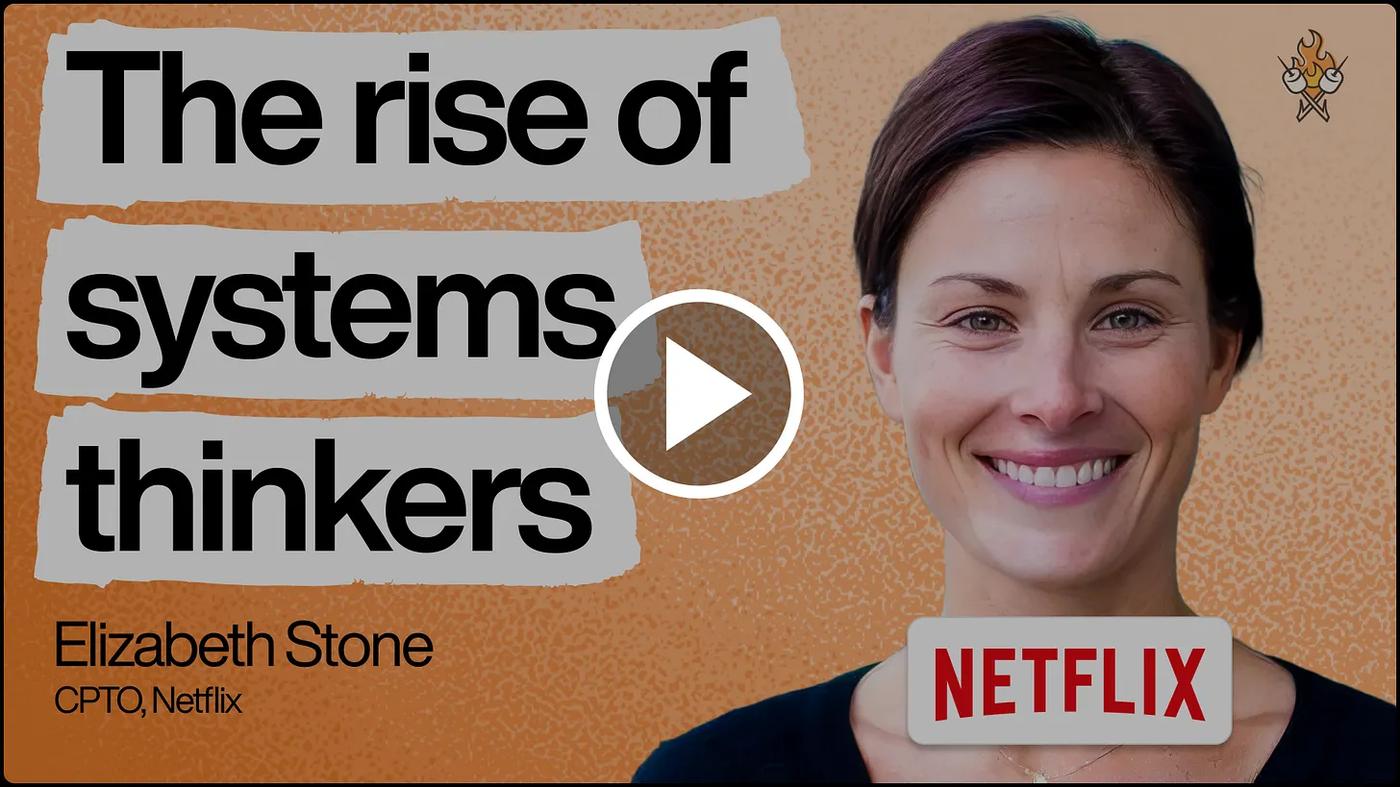
Netflix CPTO on AI and the future of product and tech roles | Elizabeth Stone
As AI automates routine software development, tech professionals must evolve from simple execution to complex systems thinking to remain competitive.
- 1Generative AI is blurring functional roles, allowing non-engineers to prototype further while demanding stronger problem-solving skills.
- 2Specialized craft excellence and systems thinking are increasingly scarce and critical as platform leverage becomes essential.
- 3Netflix maintains its high talent density through the Keeper's Test and resists adding rigid processes when mistakes happen.
Don't miss
Elizabeth Stone explains how Netflix uses the Keeper's Test as a tool for positive feedback and high agency rather than just hard decisions.
The brief
Netflix tech chief Elizabeth Stone argues that generative AI is pushing product development into a chaotic storming phase, where traditional boundaries between engineers, designers, and product managers are rapidly dissolving.
While AI enables non-engineers to build advanced prototypes, Stone warns that true craft excellence and deep systems thinking remain incredibly rare, highly valuable, and impossible for automated code generators to replace.
For Netflix, leveraging machine learning is not a new trend but a core part of its personalization history. The company relies on its famous culture of high talent density and the Keeper's Test to navigate this technological shift.
Even as AI automates routine coding tasks, understanding underlying computer systems and mastering human-centric storytelling will remain the ultimate differentiators for building products that truly resonate.
What was said on this episode
35 statements · 24 positive · 5 negative · 2 mixed · 4 neutral
Generative AI is currently creating organizational role confusion at Netflix.
“we are in the middle of that right now”
Listen at 4:00
Organizations should continue using AI despite disruption to established roles.
“I don't think that means we should put AI back into the box and say, let's not use it”
Listen at 4:03
AI access does not mean everyone should ship production code or perform every function.
“Do I believe that means anyone should be shipping code to production? That everyone should actually be doing everything? Probably not”
Listen at 4:32
Employees should explore AI capabilities through experimentation.
“it's good for people to be exploring what's possible”
Listen at 4:42
AI will not make functional expertise obsolete.
“I don't think it makes the functional expertise obsolete”
Listen at 5:13
Humans remain accountable for outcomes produced with AI assistance.
“the importance of reiterating that humans are still responsible for what happens”
Listen at 5:57
AI lets PMs, designers, and data scientists progress farther before engineering involvement.
“PMs, designers, data scientists are able to get farther in the product development life cycle before engineering really needs to be front of the line”
Listen at 8:19
AI can analyze broad information sets and distill them into useful insights.
“AI is very powerful at distilling information, looking across a broad set of things, doing an analysis around it”
Listen at 9:53
AI-generated analysis is useful as a starting point but should not be used exclusively.
“I would hesitate to rely on that Exclusively. But I think it's a head start”
Listen at 10:04
Professional disciplines retain distinct comparative strengths despite AI-enabled fluidity.
“I still see comparative strengths”
Listen at 11:16
Craft excellence in professional disciplines will remain important for the foreseeable future.
“I still see a craft excellence that's really important in the disciplines that I don't think is going away anytime soon”
Listen at 12:26
High-quality engineering, data science, and creativity remain scarce.
“I still find great engineering to be scarce, great data science to be scarce, great creativity to be scarce”
Listen at 13:14
AI-era organizations need more systems thinkers.
“We need more systems thinkers in a world with AI”
Listen at 13:52
Organizations cannot scale AI work by relying on each builder to discover standards independently.
“I don't think it scales well to have each person who's building something have to go figure out, could you remind me what good looks like here and what are the bumpers or guardrails I should keep in mind”
Listen at 18:35
Organizations should encode quality, security, and data guidance into standard workflows.
“I think we need to encode that in our paved paths and our ways of working”
Listen at 18:45
Netflix expects many AI agents to contribute to organizational work.
“we will have so many agents that are contributing to doing work”
Listen at 19:41
Future Netflix work will be performed jointly by humans and AI agents.
“the work will be done by both humans and agents”
Listen at 19:59
Faster coding will not eliminate the need for deep design expertise.
“it would be a mistake to say design and deep design expertise and thinking gets squeezed out”
Listen at 21:32
Netflix will favor fewer narrow specialists and more adaptable generalists.
“we have fewer specialists and more people who are generalists or adaptable in multiple directions”
Listen at 23:07
Netflix should expect AI fluency across roles rather than define it by level.
“The most useful thing is not to make it level specific or role specific, but to encourage everyone towards the expectation on AI fluency”
Listen at 29:57
AI and machine learning have long been central to Netflix personalization.
“this is not new to us”
Listen at 35:59
Netflix personalization becomes more important as its entertainment catalog broadens.
“Personalization becomes even more important”
Listen at 36:36
High talent density is essential to Netflix's operating model.
“The talent density is the non negotiable”
Listen at 41:51
Netflix prioritizes rapid recovery over avoiding all failures.
“We don't try to avoid failures, we try to recover quickly when we have them”
Listen at 42:12
Adding process to difficult planning problems can increase effort without improving outcomes.
“every time we saw that and we added more process, we spent more time without getting better outcomes”
Listen at 44:51
Trusting employees to learn from failures improves long-term outcomes.
“When you are trusting people to take those reflections and learn and grow, I think you get much better outcomes over time”
Listen at 46:19
Netflix continues hiring junior employees as an important talent strategy.
“We are still hiring junior people and they're really important to our talent strategy”
Listen at 53:39
AI does not reduce the importance of professional craft mastery.
“mastery of the craft is still very important”
Listen at 55:02
Understanding software systems will remain necessary even if AI writes code.
“understanding how code computer systems, products work. And I don't think the latter is going away”
Listen at 56:50
Engineering will evolve toward fluency with AI-generated code and agents.
“engineering, over time will evolve to be comfortable with that and have fluency in it”
Listen at 58:35
Entertainment will expand beyond a single format or medium.
“the future of entertainment isn't going to be one thing”
Listen at 1:01:46
Future entertainment will become more personalized, immersive, and interactive.
“it's going to have to be more personalized, more. More immersive, more interactive”
Listen at 1:01:48
Netflix should let creators choose tools for realizing their creative visions.
“Netflix's role in this is to enable creators with whatever tools they want to use to bring their vision to life”
Listen at 1:02:37
Human involvement will remain central to entertainment.
“I have a hard time picturing entertainment that doesn't have humans at the heart of it”
Listen at 1:04:09
Entertainment product and technology are currently in a high-velocity innovation period.
“we're at this unbelievable high velocity innovation period”
Listen at 1:06:40
Statements are attributed to the speaker as said on the episode and reflect their view at the time, not PodLume's. They are not advice.
Books & mentions
Lenny's Podcast
To hear more deep dives with top product and technology leaders on scaling organizations