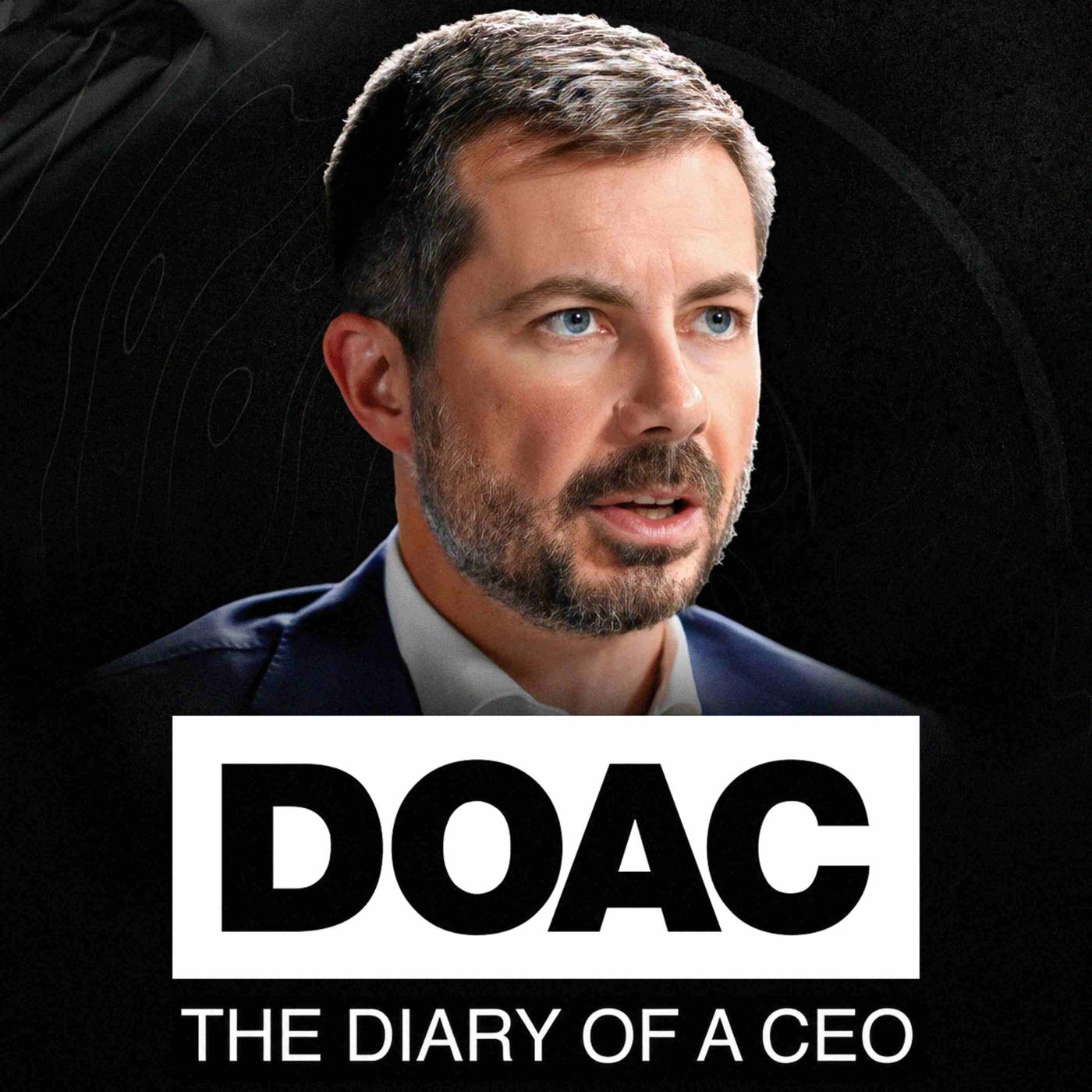
Aug 3, 2026 · 1h 55m
Pete Buttigieg warns systemic failures threaten the future of American democracy
Secretary Pete Buttigieg: The American Dream Is DEAD. We're Running Out Of Time To Fix It!
As political polarization and economic inequality deepen, one of the Democratic Party's key voices outlines the structural changes needed to restore faith in American institutions.
- 1Decades of economic stagnation and tax inequality have left voters disillusioned, fueling the appeal of populist political movements.
Don't miss
Pete Buttigieg reflects on the pivotal debate and the high-stakes decision to swap Joe Biden for Kamala Harris on the 2024 ticket.
The brief
Former US Secretary of Transportation Pete Buttigieg joins Steven Bartlett to dissect the systemic challenges threatening American democracy, from rising wealth inequality and a looming national debt crisis to the disruptive potential of artificial intelligence.
Buttigieg argues that the American Dream is on the brink of collapse due to decades of structural failure, explaining why Donald Trump's anti-bureaucratic message resonates with voters who feel completely left behind by the current political system.
Drawing on his military service, Buttigieg critiques the lack of a clear strategy in the Middle East and evaluates the rise of AI, warning that without deliberate policy intervention, automation will drastically concentrate wealth rather than ease human labor.
The conversation turns highly candid as Buttigieg reflects on the 2024 Democratic ticket swap, the visible toll of the presidency on Joe Biden, and the necessity of radical reforms like abolishing the Electoral College and restructuring the Supreme Court.
Beyond policy, Buttigieg shares the personal weight of his public life, detailing his journey of coming out to his parents in his twenties and navigating the loss of his father just as his historic 2020 presidential campaign was launching.
What was said on this episode
50 statements · 25 positive · 19 negative · 5 mixed · 1 neutral
The United States is close to losing its democracy.
“we're on the brink of losing our democracy, and we're running out of time to do something about it.”
Listen at 0:27
American democracy can survive if necessary reforms are implemented.
“I think it will. I believe it will if we do what we have to do.”
Listen at 3:12
The American Dream formerly occurred for nine in ten Americans.
“Economically, that used to happen for nine out of 10Americans.”
Listen at 3:59
Denmark currently offers the highest likelihood of achieving the American Dream.
“the place where you're most likely to live out the American dream right now is Denmark.”
Listen at 4:04
The United States tax system taxes labor more heavily than wealth.
“they tax work more than they tax wealth.”
Listen at 4:47
Extreme economic and political inequality destabilizes society.
“when inequality reaches a certain level and when the inequality of power follows the economic inequality to a certain level, that's when I think you start to have earthquakes in the society”
Listen at 4:59
U.S. inflation is currently higher than when Trump assumed office.
“right now, inflation's higher than it was the day he took over.”
Listen at 6:30
Democrats should offer policies better than both current and previous conditions.
“Democrats have a responsibility to present something that is better. Not just better than now, but it's gotta be better than before.”
Listen at 7:57
The president lacks a clear plan for the Iran war.
“the president doesn't seem to have a plan. He can't explain why we're there.”
Listen at 13:25
The Iran war has increased prices and caused troop deaths.
“Prices are higher, troops have lost their lives”
Listen at 13:58
Ending a war is more difficult than initiating one.
“it is harder to stop a war than it is to start one.”
Listen at 15:32
Countries will need international mechanisms to prevent AI-enabled bioweapons.
“There's going to have to be some way for countries that do not trust each other today to coordinate on things like making sure AI doesn't lead to bioweapons being made by rogue actors”
Listen at 16:48
The next president will face the most challenging security environment since the Cold War.
“The security picture, I think, will be more challenging for the next President than it's been for any President since the Cold War.”
Listen at 17:10
Future presidents must exercise wise, unbiased judgment free from corruption.
“we're going to need wisdom, we're going to need judgment, and we're going to need judgment that is not twisted or changed or colored or biased based on corrupt reasons.”
Listen at 17:50
The United States should avoid entering wars whenever reasonable alternatives exist.
“The only good way to do it is to not be there in the first place.”
Listen at 19:02
Iran now has greater motivation but less capacity to develop nuclear weapons.
“they may have less capacity, but they certainly have more motivation at this point.”
Listen at 21:56
Iran should not be permitted to acquire nuclear weapons.
“No, they should not be allowed to have nuclear weapons.”
Listen at 22:02
Diplomacy is the best way to prevent Iran from acquiring nuclear weapons.
“The best way to do that was through diplomacy.”
Listen at 22:29
Netanyahu’s actions suggest support for a Greater Israel beyond current borders.
“it is hard to believe that he is comfortable with anything less.”
Listen at 26:37
Trump’s policies are broadly destructive.
“most of his policies are terribly destructive.”
Listen at 33:26
Government leaders should adopt some of Trump’s bias toward action.
“I think we could learn a bit from that.”
Listen at 33:38
Political leaders should acknowledge limits and rely on more knowledgeable advisers.
“politics requires you to be a little bit humble about how much you don't know and surround yourself by people who are smarter than you”
Listen at 35:07
AI could produce shorter workweeks and higher incomes or greater wealth concentration.
“Either we're looking at a future where because of AI, we have a shorter work week and more money in our pocket, or we're looking at a future where there is even more extreme concentration of wealth and power in this country than we've already got.”
Listen at 37:30
AI’s social outcomes will depend primarily on policy choices, not technology itself.
“which of those things happen. It's actually not something that's in the technology. It's not a tech question, it's a policy choice.”
Listen at 37:48
AI may disrupt workers’ identities as well as their employment.
“there is a generation of workers who are about to have their identity, not just their job, their identity disrupted.”
Listen at 39:46
Automation will increasingly shift economic importance toward ownership of AI and robotics.
“more and more is going to depend on who actually owns the machine.”
Listen at 42:42
A public dividend from AI-created value could be appropriate.
“some version of a dividend makes sense.”
Listen at 43:07
Redistributing AI-generated value could create shorter workweeks and higher incomes.
“You do that, we really could have a shorter work week and more money in our pocket.”
Listen at 43:41
The public should receive a share of AI companies’ profits or ownership.
“I do think a public share of the profits, which could mean a public share of the ownership, can make sense.”
Listen at 46:43
Higher taxes on very wealthy people are justified.
“Higher taxes for very wealthy people is an idea that is broadly popular. I think it's the right thing to do.”
Listen at 52:01
A wealth tax could appropriately form part of the tax system.
“wealth tax, which is a property tax by another name, can be part of the menu of taxes.”
Listen at 53:27
The U.S. tax system generally taxes billionaires at lower effective rates than millionaires.
“We, even in percentage terms, generally tax billionaires less than we tax millionaires”
Listen at 54:06
Higher capital-gains and corporate taxes could produce a fairer country.
“if we had a more reasonable rate of taxation on capital gains and on corporate income, and if we Made it harder to pass along wealth”
Listen at 56:29
U.S. wealth should make universal healthcare and strong public services affordable.
“This is the wealthiest economy in the world. It just doesn't add up that we can't have nice things.”
Listen at 57:16
Rising U.S. debt could trigger a currency crisis or major tax-code changes.
“It could be a cause of a currency crisis or force us to redo our whole tax code within the next few years.”
Listen at 59:00
Unsustainable U.S. debt and politics will lead to reform or catastrophe.
“I believe one of two things can happen, reform or catastrophe.”
Listen at 59:48
The U.S. should elect presidents by nationwide popular vote.
“Should we not be a country where everybody's vote counts the same? That would mean a popular vote for the President's. We ought to do that.”
Listen at 1:04:46
The United States should ban partisan gerrymandering.
“ban gerrymandering”
Listen at 1:05:06
Kamala Harris would be a good president.
“I thought she'd be a very good president.”
Listen at 1:15:41
Gavin Newsom understands how to communicate effectively in the modern attention environment.
“he understands how to break through in this kind of attention world that we're in”
Listen at 1:15:56
A competitive selection process would likely have improved Harris’s candidacy.
“I think that even if the candidate had still been Kamala Harris, I think she likely would have been a better candidate.”
Listen at 1:19:52
The Electoral College should be abolished and the Supreme Court reformed.
“Electoral College, for sure. Supreme Court needs to change.”
Listen at 1:21:44
The Supreme Court should have term limits, more justices, and less partisan selection.
“I would have term limits, more justices, and some process that makes it less partisan who the justices are.”
Listen at 1:21:50
A constitutional amendment should remove corporate political spending’s speech protections.
“We need to clarify that corporate spending is not speech and corporations are not citizens people in the same way that a human being is.”
Listen at 1:22:59
Corporate dark money in super PACs should be legally restricted.
“you can't put unlimited unaccountable corporate dark money into a super PAC to manipulate how an election's going to go.”
Listen at 1:23:25
DOGE was a failure as a government-efficiency effort.
“the failure of Doge”
Listen at 1:26:59
U.S. federal spending was higher after DOGE than before it.
“leaving a federal government that actually spent more after Doge than before.”
Listen at 1:27:45
Economic advancement is less common in America than abroad and historically.
“it happens less in America than in certain other countries and it happens less in America than it used to in America.”
Listen at 1:32:39
The United States should provide paid family leave and support caregiving.
“Make sure that we make it easier to have a family. Things like paid family leave”
Listen at 1:36:18
America’s current problems can change, but only through deliberate collective action.
“it doesn't have to be like this, but it's not going to change on its own.”
Listen at 1:52:27
Statements are attributed to the speaker as said on the episode and reflect their view at the time, not PodLume's. They are not advice.