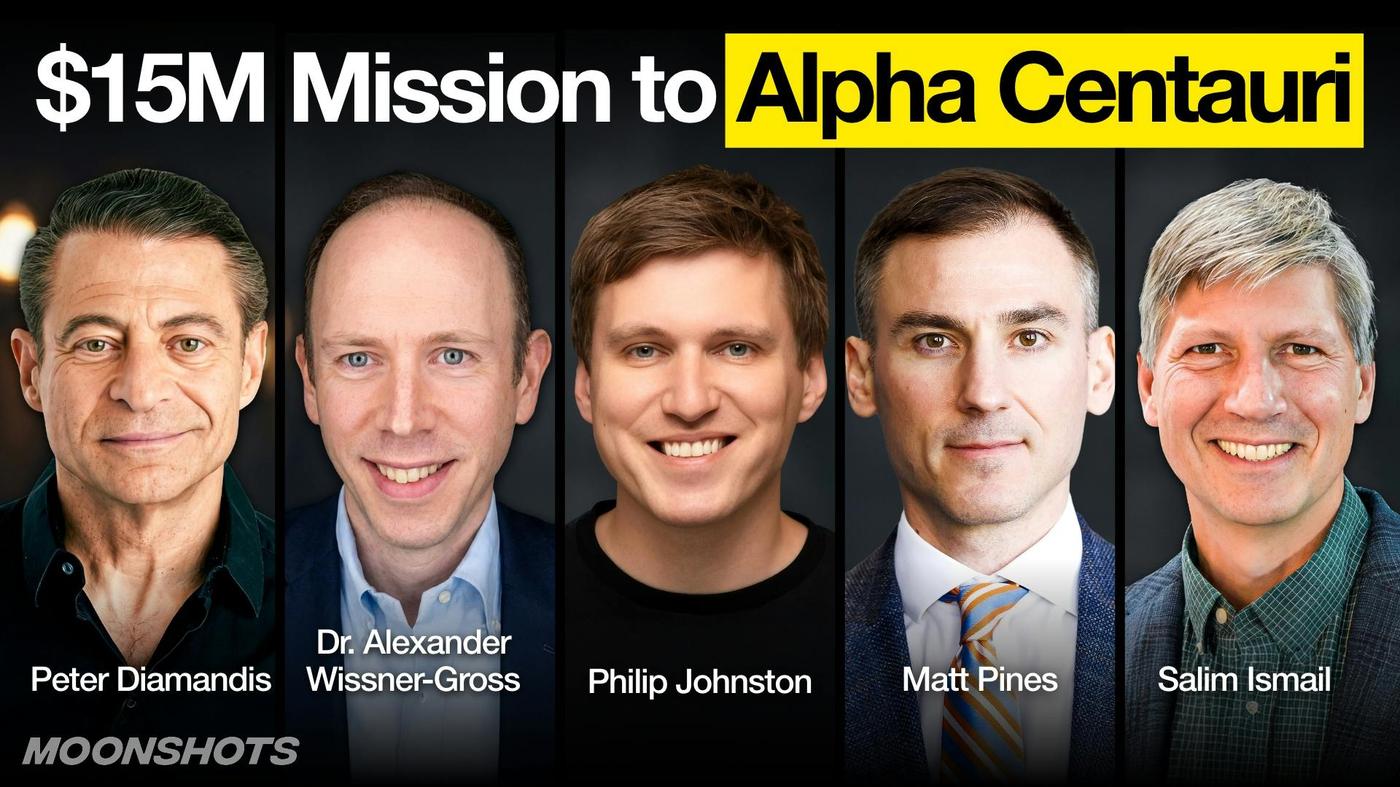
Sep 2, 2026 · 1h 57m
Private interstellar mission targets Alpha Centauri as AI designs its own chips
Humanity's First Star Probe, Architect Labs Beats NVIDIA 3.4x, Musk Wants Satellites to Cool Earth | EP #285
This episode outlines a critical convergence where autonomous AI is no longer just writing software, but actively engineering interstellar space missions and designing its own physical hardware.
- 1The Fermi Explorer mission plans to use xenon-based ion thrusters and AI-designed flight paths to reach Alpha Centauri.
- 2Architect Labs has developed Redwood, the first fully AI-designed computer chip, threatening Nvidia's hardware dominance.
- 3Massive AI compute demands are driving tech leaders to propose dedicated power grids and large-scale planetary geoengineering.
Don't miss
The detailed breakdown of how Physical Superintelligence used autonomous AI models to calculate the complex flight trajectory for the Fermi Explorer probe.
The brief
The race for deep space is moving from sci-fi to reality as Philip Johnston and Matt Pines unveil the Fermi Explorer, a private initiative aiming to launch humanity's first interstellar probe to the Alpha Centauri star system.
By leveraging xenon-based ion thrusters and flight paths designed by Physical Superintelligence, the mission bypasses traditional state-backed space agencies, signalizing a new era of highly automated, commercialized deep-space exploration.
Back on Earth, hardware limits are being shattered by Architect Labs' new Redwood chip, a fully AI-designed processor that challenges Nvidia's market dominance by utilizing recursive self-improvement to optimize silicon architecture.
To power these massive AI models, tech giants are eyeing drastic measures, from Elon Musk's massive solar and gas grid proposals to controversial geoengineering projects designed to manage the planet's climate.
What was said on this episode
30 statements · 26 positive · 2 negative · 2 neutral
Fermi Explorer will reach at least 99% of Alpha Centauri within 80,000 years.
“we want it to get at least 99% of the way to Alpha Centauri within the next 80,000 years”
Listen at 9:21
Fermi Explorer will launch within three years.
“we want to launch within 3 years”
Listen at 9:32
Fermi Explorer’s design, construction, and launch should cost under $15 million.
“it must cost less than $15 million to design, build, and launch”
Listen at 9:40
Physical Superintelligence designed the mission trajectory with almost no human intervention.
“it was entirely hands-off”
Listen at 13:53
Physical Superintelligence produced an optimal mission trajectory.
“it came up with the optimal mission trajectory”
Listen at 13:56
A colony will exist at Alpha Centauri for 15,000 years before Fermi Explorer arrives.
“by the time we arrive, for 15,000 years, there will already have been a colony at Alpha Centauri”
Listen at 14:46
Humanity will develop faster propulsion technology within five to ten years.
“we'll have that in 5 to 10 years”
Listen at 15:41
Fermi Explorer will launch in three years and reach Alpha Centauri.
“This thing is going to launch in 3 years and it is going to get to Alpha Centauri.”
Listen at 18:26
Low-cost interstellar missions will have a latent commercial market among governments and organizations.
“there's probably a latent commercial market for everyone, every small government, every organization that wants to start throwing probes out into deep space”
Listen at 25:45
Every nation-state can now afford an interstellar probe at Fermi Explorer’s price point.
“every single nation state, I would argue, can afford to send now at this price point”
Listen at 26:27
AI enables multiple-orders-of-magnitude speedups in mission planning.
“there's now multiple orders of magnitude speedup possible for these sorts of mission planning”
Listen at 28:39
Fermi Explorer will be humanity’s first successful interstellar mission.
“my expectation is it will be the first successful interstellar mission”
Listen at 33:12
AI will solve interstellar travel, enabling humanity to spread among the stars.
“AI will solve interstellar travel and humanity will spread to the stars”
Listen at 35:18
Elon could white-label Claude from Anthropic as a future Grok model.
“could Elon turn around tomorrow and strike a deal with Anthropic, which now seems to need him to some extent for data center infra capability, and white label a version of Claude and call that Grok 10? I think he could.”
Listen at 43:24
Grok has not yet demonstrated the ability to produce a strong foundation model.
“the evidence so far is that it's not happening at Grok”
Listen at 44:15
Elon Musk responds to dependencies by vertically integrating across the entire technology stack.
“He vertically integrates across the entire stack.”
Listen at 44:44
Astra will substantially improve AI agents’ ability to preserve context over long tasks.
“my bet is it brings some much better way to solve the problem of losing context”
Listen at 50:39
Outcome-based AI pricing will unlock opportunities excluded by token-based pricing.
“I think outcome-based pricing will actually unlock a lot of, a lot of opportunity that might otherwise not fit the price model”
Listen at 55:20
Architect Labs’ Redwood chip was AI-designed in two weeks with zero first-silicon bugs and 3.4× Jetson efficiency.
“a chip designed entirely by AI in 2 weeks, zero bugs on first silicon, and 3.4 times the performance per watt of Nvidia's Jetson”
Listen at 1:04:08
Recursive self-improvement will ultimately extend to the chip-design layer.
“It ends with the recursive self-improvement at the chip layer.”
Listen at 1:06:01
AI-designed chips pose an extraordinary threat to Nvidia.
“Is this an incredible threat to Nvidia? Yeah, absolutely.”
Listen at 1:08:32
AI-specific chip and microcode design could unlock roughly million-fold performance gains.
“you're unlocking probably, you know, 7 layers of factor of 10 inefficiency that are all compounding, get unleashed. So, you know, a million X kind of performance gains everywhere.”
Listen at 1:09:39
Elon Musk will become a dominant figure in liquid natural gas and fossil fuels.
“my prediction here, I'll preregister it, is that Elon ironically becomes the king of liquid natural gas and fossil fuels in general”
Listen at 1:23:03
AI weather models and orbital actuators will enable global weather engineering.
“that's a recipe for global weather engineering. And I think we're going to get it.”
Listen at 1:28:21
Satellites can begin controlling Earth’s temperature.
“we can easily start controlling Earth's temperature through satellites”
Listen at 1:29:57
Nuclear propulsion could reduce Mars transit time from seven months to one or two months.
“getting us to Mars instead of in 7 months, getting us there in 1 or 2 months”
Listen at 1:39:41
Cheap reusable launch and AI design will drive rapid expansion of space operations.
“the explosion of things operating in space is going to come from that double whammy of concurrently we can get out of the gravity well cheaply and we have AI as a design tool”
Listen at 1:41:28
AI knowledge capacity will expand toward effectively unlimited levels.
“It's, it's very likely that it can expand to infinity or near infinity or levels we can't even comprehend very quickly from where we are right now.”
Listen at 1:50:14
Planetary AI models could enable trading precipitation between distant regions.
“I think that is possible with a suitable weather control system and good enough planetary-scale AI models”
Listen at 1:52:09
Autonomous vehicles will require verifiable identifiers and likely emergency off switches.
“every one of these autonomous vehicles is going to be needing, for regulatory purposes as well as insurance purposes, needing to have an identifier and probably an off switch as well”
Listen at 1:52:36
Statements are attributed to the speaker as said on the episode and reflect their view at the time, not PodLume's. They are not advice.
Books & mentions
The Superintelligence Podcast
To dive deeper into the hardware and software engineering behind recursive self-improvement.