Sep 30, 2026 · 1h 3m
SAP CEO defends enterprise software’s moat in the AI era
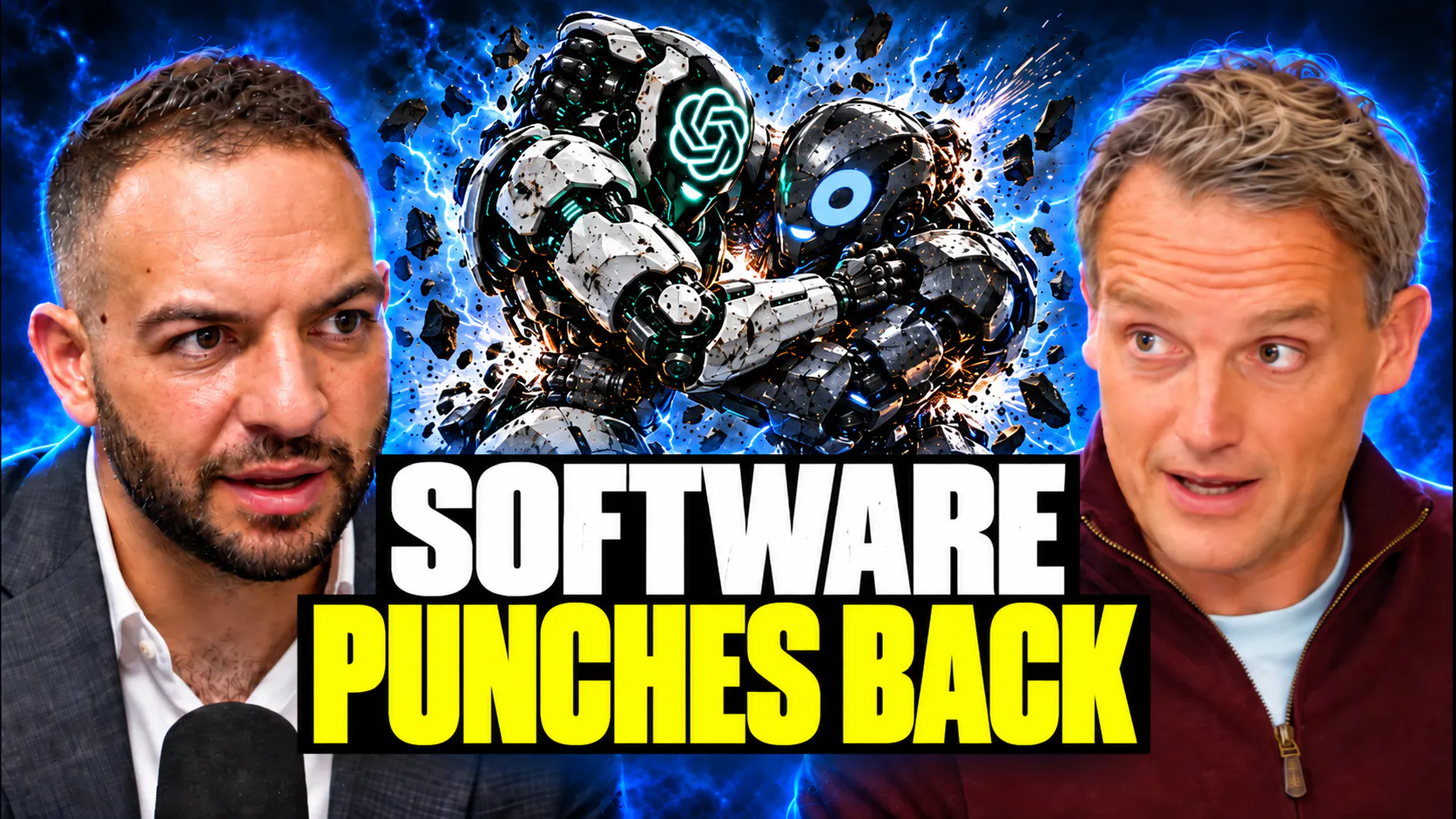
SAP CEO: AI Won't Kill Software, But It Will Change Your Job — With Christian Klein
As AI agents take on more consequential business work, the episode examines whether trusted data, governance, and domain expertise can keep enterprise platforms indispensable.
- 1Enterprise AI depends on clean, contextualized data and governed access, not model capability alone.
- 2Automation may remove administrative work while forcing software companies to reskill employees for more inventive roles.
- 3SAP argues its accumulated business processes and domain knowledge are harder to recreate than its software code.
Don't miss
Christian Klein explains why SAP’s decades of business processes and domain knowledge may be a stronger moat than the code itself.
The brief
Alex hosts SAP CEO Christian Klein on the shift from cloud transformation to AI, asking whether enterprise software can meet the accuracy demands of finance and planning.
Klein argues that useful enterprise AI requires clean data, business semantics, and governance; better models alone cannot resolve fragmented information or missing context.
The conversation turns to work: automation could remove controls, compliance checks, and preparation tasks, but employees will face restructuring and a need to reskill.
Klein rejects the idea that AI can easily reproduce SAP by generating code, pointing instead to decades of business processes, functionality, and domain expertise.
SAP’s strategy combines Joule, multiple model partners, governed gateways, and smaller models that can deliver adequate performance at lower cost for many business tasks.
The episode closes on token budgets, cybersecurity, and European regulation, revealing that enterprise AI’s hardest problems may be economic and institutional as much as technical.
What was said on this episode
46 statements · 30 positive · 9 negative · 1 mixed · 6 neutral
AI will reach trustworthy business-operation capability within months
“this is more a question of now months until we are really reaching a level where you can really trust AI running your business”
Listen at 6:01
“I would say that's absolutely possible. Yeah. So it's for certain tasks”
Listen at 6:38
SAP may reach supply-chain optimization capability in eight to nine months.
“here we are maybe there in 8 to 9 months.”
Listen at 6:47
AI will automate matching data across enterprise systems
“AI will help us to match data from an SAP to a Salesforce system, from a Workday system to an SAP system”
Listen at 10:13
AI will automate data matching and cleanup across enterprise systems.
“all of this work will also get automated because AI is very good in matching those data points together.”
Listen at 10:41
AI is increasing business execution speed
“The speed of execution is definitely getting faster.”
Listen at 11:34
AI is shortening business planning cycles.
“speed of execution getting much faster, planning cycles getting shorter”
Listen at 12:43
AI is shortening corporate planning cycles
“planning cycles getting shorter”
Listen at 12:45
AI will dramatically change many jobs
“many jobs will change really dramatically”
Listen at 13:52
AI will dramatically change many jobs.
“many jobs will change really dramatically.”
Listen at 13:52
AI agents will automate finance and HR controls and compliance checks
“The controls, the compliance checks, everything.”
Listen at 14:05
AI agents will automate finance and HR controls and compliance checks.
“The controls, the compliance checks, everything. Yeah. So also the typical stuff, yeah, what many people are doing in their business life.”
Listen at 14:05
AI-driven work will not necessarily become more boring or exhausting.
“will it get more boring or more exhausting? I mean, I don't believe so.”
Listen at 16:48
AI users prefer removing workflow approvals and compliance tasks to focus on higher-value work.
“They are all happy if, okay, let's get rid of all of these workflow approvals. Let's get rid of all these compliance checks and controls, and then let me focus on the stuff what really matters.”
Listen at 17:08
AI increases employee productivity at SAP
“AI helps them to get more productive”
Listen at 17:56
SAP will have a different job-profile mix within 12 months
“in 12 months from now, there will be a mix, a different mix of job profiles. We will need other jobs.”
Listen at 18:55
SAP will need fewer people in some workforce roles
“but we will need less people”
Listen at 19:07
SAP will need fewer people in some workforce roles.
“we will need less people”
Listen at 19:08
80,000 SAP employees use Joule Work
“80,000 people are using it”
Listen at 20:50
Training employees to use Joule Work enables faster work and higher-value tasks.
“once you train the people, you coach the people, and you see, hey, you can get stuff done faster and you can focus on higher value-adding tasks”
Listen at 21:08
Most enterprise software cannot be easily recreated through vibe coding
“the rest, I mean, definitely, you know, you need to have a lot of domain knowledge. It's definitely not easily, you can definitely not easily white code it.”
Listen at 26:56
An LLM alone cannot reliably run warehouses or perform financial closes
“If you just use an LLM alone, there's no way that you can run a warehouse with it, that you can do a financial close with it”
Listen at 28:42
Enterprise AI agents require process context, data context, and governance.
“they need the process context, the data context, and the governance.”
Listen at 29:15
No single AI model currently solves all enterprise problems.
“there is a healthy competition also going on. And we are not seeing this one model who solves all of the problems.”
Listen at 36:51
Third-party agents will access SAP through governed gateways
“there will be definitely also third-party agents accessing SAP”
Listen at 38:56
Third-party AI agents accessing SAP must be controlled.
“it needs to be controlled.”
Listen at 39:09
Third-party AI access to SAP must be controlled
“it needs to be controlled”
Listen at 39:09
SAP supports both native and third-party agent access
“Actually, we offer both.”
Listen at 40:52
SAP supports both Joule Work and third-party API access.
“we offer both.”
Listen at 40:53
Most SAP users will access AI through Joule Work
“the main route will go via Joule Work”
Listen at 42:09
Most SAP users will access SAP capabilities through Joule Work.
“the main route will go via Joule Work.”
Listen at 42:09
SAP will switch agents to cheaper open-source models when performance is sufficient
“some of the open source models perform so good that it— and then compare it to the cost of those models, we are going to switch”
Listen at 45:45
SAP’s Tableau AI matched ten data scientists’ prediction accuracy
“the Tableau AI model actually did it with the same accuracy for the customer than what a team of 10 data scientists did before”
Listen at 47:51
Frontier AI providers must keep innovating to justify premium prices
“The only way is keep on innovating to justify the price.”
Listen at 49:07
SAP will not ship agents below 95% accuracy for critical use cases
“We have a rule, 95% or better, otherwise it's not worth to ship the agent.”
Listen at 50:05
SAP introduced token limits for certain employee roles
“we really saw, oh my God, now the token spend is really coming to a point where we definitely need to set certain limits for certain jobs”
Listen at 52:21
SAP can adapt its APIs and MCP servers to new models quickly
“we can do this very fast”
Listen at 56:21
SAP can test and integrate new AI models within weeks.
“we can do this very fast. And so it doesn't take a long time to really test out a new model”
Listen at 56:21
SAP is testing agent swarms and multi-agent collaboration
“We are doing this”
Listen at 56:36
SAP is testing agent swarms and agent-to-agent business use cases.
“We are doing this and When we are building all of these A2A use cases, I mean, obviously, yeah, we need to test it.”
Listen at 56:36
SAP is using AI to detect vulnerabilities, test defenses, and improve patching.
“how can we use AI to detect vulnerabilities earlier? How can we put more proactive measures in play to test the firewalls of the company and the product? What do we do on patching the system and so on?”
Listen at 57:22
SAP is using AI to detect cybersecurity vulnerabilities earlier
“how can we use AI to detect vulnerabilities earlier?”
Listen at 57:22
European regulators should regulate AI outcomes rather than technology itself
“you should regulate more the business outcome, the impact on a society, and not the technology per se”
Listen at 59:35
European AI regulation will be rolled back
“I'm confident”
Listen at 1:00:42
European technology regulation will be rolled back.
“I'm confident.”
Listen at 1:00:42
Europe’s AI and data regulations create overlapping regulatory layers.
“these all of these layers of regulations”
Listen at 1:01:52
Statements are attributed to the speaker as said on the episode and reflect their view at the time, not PodLume's. They are not advice.
Weekly email
State of the Pod, every Monday
The week's most-discussed names and stories from podcasts, with the moments behind them. Free, five minutes, unsubscribe in one click.