Oct 10, 2026 · 1h 58m
Listen from 1:56:17
Listen at 1:56:17
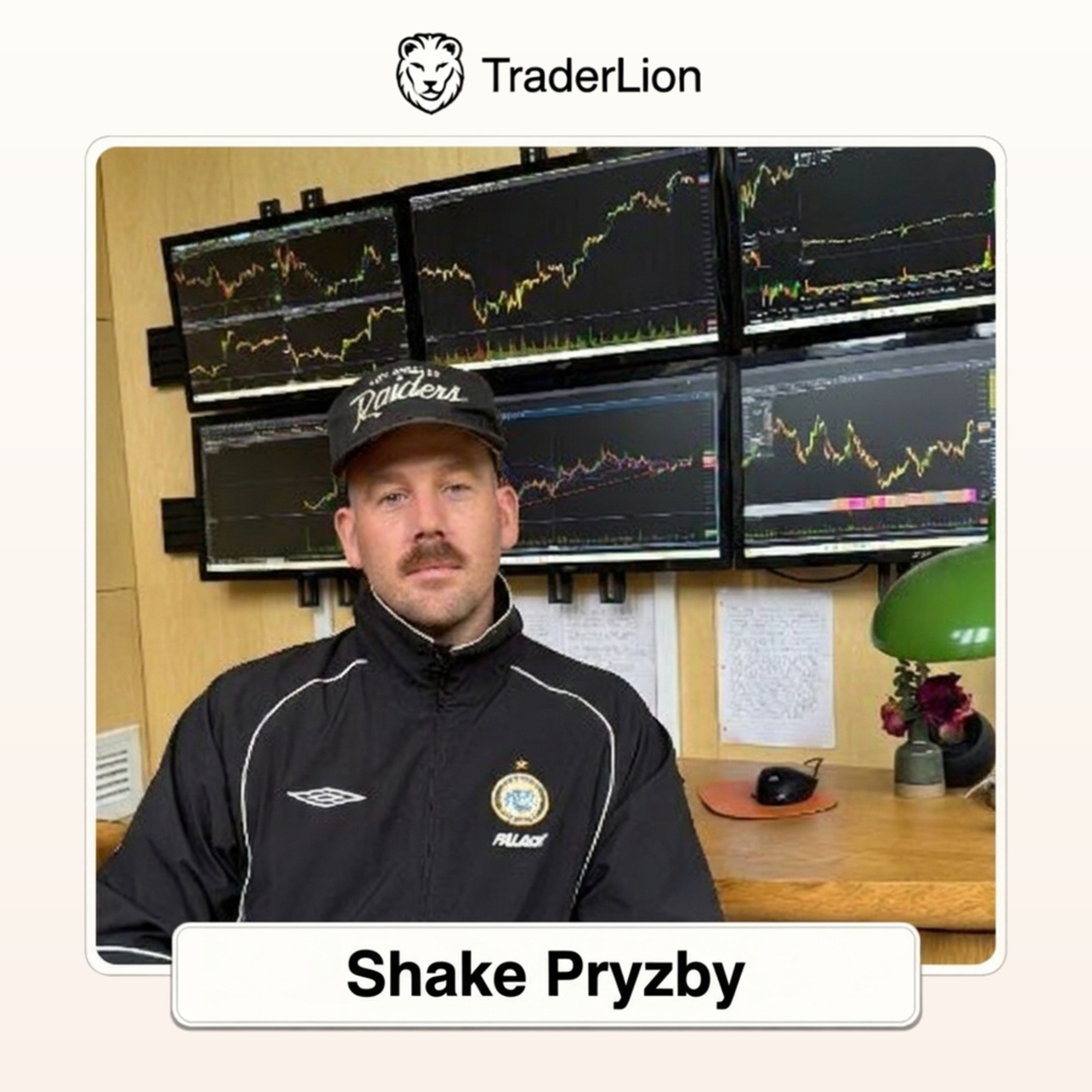
Shake Pryzby sizes risk by market regime
The Dynamic Sizing Strategy of a Top Swing Trader | Shake Pryzby
The episode presents a practical framework for deciding when to stay defensive, when to build exposure, and how to press winners without surrendering discipline.
- 1Pryzby adjusts exposure from cash to leverage according to market conditions, opportunity quality, and portfolio heat.
- 2He combines weekly breakouts with precise intraday entries, pre-positioning, and adds that depend on intact key levels.
- 3He manages momentum risk by taking profits in extended stocks, reducing activity as leadership fades, and avoiding FOMO.
Don't miss
Pryzby explains how a one-share feeler position keeps a promising setup on his radar while preserving optionality amid thousands of opportunities.
The brief
Shake Pryzby’s central argument is that position size should move with the market’s opportunity set, from cash to concentrated leverage rather than staying fixed.
His trade reviews connect weekly bases and earnings gaps to precise intraday entries, including pre-positioning and one-share feelers that preserve attention without forcing commitment.
The tension is between acting early and avoiding shakeouts: Pryzby leaves room for trades to develop, then adds only while the key level and broader thesis remain intact.
A Qualcomm review shows the other side of momentum trading: when a stock becomes extended from its moving averages, he takes profits while keeping re-entry possible.
The broader framework tracks breadth, sectors, leading themes, and index signals, while emotional discipline means letting high-quality setups arrive instead of chasing them.
What was said on this episode
56 statements · 34 positive · 13 negative · 2 mixed · 7 neutral
Shake’s momentum strategy targets 150% margin investment concentrated in high-beta stocks.
“Strategy I'm going to tell you about today is just the pure momentum risk on strategy where I'm trying to be 150% invested on margin, concentrated in the highest of beta names.”
Listen at 1:10
Excessive trade size increases emotional decision-making.
“Having too much size in a trade will only increase your emotional decision-making.”
Listen at 1:22
Rapidly reducing exposure after a breakout helped preserve gains.
“And I really was able to hold onto my gains.”
Listen at 2:01
Shake will hold entirely cash during unfavorable trading periods.
“I'll hold 100% cash for weeks while other traders continue to enter stock.”
Listen at 2:07
Personal trading risk tolerance develops over years and differs between traders.
“understanding personal risk tolerance. This is something that it takes years to develop and it's super personal for you.”
Listen at 7:48
The strategy should be activated only when its binary trend conditions are present.
“The trend filter is binary. This isn't feel, right? So I have to see these things out of the market in order to put this strategy on.”
Listen at 10:26
Broad earnings tailwinds and raised guidance are required for the strategy.
“We want to see earnings season tailwinds, power earnings gaps, and raise guidance appearing across the watch list, not in isolation.”
Listen at 10:41
The strategy requires consistently low VIX conditions.
“The VIX has to be consistently low because this strategy relies a lot on moving average trading.”
Listen at 10:56
Higher VIX levels reduce the reliability of moving-average support.
“The higher the VIX gets, the less moving averages are respected, right?”
Listen at 11:00
Shake sometimes enters ARM with a 40% portfolio position at an intraday pivot.
“I'm buying a 40% portfolio position on this 30 minute pivot right here”
Listen at 11:37
The strategy requires exceptionally strong trade and stock selection.
“It requires trade and name selection to be A plus. And just an understanding of emotional decision-making.”
Listen at 13:11
Intraday entry tactics enable Shake to take larger portfolio positions.
“I'm utilizing intraday levels of entry tactics in order to have larger portfolio positions.”
Listen at 14:17
Large portfolio positions can coexist with account risk of 0.5% to 1.5% per trade.
“I'll quantify this at greater than 20% up to 40% while maintaining strict risk parameters, typically a half percent account risk per trade. up to one and a half percent.”
Listen at 14:21
Shake avoids applying the strategy to earnings-list stocks because they can gap sharply.
“I'm not going to be applying the strategy in earnings list names like a quantum stock, for example, because those names gap up.”
Listen at 14:35
A position must gain distance from entry on day one to justify a 40% weighting.
“I need that distance. I need to be up in the trade in day one to hold that 40% portfolio weighting.”
Listen at 15:08
A first-day gain is needed to hold a 40% portfolio weighting overnight.
“I need to be up in the trade in day one to hold that 40% portfolio weighting.”
Listen at 15:09
Trading systems should be evaluated across aggregate results rather than isolated streaks.
“Systems are judged over the aggregate.”
Listen at 18:12
Stock selection accounts for approximately 75% of trading success.
“And name selection is 75% of the battle.”
Listen at 19:25
Stock selection accounts for 75% of trading success.
“Name selection is 75% of the battle.”
Listen at 19:26
A stock’s movement is typically attributed 40% to market, 30% sector, and 30% company factors.
“A stock is typically 40% the market, 30% the sector, 30% itself.”
Listen at 20:28
Market and group conditions determine roughly 60% of a stock’s move before company analysis.
“the implication here is 60% of a stock's move is decided before you ever analyze the company.”
Listen at 21:32
Power earnings gaps usually initiate large stock moves.
“The power of power earnings gaps is it's usually the genesis of the start of a large move”
Listen at 22:26
Software stocks were expected to rise for the remainder of the year.
“I believe they're set to go higher the rest of the year.”
Listen at 23:14
Classic technical buy points have become prone to choppy trading.
“classic buy points have become areas of chop.”
Listen at 23:55
Tight-risk entries enable profit-taking while retaining meaningful swing exposure.
“And it gives the optionality of taking profit into strength while holding significant portfolio waiting for manageable long-term swing.”
Listen at 25:35
Shake enters only at inflection points offering limited downside or rapid upside.
“I'm stacking layers of probability in these areas, these inflection points that I'm either wrong, small, or I'm right quickly and very right.”
Listen at 26:21
A first-day gain allows Shake to hold a 38% JFrog position overnight.
“I buy the stock here, 38% portfolio position, but the stock closes up here, 67.94. I've got that price distance from cost. I can hold this big position overnight.”
Listen at 29:22
Without a first-day price cushion, Shake reduces oversized positions to 15–20%.
“If I don't have that price distance, I'm going to trim the position down, down to 15 to 20%.”
Listen at 29:31
Shake recommends trimming half a position after gains of five to ten R multiples.
“I want 50% of my position trimmed into strength at five to 10 R multiples.”
Listen at 34:30
Dollar strength signaled an impending selloff in metals before prices declined.
“external factors told us metals would sell off before they did.”
Listen at 42:49
Korean overnight trading provided genuine price discovery for the dominant U.S. memory theme.
“Korean overnight action was genuine price discovery for the dominant U.S. theme.”
Listen at 43:52
A lower KOSPI break would probably trigger a pullback in the Nasdaq-100.
“If this thing breaks lower, we're probably going to have a pullback in the queues”
Listen at 44:42
Dynamic selling preserved approximately 93% of peak gains during the run.
“I was able to hold on to, I think, 93% of my max gains from this run.”
Listen at 49:01
Shake predicts an exceptionally strong market run exceeding the 1999 episode.
“I believe we're going to have this insane market run better than 1999.”
Listen at 49:26
A power earnings gap near major weekly resistance often initiates a stage-two breakout.
“it's very often the catalyst to begin that stage two breakout.”
Listen at 50:34
Shake sold half of his JFrog position at approximately 12R.
“So I sell half of my 38% position into strength at Monday's close around $88 for 12R.”
Listen at 54:21
The JFrog trade produced a 36.36% stock gain and 13.22% portfolio gain.
“36.36%. stock gain and this portfolio gain book, 13.22% portfolio gain booked”
Listen at 56:19
Shake buys one share to keep promising stocks on his active radar.
“What I've begun doing the last few years is buying a single share of stock.”
Listen at 57:15
Achieving 150–200% annual returns requires tolerating roughly 10% down days.
“In order to have these 150, 200% years that all the best momentum traders are going to have, You have to be willing to have kind of these 10% down days”
Listen at 58:03
Shake reported a 73.5% gain with a 7.74% maximum drawdown.
“So I had a 73.5% portfolio gain. My max drawdown was only 7.74%.”
Listen at 58:18
Shake reported a 73.5% portfolio gain and 7.74% maximum drawdown.
“I had a 73.5% portfolio gain. My max drawdown was only 7.74%.”
Listen at 58:19
ARM could make a large move on a breakout because SoftBank owns 87% of its float.
“This is essentially a low float stock because he owns 87% of the float, right? So it's going to make a huge move if it breaks out.”
Listen at 1:00:56
Shake recommends fewer positions, fewer losses, and greater commitment to selected names.
“I want to be taking less losses. I want to be focused on less names, and I want to commit. commit more so to the names”
Listen at 1:08:39
Shake’s revised approach focuses on fewer names and greater commitment.
“I want to be focused on less names, and I want to commit. commit more so to the names”
Listen at 1:08:41
Position size should be determined by stop distance, not conviction.
“the position weight is the output of the stop never the input of conviction”
Listen at 1:31:44
Intraday entries can compress risk and permit larger participation in weekly breakouts.
“I'm exploiting intraday timeframes and classic technical analysis to participate in weekly chart breakouts while risk is compressed to its minimum, allowing position size to be pushed to its maximum.”
Listen at 1:32:08
Intraday inflection entries can use a 2% stop with a 25% portfolio position.
“For me, buying these intraday inflection points, I'm going to have a 2% stop in like a 25% position.”
Listen at 1:32:28
The aggressive strategy works only in trending regimes; otherwise position size should be zero.
“Strategy only pays in trending regimes. The rest of the time, the correct size is zero.”
Listen at 1:33:01
Shake avoids day-one earnings opening-range breakouts.
“I'm not even interested in that day one earnings opening range breakout.”
Listen at 1:34:04
Correlated holdings should be treated as one position because portfolio heat drives damage.
“Correlated names are simply one position. Portfolio heat, not per trade risk, is what breaks you”
Listen at 1:34:58
Extended rallies and widespread retail euphoria usually precede a large decline.
“10 weeks up, 10 straight days up, looking at the emotions from not only my traders, but like the retail traders on Twitter and stuff, everyone's patting themselves on the back. You know, that's usually a signal that we're going to see this huge down move soon.”
Listen at 1:40:27
Applying the leveraged strategy before market confirmation could severely damage the account.
“I don't want to be executing the strategy in here because I'm going to kill my account.”
Listen at 1:43:50
A tight four-day consolidation followed by a breakout would signal renewed buying and margin use.
“If we consolidate for four days, let's say, really, really tight, and then we break out higher, that's pretty much my first signal to start buying, maybe get on margin again.”
Listen at 1:47:45
The first test of the 20-day moving average during a momentum trend is a buy.
“first test of the 20 in a momentum trend is a buy.”
Listen at 1:50:04
Shake covered shorts and became 150% long after a leading-sector moving-average test.
“So I cover my shorts and I go, again, this day I go 150% long.”
Listen at 1:52:04
Traders should eliminate FOMO-driven chasing from their process.
“ridding your life of FOMO is another message I'd really like to leave with traders.”
Listen at 1:56:17
Statements are attributed to the speaker as said on the episode and reflect their view at the time, not PodLume's. They are not advice.
Books & mentions
Some links are affiliate links — PodLume may earn a commission if you buy.

Weekly email
State of the Pod, every Monday
The week's most-discussed names and stories from podcasts, with the moments behind them. Free, five minutes, unsubscribe in one click.