Nov 1, 2026 · 33 min
Listen from 15:28
Listen at 15:28
Stevens breaks with Democrats in Michigan Senate race
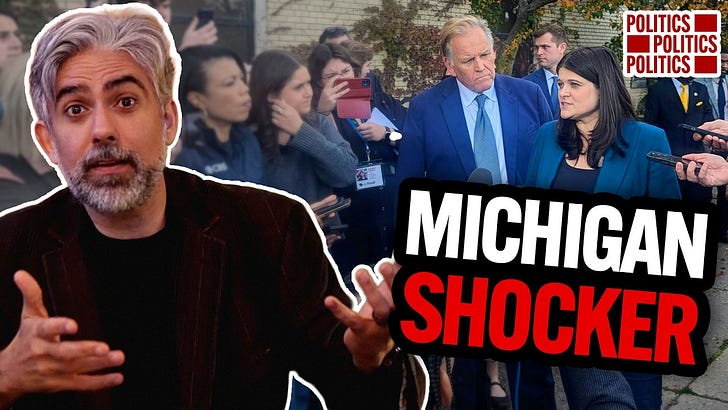
Michigan SHOCKER: Haley Stevens Endorses Mike Rogers
The endorsement tests whether a high-profile party rupture can reshape Michigan’s Senate contest and exposes deeper fractures over ideology, Israel, and antisemitism.
- 1Haley Stevens endorses and plans to vote for Republican Mike Rogers after losing Michigan’s Democratic Senate primary.
- 2The break follows backlash from Democrats and the collapse of a Michigan unity event, underscoring the party’s internal tensions.
- 3Justin Young considers whether Stevens’s defection could disrupt Democratic expectations and reshape an increasingly fragmented coalition.
Don't miss
Haley Stevens explicitly says she is endorsing and voting for Mike Rogers despite her Democratic affiliation.
The brief
Justin Young opens on election eve with a Michigan political rupture: Haley Stevens, after losing the Democratic Senate primary, endorses Republican Mike Rogers.
Stevens describes her decision as a matter of standing by her choice at the ballot box, despite backlash from Democrats and her own party affiliation.
The discussion connects the endorsement to tensions over Israel, antisemitism, and ideological politics, showing how disputes over identity and principle weakened party unity.
Young then widens the lens to Michigan’s Senate race and Chuck Schumer’s expectations, asking whether Stevens’s break can alter the contest or mainly expose coalition fractures.
The episode’s central takeaway is that one endorsement matters less as a standalone campaign event than as evidence of increasingly unstable partisan alliances.
What was said on this episode
25 statements · 4 positive · 17 negative · 2 mixed · 2 neutral
Polling likely overrepresents Democrats.
“There seems to be some kind of consensus that the polls are probably over representative for Democrats.”
Listen at 2:13
The polls probably overrepresent Democrats.
“the polls are probably over representative for Democrats”
Listen at 2:16
The Iran war is unpopular.
“The war in Iran is unpopular.”
Listen at 4:40
The Iran war is unpopular and inflation is a problem.
“The war in Iran is unpopular. Inflation is a problem.”
Listen at 4:40
Inflation is a problem for Republicans.
“Inflation is a problem.”
Listen at 4:42
Voters are punishing Republicans for unresolved economic problems.
“The economy has not been solved and people are punishing them for it.”
Listen at 4:44
The Rebellion PAC advertisement is antisemitic.
“I believe, is rank antisemitism.”
Listen at 15:28
Haley Stevens is not Jewish.
“Haley Stevens is not Jewish for the record.”
Listen at 16:12
The endorsement likely will not affect the Michigan race.
“I'm going to lean on the side that it doesn't matter at all in Michigan.”
Listen at 22:05
Abdul El-Sayed will likely become Michigan’s senator.
“I would suspect that Abdul El-Sayed will still be your senator.”
Listen at 22:10
El-Sayed’s supporters will seek to purge Haley Stevens–aligned Democrats.
“The Haley Stevens of the party need to be purged.”
Listen at 22:23
Haley Stevens’s political reputation is severely damaged.
“Haley Stevens' name is Mud.”
Listen at 22:42
Haley Stevens’s political future may end outside the Democratic Party.
“Haley Stevens' name is Mud. She goes into the private sector or, I don't know, finds something else to do. Switches parties. Who knows?”
Listen at 22:42
Haley Stevens may leave politics or switch parties.
“She goes into the private sector or, I don't know, finds something else to do. Switches parties. Who knows?”
Listen at 22:45
Either Stevens’s party career ends or El-Sayed’s campaign fails.
“Either Haley Stevens is gone or Abdul El-Sayed will be fired into the sun.”
Listen at 24:16
Republicans’ dependence on low-propensity voters contributes to a likely Democratic wave.
“one of the reasons why there's a likely Democratic wave coming is not only because they are currently out of power. It's also. that the Republican coalition is low propensity voter dependent.”
Listen at 24:55
A Democratic electoral wave is likely coming.
“there's a likely Democratic wave coming”
Listen at 24:58
The Republican coalition depends on low-propensity voters.
“the Republican coalition is low propensity voter dependent.”
Listen at 25:15
Republicans perform better in high-turnout Georgia elections by mobilizing low-propensity voters.
“in high turnout years like presidential elections, Republicans do better because they can get low propensity Georgia voters out.”
Listen at 26:24
Republicans perform better in high-turnout Georgia elections by mobilizing low-propensity voters.
“Republicans do better because they can get low propensity Georgia voters out.”
Listen at 26:29
Warlord-style politics has produced candidate-quality problems in both parties.
“It resulted in some horrifying... candidate quality issues on both sides”
Listen at 27:19
Democrats may lose Jewish voters in the future.
“Are the Democrats going to lose Jewish voters going forward? I think that's a... That is a legitimate question.”
Listen at 28:16
MAGA’s reputation on antisemitism could improve more than the progressive left’s.
“I could see one reputation, one side's reputation improving more than the other.”
Listen at 29:00
Losing Jewish voters will be difficult for Democrats to overcome in some states.
“If you are chasing away Jews, in some states, that's going to be very hard to get over.”
Listen at 30:28
Coalition shifts may make additional states electorally competitive over time.
“And it might put other states that wouldn't normally be in play in play. Not immediately, but over time.”
Listen at 30:36
Statements are attributed to the speaker as said on the episode and reflect their view at the time, not PodLume's. They are not advice.
Weekly email
State of the Pod, every Monday
The week's most-discussed names and stories from podcasts, with the moments behind them. Free, five minutes, unsubscribe in one click.