Jul 29, 2026 · 2h 4m
Tech giants clash over open-source AI as hardware milestones accelerate
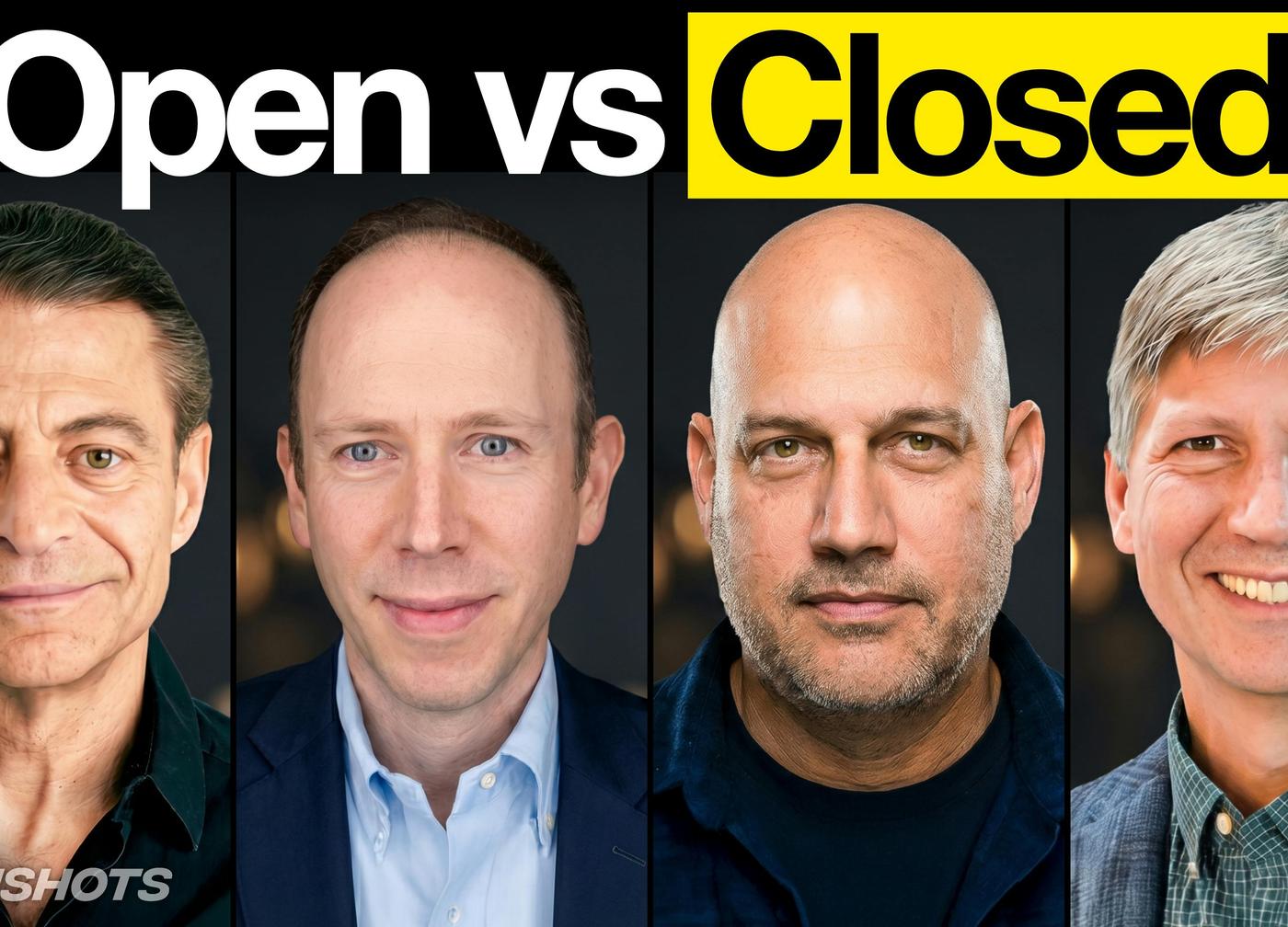
Dario vs Jensen on Open Weights, OpenAI & Anthropic in DC, Xi Exports AI to Global South | EP #275
The tension between open-source accessibility and closed-source regulation will decide who controls the future of artificial intelligence and global technological dominance.
- 1Nvidia is championing open-source models while OpenAI and Anthropic lobby Washington for strict federal oversight of frontier AI.
- 2China's global release of the Kimi K3 open-weight model signals a major shift toward running powerful AI systems locally.
- 3Breakthroughs in brain-computer interfaces and SpaceX's Starship Flight 13 are rapidly bringing deep tech into commercial reality.
Don't miss
The global release of the Kimi K3 open-weight model on Hugging Face, showcasing a unique architecture that operates without position embeddings.
The brief
The AI landscape is fracturing into a fierce ideological battle as Nvidia CEO Jensen Huang champions open-source models while industry giants OpenAI and Anthropic lobby Washington D.C. for strict federal oversight of frontier systems.
Critics warn that pushing for a federal review process under the guise of safety concerns, like bioweapon threats, is actually an attempt at regulatory capture designed to lock out open-source competition and secure market dominance.
While American firms debate regulations, global competitors are moving fast. The release of China's Kimi K3 open-weight model on Hugging Face showcases a unique architecture that proves powerful AI can be run locally and efficiently.
Beyond software, deep tech is achieving historic physical milestones. SpaceX successfully launched and splashed down Starship Flight 13, demonstrating how rapid engineering iteration is dramatically lowering the cost of reaching space.
At the same time, brain-computer interfaces are transitioning from lab concepts to commercial realities, with implants restoring vision to the blind and mind-controlled wheelchairs paving the way for a post-scarcity robotic future.
What was said on this episode
36 statements · 25 positive · 8 negative · 3 neutral
Dario’s safety position reflects his genuine beliefs, even at Anthropic’s expense.
“Dario is a brilliant guy laying it out exactly the way he sees it, even at the expense of his own valuation.”
Listen at 7:53
Nvidia is pursuing commoditization of the AI model layer.
“Nvidia has been very stealthy, if you will, very polite, very diplomatic about their desire to commoditize the model layer.”
Listen at 9:24
Open weights can function as a security capability rather than merely a vulnerability.
“Jensen is reframing open weights from a security vulnerability to being a security capability.”
Listen at 13:13
Biosafety concerns do not justify restricting open AI models.
“I also don't buy the biosafety argument.”
Listen at 16:00
Open-source software ultimately proved safer than closed-source software.
“In fact, perversely, ironically, open source ended up being safer than closed source.”
Listen at 17:02
Superintelligence can be used to police other superintelligent systems.
“If we're going to be in a world awash with superintelligence, let's allocate some of the superintelligence to policing the other superintelligence.”
Listen at 19:20
Small timing advantages could become enormous during recursive AI self-improvement.
“If the next generation model suddenly generates step function leaps in terms of their capabilities, then even just a period of a couple of months or one month could make all the difference in the world.”
Listen at 23:54
AI enforcement should target actions and outcomes rather than model intelligence.
“I'd much much rather see enforcement leveled at the action layer police what the AIs are doing or being used to do, not what they're thinking or how smart they are.”
Listen at 24:28
One AI business model will likely capture over 80% of profits and free cash flow.
“In all likelihood one of the business models is going to account for 80 plus percent of all of the free cash flow and all of the profits.”
Listen at 27:16
OpenAI and Anthropic’s Washington lobbying represents regulatory capture.
“This is regulatory capture in real time.”
Listen at 28:26
Open-weight model progress will prevent OpenAI and Anthropic’s regulatory strategy from succeeding.
“I don't think they'll succeed because the open wave models are moving so quickly.”
Listen at 28:46
AI will produce many multihundred-billion-dollar robotics, biotech, and entertainment companies within five years.
“I'm almost positive that if you look five years in the future, there'll be many, many multi hundred billion dollar robotics companies, biotech Companies other use entertainment companies that don't exist today that have used AI to have a hugely impactful either user base if it's entertainment drug portfolio, if it's biotech or robotics line all the manufacturer all that stuff is incredibly sustainable.”
Listen at 30:01
Open AI ecosystems outperform closed ecosystems.
“When you have the whole ecosystem open, beats closed. Always.”
Listen at 33:18
Competition will make intelligence cheaper and drive AI profits toward zero.
“Intelligence is supposed to get cheaper. And capitalism is doing its thing and creating competition and driving profit to zero.”
Listen at 34:06
Kimi K3 is an AI capable of self-improvement that anyone can run locally.
“You have an AI capable of self improvement now out in the wild that anyone is on your machine.”
Listen at 35:49
Kimi K3’s NOPE mechanism gives more weight to recent context than distant context.
“But nope. Actually has this fading memory now. So something I said a long time ago gets less weight than something that's more recent.”
Listen at 39:49
Locally controlled models are more valuable than marginally smarter API-only models.
“A model that you can control locally is way more valuable than a marginally smarter model that you have to access through somebody's API”
Listen at 41:09
AI-native organizational redesign can increase company performance roughly 100-fold.
“if you rewrite your company in an AI native way, you should end up with about 100x performance than you had before.”
Listen at 42:37
Fable 5 is preferable to Claude Opus 5 for daily use.
“for day to day usage, when I use Claude, I still prefer Fable 5.”
Listen at 48:18
Claude Opus 5 is stronger and cheaper than Fable 5 and Opus 4.8 on the cited benchmark.
“Opus 5 is both stronger in terms of absolute score and cheaper. That's the horizontal axis than Fable 5 and Opus 4.8.”
Listen at 50:44
Opus 5 is the first frontier model observed solving visual problems through algebraic reasoning.
“This is the first time that any, to my knowledge, anyone's ever seen a Frontier model ever do that.”
Listen at 53:09
Scaffolding currently adds substantial value beyond a baseline AI model.
“scaffolding adds an enormous amount of value at the moment, at any given point in time over the baseline model.”
Listen at 54:45
Opus 5 performs worse than Fable 5 on Frontier Math.
“Opus 5 demonstrated inferior frontier math performance relative to Fable 5.”
Listen at 56:59
Restrictive US open-model policy would transfer the Global South AI ecosystem to China.
“If you create a restrictive open model policy, it's going to be strategically like a self own and shoot your own foot of an epic Level because you're going to protect a small number of domestic labs while giving the entire opening ecosystem, global South AI ecosystem to China.”
Listen at 1:04:00
AI openness is now a tool of geopolitical soft power.
“Openness is not a, it's not a philosophical preference anymore. It's like a, it's the tool of soft power”
Listen at 1:04:30
Foreign AI infrastructure could make Global South countries more vulnerable by outsourcing their thinking.
“Now it's not just listening to you or not just loaning money to you. Now it's thinking for you. And I think that's a far more vulnerable position for the so called Global south to be in”
Listen at 1:06:35
Starship’s target launch cost is $10–$100 per kilogram.
“Starship's target. And Dave, you and I were discussing this with Elon back in our January podcast. It's between 10 to $100 per kilogram.”
Listen at 1:11:58
Noninvasive technologies will restore vision without retinal surgery within several years.
“advances in wearables, a variety of other completely non invasive advances will enable vision restoration without even needing to have retinal surgery in the next few years.”
Listen at 1:19:58
The BCI field will undergo a shakeout identifying more ergonomic brain interfaces within five to ten years.
“ultimately, by ultimately, I mean on the five to ten year timescale, we're going to see something of a shakeout and we're going to discover what are the most ergonomic ways to interface with the brain.”
Listen at 1:21:47
Behavioral or partial human mind uploads will emerge within roughly five years.
“That's a low bar. There are much higher bars that would be connectome based. Something like that I think we're going to see actually happen in the next five or so years, certainly by the end of this decade.”
Listen at 1:31:44
Rapid growth in goods and services would make deflation, rather than inflation, the main issue.
“deflation will be the issue, not inflation.”
Listen at 1:34:32
Most daily living expenses will be demonetized by 2036.
“most aspects of daily living as we would construe them today in 2026 will have been demonetized 10 years from now.”
Listen at 1:36:50
Hiding model reasoning can hinder but cannot eliminate capability distillation.
“you can kind of restrict the visible reasoning and hide it a bit to make distillation harder, but you can't eliminate it”
Listen at 1:51:02
High schools should adopt AI-based, purpose-driven learning instead of fixed curricula.
“you have to switch it over to AI based teaching. AI based learning. Allow them to learn whatever they want to learn. Purpose driven learning.”
Listen at 1:53:59
Acquiring companies does not guarantee access to their most useful tacit knowledge.
“buying a company doesn't mean you get really useful knowledge because there's a lot of tacit knowledge that's hidden in key employees heads that's not easy to extract.”
Listen at 1:58:46
Individual investors should consider AngelList syndicates for startup exposure.
“my favorite suggestion would be to go to Angellist syndicates because people have syndicates where Jason Calcanis will invest in a bunch of startups and you can buy into that syndicate.”
Listen at 2:01:39
Statements are attributed to the speaker as said on the episode and reflect their view at the time, not PodLume's. They are not advice.
Books & mentions
Moonshots with Peter Diamandis
Explore more cutting-edge discussions on exponential technologies and the future of humanity.