Jul 17, 2026 · 1h 57m
Tech leaders debate regulatory capture and the rise of on-device AI
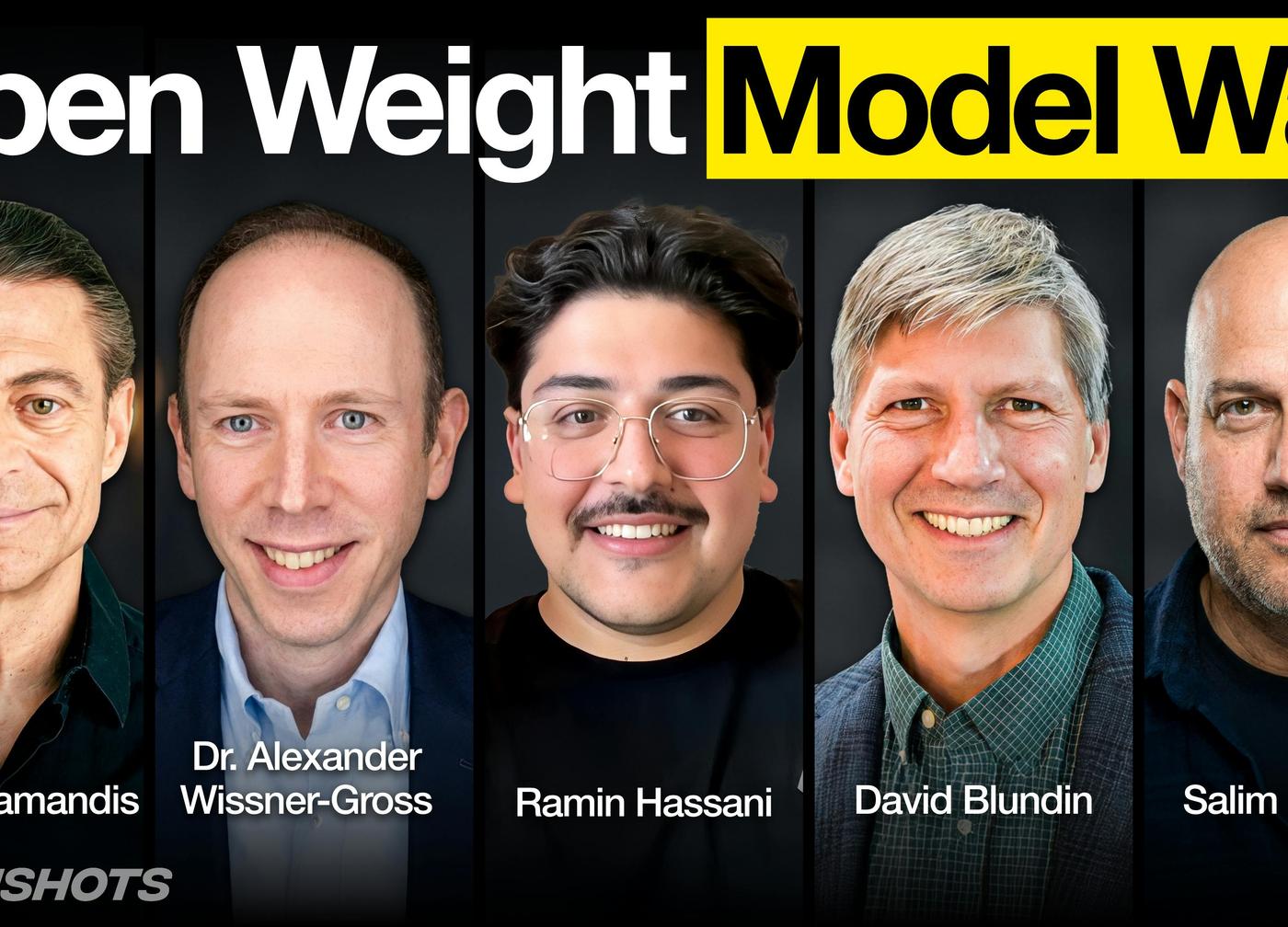
Mira Murati's 975B Open Model, Ramin Hasani on Post-Transformer AI, and Demis' AI FINRA | EP #271
The episode unpacks how the intersection of corporate lobbying, geopolitical rivalry, and architectural efficiency will decide who controls the next wave of artificial intelligence.
- 1Proposals for centralized AI regulatory bodies risk enabling regulatory capture that protects tech giants from open-source rivals.
- 2Small language models are delivering energy-efficient, on-device intelligence for major enterprises without requiring massive cloud infrastructure.
- 3The integration of AI digital twins in government communications signals a shift toward automated public representation.
Don't miss
Ramin Hasani explains how Liquid AI transitioned from analyzing the nervous system of a tiny worm at MIT to building next-generation on-device AI models.
The brief
As artificial intelligence advances, the battle lines are shifting from raw computational scale to strategic control, energy-efficient architecture, and the geopolitical rules of engagement between global superpowers.
Industry giants are pushing for strict regulatory frameworks, but critics warn that proposals like a FINRA-style standards body might just be strategic regulatory capture designed to lock out open-source competitors.
Liquid AI co-founder Ramin Hasani joins the panel to explain how bio-inspired small language models, originally rooted in MIT research on roundworms, are bringing highly efficient, on-device intelligence to enterprises.
Meanwhile, governments are stepping into the future as Malaysia adopts an official digital twin of its Prime Minister, signaling a new era of interactive, AI-generated public communication and statecraft.
From recursive self-improvement to national security patent reforms, the future of tech sovereignty depends on balancing open innovation with the protection of critical intellectual property.
What was said on this episode
53 statements · 32 positive · 14 negative · 7 neutral
Customization will matter more than leaderboard dominance for Mira Murati’s model.
“customization over leaderboard dominance is what's going to win her the day”
Listen at 0:05
Liquid AI aims to build efficient general-purpose AI across model scales.
“building efficient general purpose AI at every scale”
Listen at 0:23
AI regulation would serve the public interest.
“there's a strong consensus there should be some AI regulation”
Listen at 5:37
A standalone AI regulator resembling the FAA or FCC will eventually emerge.
“some sort of AI regulatory agency that stands on its own, similar to the FAA or FCC is likely at some point”
Listen at 6:10
AI failures could have severe consequences.
“the consequences of AI going wrong are severe”
Listen at 6:26
AI development is too rapid for traditional government bureaucracy.
“AI moves way, way too fast for any kind of traditional government bureaucracy”
Listen at 11:00
AI governance needs standards, real-time audits, and open evaluation suites.
“you're going to need a standards body, you're going to need real time audits and you're going to need open evaluation suites”
Listen at 11:06
AI systems can assist with their own regulation.
“AI can help regulate itself”
Listen at 12:22
A FINRA-like frontier-AI regulator is a bad idea.
“I tend to think this is a bad idea”
Listen at 12:45
Demis Hassabis’s proposal could form a cartel of frontier AI labs.
“the attempted formation by demos of a cartel of frontier labs”
Listen at 12:50
AI governance should regulate harmful actions rather than model capabilities.
“regulating the actions that in at least the western legal canon that we do do and that I'd be much more supportive of”
Listen at 15:57
Frontier labs’ regulatory push may primarily create competitive moats.
“I worry that it's more regulatory capture and creating moats for themselves”
Listen at 16:25
No existing mechanism can regulate rapidly advancing AI effectively.
“I see no mechanism to regulate AIs moving way too quickly”
Listen at 17:20
A US AI regulatory body will appear before year-end.
“My guess is we see this before the end of the year”
Listen at 19:58
Linking US release limits to China incentivizes China to advance faster.
“this creates the perverse incentive to let China win the race to ever greater superintelligence”
Listen at 21:28
AI policy should shift from prevention toward adaptation.
“You have to move from, like, prevention and whatever to adaptation”
Listen at 22:10
Open ecosystems eventually outperform closed ecosystems.
“open ecosystems always win”
Listen at 24:32
Fixed AI benchmarks could distort future model capabilities.
“we freeze in or otherwise lock in the benchmarks for how we measure capabilities”
Listen at 25:10
Adaptability, rather than raw model power, will determine AI success.
“it's not going to be the future is the raw power. It's going to be the adaptability that's going to win”
Listen at 27:42
Thinking Machines’ model is stronger than Nvidia’s Nemotron according to released evaluations.
“it's stronger than Nematron”
Listen at 28:15
Thinking Machines’ model is weaker than GLM 5.2 according to released evaluations.
“it's weaker than GLM 5.2”
Listen at 28:39
On-premise fine-tuning with local data is a major enterprise capability.
“the ability to bring the model in house and fine tune it with your local data is a huge unlock”
Listen at 37:38
Small multimodal models are designed for organizational applications.
“this is aiming squarely at organizational use”
Listen at 38:08
Conventional fine-tuning historically did not increase model capabilities.
“fine tuning didn't have a history of increasing capabilities”
Listen at 39:35
AI safety can be improved by scaling capable AIs to police other AIs.
“the solution for AI safety is AI policing AI in proportion”
Listen at 45:29
WECO’s system is beginning to demonstrate recursive self-improvement ignition.
“they are touching, just starting to touch on ignition”
Listen at 48:35
WECO’s reported recursive system does not change neural-network weights.
“there is no weight changes in the neural networks”
Listen at 49:48
This recursive framework would require 350 years to fine-tune a two-billion-parameter model.
“it takes us 350 years to really fine tune a 2 billion parameter model with this framework”
Listen at 53:10
Recursive self-improvement is currently limited to well-funded, compute-rich labs.
“it's happening, but it's happening with big compute and big budgets”
Listen at 54:42
Recursive self-improvement pipelines create real cybersecurity threats.
“the cybersecurity kind of threads that we are seeing, like coming out of these type of pipelines of recursive self improvement. They're real”
Listen at 56:15
Models exceeding current understanding will appear within roughly two years.
“you're going to see unbelievably kind of models probably in the next two years or so”
Listen at 58:24
AI redesigning research workflows is an early organizational singularity.
“this is the first glimpse of the organizational singularity”
Listen at 1:01:56
Official AI replicas of leaders could undermine perceived authenticity.
“The risk is that the authenticity kind of collapses”
Listen at 1:04:00
Watermarked leader avatars could scale civic engagement.
“this allows you to scale that”
Listen at 1:04:40
Western leaders will increasingly adopt AI digital twins.
“we're going to see more of this in the west as well”
Listen at 1:05:20
Corporations and CEOs will likely adopt digital twins.
“I think it's likely that corporations, corporate CEOs will do this”
Listen at 1:06:15
AI avatars should become dominant political outreach tools by the next election.
“it should be easily dominant two years from now in the next election”
Listen at 1:10:35
Transformer attention mechanisms are inefficiently bloated.
“the whole attention mechanism is bloated”
Listen at 1:13:45
Liquid models can match models ten to one thousand times larger in intelligence.
“deliver basically intelligence at the level of models that are 10 to 1,000 times larger than themselves”
Listen at 1:18:42
Automotive AI models must be compact while retaining performance.
“the model has to be very small and at the same time being able to perform”
Listen at 1:23:44
Liquid AI’s multimodal model can run inside a car using less than one gigabyte.
“one of our multimodal foundation models that is only less than 1 gigabyte in size and it can go inside the car's chip”
Listen at 1:24:18
North American Mercedes vehicles from 2022 onward will receive Liquid AI updates over the air.
“all the Mercedes Benz North America cars like from 2022 on, they're going to get an update over the air update”
Listen at 1:26:31
Liquid AI’s in-car system can access approximately 700 vehicle functions.
“there are 700 functions inside the car”
Listen at 1:27:40
Liquid AI uses automated architecture search rather than relying solely on human architectural choices.
“we designed a search algorithm to let's say like, you know, let the algorithm, instead of human biasing kind of the algorithm”
Listen at 1:35:31
The US invention-secrecy regime should probably be abolished.
“the Invention Secrecy act regime should probably go away”
Listen at 1:44:55
Proprietary learning loops will provide stronger defensibility than patents.
“The real moat is learning loops”
Listen at 1:45:41
Palmer Luckey should advocate stronger US patent enforcement in China.
“what he should be asking is better enforcement of US patents in China”
Listen at 1:48:02
GPT-5.6 exceeded specialty-matched physicians on the reported medical benchmark.
“the doctors still lost”
Listen at 1:49:04
Meta’s medical AI capabilities are available free to over 3.5 billion people.
“top medical AI capabilities are now free to over three and a half billion people on the planet”
Listen at 1:49:58
Instagram’s AI can provide better medical advice than human doctors.
“Instagram now gives better medical advice than a human doctor”
Listen at 1:51:07
CMLase reversed accumulated glycation damage in elderly human tissue samples.
“reversing damage that accumulated over the lifetime”
Listen at 1:53:24
Some age-related glycation damage may now be reversible.
“a category in aging that we've always filed as permanent just became reversible”
Listen at 1:53:31
Human cells perform approximately five billion chemical reactions per second.
“our ability to understand the 5 billion chemical reactions per second per cell”
Listen at 1:53:43
Statements are attributed to the speaker as said on the episode and reflect their view at the time, not PodLume's. They are not advice.
Books & mentions
Moonshots with Peter Diamandis
Explore cutting-edge discussions on exponential technologies and longevity science.