Aug 26, 2026 · 1h 31m
VCs debate who pays for AI’s labor shock
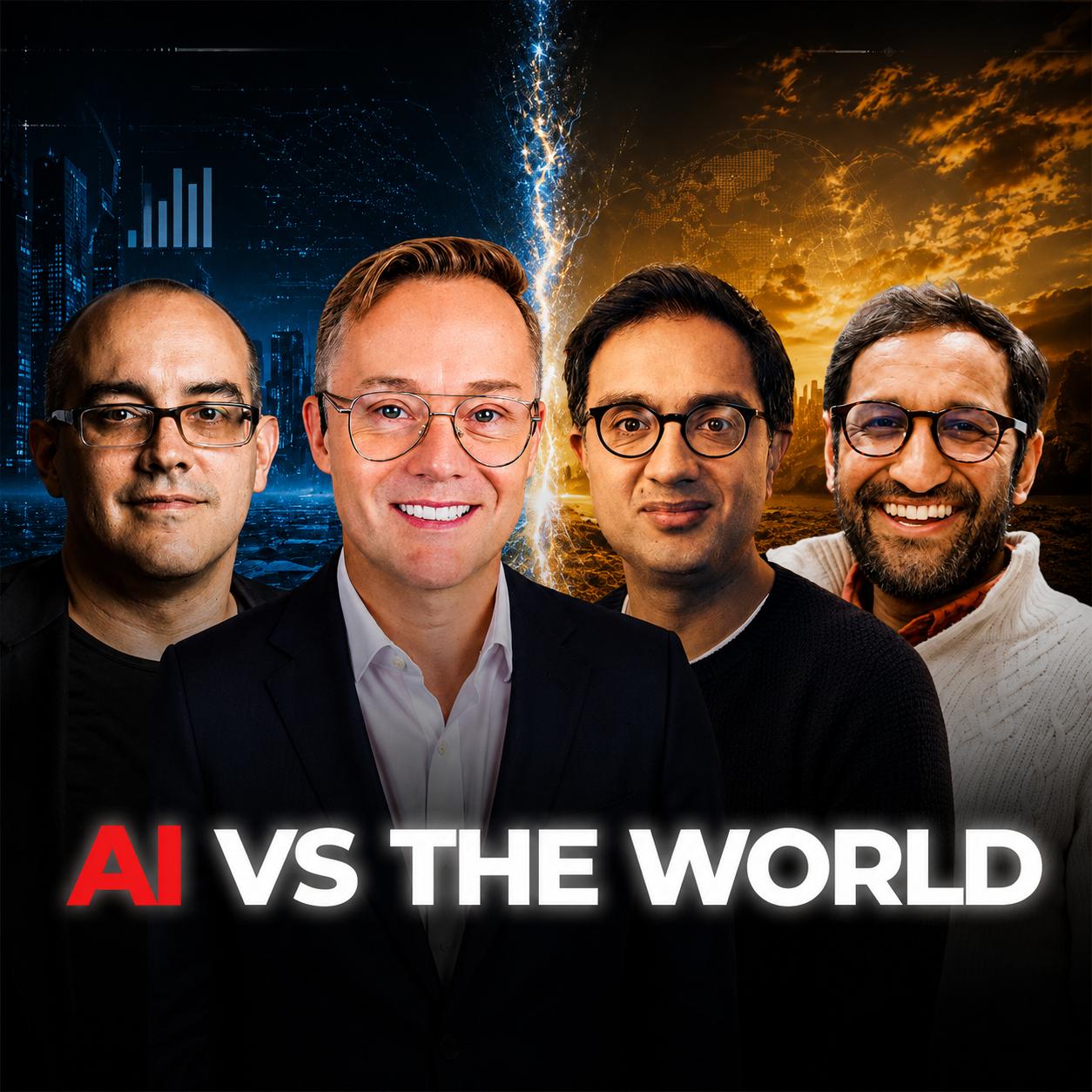
Bill Gates foresees massive AI job loss: these VCs disagree | E2330
The panel weighs whether AI’s productivity gains can offset mass displacement—and who should finance the transition if they cannot.
- 1The panel disputes Bill Gates’ warning while acknowledging AI could rapidly reduce demand for human labor.
- 2Proposed responses include taxing AI usage, taking equity in leading labs, sovereign wealth funds, and microloans.
- 3The conversation connects AI’s economic stakes to child-safety regulation, robotics, private markets, and investment opportunities.
Don't miss
The panel confronts the possibility that household robots could bring AI-driven labor displacement into everyday physical work.
The brief
Jason Calacanis convenes Sheel Mohnot, Dave McClure, and Hussein Kanji to test Bill Gates’ warning that AI could disrupt employment and widen inequality.
The panel agrees AI may deliver extraordinary gains in productivity, health, and living standards, but disagrees on whether markets can manage the transition without coordinated policy.
Their proposed safeguards range from taxing token use or self-driving licenses to taking equity in AI companies, building sovereign wealth funds, and expanding microloans.
The discussion then widens to Meta’s $17.1 billion child-safety settlement, Stripe’s OpenRouter acquisition, private-market shifts, and the investment case beyond software AI.
A Skilled AI robotics demo becomes the clearest test of the debate: household machines could extend AI’s labor shock from screens into the physical world.
The episode closes with arguments over Silicon Valley’s lost idealism and portfolio bets including Basis, Motu, EquityBee, Cusp AI, and Peptone.
What was said on this episode
67 statements · 37 positive · 15 negative · 2 mixed · 13 neutral
Dave McClure predicts some jobs will permanently disappear.
“Some jobs are probably going to go permanently go away.”
Listen at 0:13
Hussein Kanji says humans may increasingly obstruct automated economic activity.
“Humans just kind of sort of get in the way is probably like a real thing.”
Listen at 0:17
Jason Calacanis says AI adoption creates several new opportunities within his firm.
“Every time somebody really adopts these tools inside of my firm, three or four new opportunities open up for our company.”
Listen at 0:23
Dave McClure says AI empowers malicious actors.
“Bad actors get superpowers. That's probably true.”
Listen at 4:31
Sheel Mohnot predicts substantial AI-related job losses.
“There will be a lot of job losses.”
Listen at 5:08
Sheel Mohnot says AI governance likely needs to change.
“there probably does need to be some change.”
Listen at 6:18
Dave McClure recommends sovereign wealth funds funded by AI surplus.
“Shouldn't we be creating sovereign wealth funds with our surplus coming from AI and sharing that broadly?”
Listen at 6:48
- Hussein Kanjion AI automationNegative8:24
Hussein Kanji predicts improving AI automation will reduce human employment.
“automation is going to happen, AI is going to get better at the automation, human jobs are going to get deprecated”
Listen at 8:24
- Hussein Kanjion AI-driven automationMixed8:32
Automation may make economies better run while rendering human labor obstructive.
“the economy will be so much better run by automation that humans just kind of sort of get in the way is probably like a real thing”
Listen at 8:32
AI will eventually replace even higher-cognition work.
“it's. I think it's only a matter of time before even the higher cognition things in society kind of get replaced.”
Listen at 8:50
- Hussein Kanjion AI automation of cognitive workNegative8:51
Hussein Kanji predicts AI will eventually replace higher-cognition work.
“it's only a matter of time before even the higher cognition things in society kind of get replaced.”
Listen at 8:51
Dave McClure favors capital access and debt repayment over direct cash transfers.
“giving people access to capital with some amount of debt repayment is probably a better strategy.”
Listen at 9:35
Dave McClure expresses greater trust in technology than government.
“I trust tech more than I trust government.”
Listen at 11:53
Jason Calacanis says AI users, rather than AI itself, will displace workers.
“You're not going to have your job replaced by AI. You're going to have your job replaced by somebody using AI.”
Listen at 13:24
Sheel Mohnot predicts DoorDash drivers will remain safe from displacement for five to ten years.
“your doordash driver is probably safe for the next five, 10 years.”
Listen at 14:25
Dave McClure predicts small businesses will be AI's biggest beneficiaries.
“the biggest beneficiary of AI will be a whole bunch of sole proprietors and small businesses all across.”
Listen at 16:19
Sheel Mohnot predicts AI software will improve sole-proprietor operations.
“There will be AI software companies that help people run their sole props much better.”
Listen at 16:46
- Hussein Kanjion AI virtual workersPositive17:13
Hussein Kanji says virtual workers could outperform humans at lower cost.
“if the virtual humans are better at doing the jobs than the actual humans and they're a lot cheaper”
Listen at 17:13
Jason Calacanis predicts rapid growth in sole proprietorships.
“I think we'll see a Cambrian explosion in sole proprietorships”
Listen at 19:12
Jason Calacanis predicts socialist politicians will respond by defending workers.
“My prediction is the socialists in the country who are rising up right now and saying, hey, we're going to defend workers”
Listen at 20:18
Jason Calacanis proposes auctioning self-driving licenses from $30,000.
“The licenses are auctioned off at $30,000 starting price.”
Listen at 20:56
“I think that's literally what we're going to have in the next two years”
Listen at 20:59
Sheel Mohnot supports taxing self-driving cars for their externalities.
“I do think that it's totally fair to say to society that we need to tax these”
Listen at 22:27
Dave McClure supports token taxation because token costs will approach zero.
“I think that's a great idea because token costs are going down to zero.”
Listen at 23:15
AI token costs will approach zero.
“token costs are going down to zero”
Listen at 23:17
Governments should plan retraining or support budgets for AI-displaced workers.
“I do think we need to start planning for the equivalent of retraining budget and or support budget for people who are going to be displaced.”
Listen at 24:41
Dave McClure recommends planning retraining or support budgets for displaced workers.
“we need to start planning for the equivalent of retraining budget and or support budget for people who are going to be displaced.”
Listen at 24:42
Dave McClure predicts AI will enable abundant energy, food, and major disease cures.
“we will get to free energy, we will get to free food, we will cure cancer and major disease.”
Listen at 26:12
AI-enabled benefits will be distributed very unevenly across humanity.
“the distribution of those benefits to all of humanity will be incredibly uneven.”
Listen at 26:21
Sheel Mohnot recommends taxing AI companies' excess profits when they concentrate wealth.
“if these companies have enormous excess profits that concentrates wealth, then tax the excess profits.”
Listen at 28:29
Sheel Mohnot supports a per-mile tax on robotaxis.
“the robo taxi, maybe there's a per mile tax, totally reasonable.”
Listen at 28:48
Dave McClure proposes taking 10% stakes in Anthropic and OpenAI to address national debt.
“let's take 10% of anthropic and OpenAI and solve our national debt problem.”
Listen at 29:51
Sheel Mohnot doubts government ownership of Anthropic and OpenAI makes sense.
“I'm not sure that that makes sense to me.”
Listen at 33:10
- Hussein Kanjion social media use by children and teensNegative35:49
Hussein Kanji suggests restricting social-media use by prepubescent children and teens.
“you might actually not want to want like prepubescent teens and maybe teens to be using some of these things.”
Listen at 35:49
Sheel Mohnot says social media alleviated his depression during COVID.
“Social media cured me, I think, like from depression.”
Listen at 37:17
Dave McClure says technology itself does not cause bullying and shaming.
“It's not like the technology is what's causing it.”
Listen at 39:50
- Hussein Kanjion Children and social mediaPositive42:03
Shielding children from social media is beneficial.
“I think shielding kids from this stuff is actually a good thing versus a bad thing.”
Listen at 42:03
Jason Calacanis assesses social media as exceptionally addictive.
“I don't think we've ever seen anything in humanity as addicting as social media.”
Listen at 45:05
Dave McClure says fintech remains large and not overfunded.
“I still think fintech is like a big category and it's not, you know, overfunded”
Listen at 46:35
Fintech and e-commerce remain large, growing investment categories.
“I would say fintech and E commerce are still big categories and are still growing.”
Listen at 46:45
- Hussein Kanjion Stripe acquisition of OpenRouterPositive47:40
Hussein Kanji evaluates Stripe's OpenRouter acquisition as strategically interesting.
“I think it's an interesting strategic purchase.”
Listen at 47:40
Sheel Mohnot says Stripe's OpenRouter acquisition price is unusually high.
“I think the price is wild.”
Listen at 48:40
Sheel Mohnot says the OpenRouter deal bets on neutral routing becoming important.
“It's clearly a bet that neutrality ends up like that.”
Listen at 49:16
Dave McClure says Cursor's $60 billion deal was the largest M&A transaction ever.
“I think cursor was the biggest M and a ever. $60 billion.”
Listen at 49:57
Andreessen earned a 150-fold return on its Cursor investment within a few years.
“Andreessen got 6.6 billion back on 44 million in 150x return in a couple years.”
Listen at 50:12
Hussein Kanji predicts language-related work will be handled by AI.
“I am convinced that the future is like everything language related is done”
Listen at 55:07
- Hussein Kanjion physical and biological AIPositive55:24
Hussein Kanji says physical and biological AI remain open competitive frontiers.
“Who's going to win Transformers AI for physical and Transformers AI for biology. And it's no surprise that due to spaces have kind of gotten hot.”
Listen at 55:24
Sheel Mohnot says Skilled AI's robot can learn to walk after losing a leg.
“it just learns how to walk on fewer legs.”
Listen at 57:17
Hussein Kanji says physical AI capabilities are improving exponentially.
“It's compounding at a rate which is like exponential.”
Listen at 58:53
- Hussein Kanjion household robotsPositive59:00
Hussein Kanji predicts household robots will arrive sooner than ten years.
“I think it's a lot sooner.”
Listen at 59:00
Sheel Mohnot values a capable household robot at $100,000 or more.
“is a robot worth a hundred thousand dollars? To me, easily”
Listen at 59:25
A household robot capable of cleaning and cooking would be worth $100,000 to him.
“is a robot worth a hundred thousand dollars? To me, easily, like, if it's cleaning and cooking, it's worth a hundred thousand dollars.”
Listen at 59:25
“I think they got to be 20 to 30. So I think they're the cost of a Toyota Prius.”
Listen at 59:52
“even for the average person at 20, $30,000, it actually pays for itself pretty quickly.”
Listen at 1:00:09
Sheel Mohnot says many Anthropic and OpenAI workers are motivated by mission rather than money.
“the people doing the great work, like my friends at Anthropic and OpenAI could give two shits about the money.”
Listen at 1:03:21
Dave McClure says companies now need $500 million–$1 billion to IPO.
“the IPO market now is requiring half a billion to a billion dollars to go public.”
Listen at 1:06:07
Dave McClure says companies are remaining private longer than before.
“companies being private a lot longer.”
Listen at 1:06:15
Dave McClure predicts corporate tender offers will become more frequent.
“we're just going to see more and more of these corporate tenders happening on a regular basis.”
Listen at 1:09:45
- Hussein Kanjion retail investors in private companiesNegative1:10:07
Hussein Kanji says retail investors must wait until private companies become expensive.
“retail investors. Right? Retail investors have to wait until these things are super expensive”
Listen at 1:10:07
Sheel Mohnot questions whether Stripe will ever go public.
“why would Stripe go public ever?”
Listen at 1:14:50
Privately valued companies may offer an arbitrage opportunity when repriced on free-cash-flow metrics.
“there's an arbitrage opportunity here where these companies have been priced on sort of venture scale projections.”
Listen at 1:15:46
Dave McClure says some private companies are valued using venture-scale growth projections.
“these companies have been priced on sort of venture scale projections.”
Listen at 1:15:47
Dave McClure predicts xAI's infrastructure business will become its revenue majority.
“He's going to have a line of business that is the majority of their revenue that did not exist.”
Listen at 1:17:02
Sheel Mohnot says Instinct can autonomously book flights for users.
“Instinct will actually go through and book it for you.”
Listen at 1:18:49
Jason Calacanis predicts Instinct could grow explosively with team collaboration features.
“I think that product, if it goes multiplayer mode, will go parabolic.”
Listen at 1:20:19
Sheel Mohnot says Grokbot's 100-million-user potential depends on competitors failing to catch up.
“I think that relies on the other guys not catching up.”
Listen at 1:22:40
- Hussein Kanjion Peptone prostate-cancer drugPositive1:29:43
Hussein Kanji says Peptone has an AI-generated drug that may nearly stop prostate cancer.
“we have a drug against prostate cancer that might actually stop prostate cancer almost entirely generated by the computer.”
Listen at 1:29:43
Statements are attributed to the speaker as said on the episode and reflect their view at the time, not PodLume's. They are not advice.
Weekly email
State of the Pod, every Monday
The week's most-discussed names and stories from podcasts, with the moments behind them. Free, five minutes, unsubscribe in one click.