Sep 3, 2026 · 1h 9m
Listen from 42:56
Listen at 42:56
El-Sayed’s progressive strategy faces Michigan’s general-election test
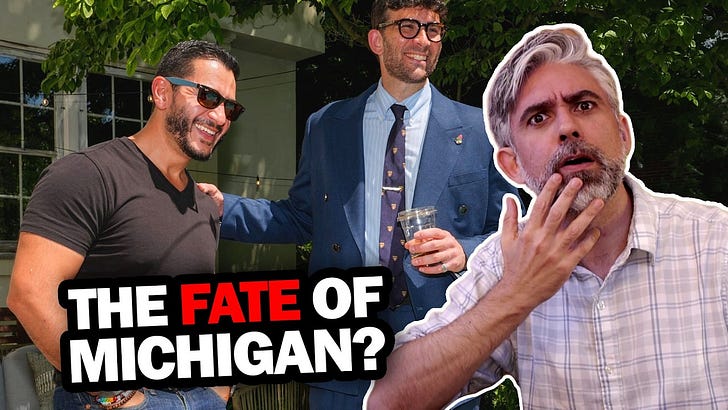
Could Hasan Piker Cost El-Sayed the Michigan Senate Race? (with Bill Scher)
The episode examines whether a candidate can preserve progressive momentum while answering vulnerabilities on media controversies, Gaza, Medicare for All, and partisan online alliances.
- 1Abdul El-Sayed’s primary strategy may leave him underprepared to broaden his appeal against Mike Rogers in Michigan’s general election.
- 2His association with Hassan Piker turns a campaign-messaging question into a larger debate over partisan media influence and political accountability.
- 3Bill Schneider sees Democrats favored to regain the House, while the Senate outlook remains shaped by an uncertain map and volatile environment.
Don't miss
The discussion compares Hassan Piker’s online political influence with Rush Limbaugh’s role in shaping Republican politics.
The brief
Justin and Bill Schneider assess Abdul El-Sayed’s Michigan Senate campaign, where confidence and progressive momentum also create material for opponents to clip and weaponize.
The central campaign question is whether El-Sayed treated the Democratic primary as the real contest and underestimated the need to broaden his message for Michigan swing voters.
Israel, Gaza, Medicare for All, and El-Sayed’s reluctance to distance himself from Hassan Piker expose the tension between ideological alignment and general-election reach.
The conversation widens from Michigan to the political power of streamers and partisan media, comparing Piker’s influence with Rush Limbaugh’s earlier role in Republican politics.
Bill Schneider predicts Democrats are better positioned to retake the House than the Senate, while warning that polling, competitive districts, and the Senate map remain volatile.
What was said on this episode
50 statements · 17 positive · 16 negative · 8 mixed · 9 neutral
Mike Collins and Michael Watley are exceptionally weak Republican challengers.
“You've got two exceptionally weak challengers in states that Republicans should do really well. Mike Collins in Georgia and Michael Watley in North Carolina.”
Listen at 4:00
John Ossoff will remain Georgia’s senator for another two years.
“Ossoff is going to be senator for another two years.”
Listen at 5:09
Gender-affirming care for minors almost never involves penis removal.
“There are almost no cases of gender affirming medical care for minors that involves removing a penis.”
Listen at 8:45
Castration and circumcision have vastly different long-term consequences.
“the long-term consequences of the two are vastly different”
Listen at 10:51
Bill predicts El-Sayed’s circumcision response will spread beyond Fox News.
“You've now created this viral clip that's going to go well beyond Fox.”
Listen at 11:16
Abdul El-Sayed’s Michigan Senate outcome is uncertain.
“I can't tell if he's going to win or lose.”
Listen at 12:51
Bill says El-Sayed’s Michigan Senate outcome cannot currently be determined.
“I can't tell if he's going to win or lose.”
Listen at 12:51
Bill assesses El-Sayed’s innate confidence can sometimes create political trouble.
“I think it gets him into trouble sometimes.”
Listen at 14:03
El-Sayed’s innate confidence sometimes gets him into trouble.
“I think it gets him into trouble sometimes.”
Listen at 14:03
A viral clip could let Mike Rogers portray El-Sayed as a confused fake moderate.
“If you're Mike Rogers tells your entire story about El Sayed, that he is masquerading as a moderate and he really doesn't understand because he thinks. circumcision is castration.”
Listen at 16:13
Bill says El-Sayed is on record supporting the Green New Deal.
“he's on record being Ford.”
Listen at 17:48
Eliminating fossil fuels would eventually eliminate gas-powered cars.
“If there's no fossil fuels, you're not going to have gas-powered cars anymore. They're going to eventually die away.”
Listen at 18:08
Bill assesses El-Sayed’s refusal to defend the Green New Deal as nearly a policy reversal.
“By saying I will not defend the Green New Deal comes perilously close to a flip flop.”
Listen at 19:04
Bill assesses Rogers’ focus on the Green New Deal as strategically smart because transgender issues lack broad salience.
“I think it's actually smart on Rogers' part because I don't think the trans issue has great salience in general elections.”
Listen at 19:44
Mike Rogers was smart to emphasize the Green New Deal over transgender issues.
“I think it's actually smart on Rogers' part because I don't think the trans issue has great salience in general elections.”
Listen at 19:44
Neither El-Sayed nor Rogers is campaigning effectively.
“I don't really love how either of these people are in their campaigns.”
Listen at 21:19
El-Sayed should stop talking about Israel to help heal the rift.
“If you want to help heal this rift, just stop talking about Israel.”
Listen at 24:17
Bill recommends that El-Sayed stop discussing Israel to help repair relations with Michigan’s Jewish community.
“If you want to help heal this rift, just stop talking about Israel.”
Listen at 24:17
El-Sayed’s core progressive message remains consistent after the primary.
“the basic construct, the core message that he repeats, money out of politics, money in your pocket, Medicare for all, that is remaining consistent”
Listen at 26:10
Bill says El-Sayed’s core campaign message remains centered on economic populism and Medicare for All.
“the basic construct, the core message that he repeats, money out of politics, money in your pocket, Medicare for all, that is remaining consistent”
Listen at 26:10
Michigan’s Jewish community is experiencing genuine pain over the controversy.
“I think there is genuine pain in the Michigan Jewish community.”
Listen at 27:49
Bill recommends that El-Sayed more explicitly acknowledge Michigan’s Jewish community’s concerns.
“I think he needs to go a step farther in that direction to signal to the Jewish community there, hey, I hear you.”
Listen at 28:32
El-Sayed should more clearly acknowledge Michigan’s Jewish community’s concerns.
“he needs to go a step farther in that direction to signal to the Jewish community there, hey, I hear you.”
Listen at 28:33
Bill reports that August polling averages put El-Sayed roughly two points ahead, an uncomfortable margin.
“you take the average of the August polling, he's up by about two, which I would say is too close for comfort.”
Listen at 31:13
August polling averages put El-Sayed ahead by about two points, too close for comfort.
“you take the average of the August polling, he's up by about two, which I would say is too close for comfort.”
Listen at 31:13
El-Sayed must make campaign adjustments immediately if needed.
“If he's going to make some more recalibrations, he's got to do it like right now.”
Listen at 31:52
Bill recommends that El-Sayed make any campaign adjustments immediately before the general-election sprint.
“if he's going to make some more recalibrations, he's got to do it like right now.”
Listen at 31:52
The Democratic Party will need to understand Hassan Piker as Republicans understood Rush Limbaugh.
“Ultimately, the Democratic Party is going to have to understand him in the way that the Republican Party understood Rush Limbaugh.”
Listen at 42:26
Bill says Rush Limbaugh survived Democratic attacks, became wealthy, and entrenched in Republican politics.
“Rush didn't go away, made a lot of money and became entrenched in the Republican Party apparatus.”
Listen at 42:56
Hassan Piker will keep discussing the race even if it harms El-Sayed’s campaign.
“He will not shut up about this, even if it comes to the detriment of the campaign”
Listen at 44:40
Hassan Piker prioritizes changing the Democratic Party over winning the general election.
“I think Hassan Piker is more interested in changing the Democratic Party than winning the general election.”
Listen at 45:04
Bill predicts Republican ads featuring Hassan Piker will not affect several named congressional races.
“I don't think it's going to affect Tallarico or Josh Turek or Mary Patola or Adam Hamilton that Hassan Piker's in national ads.”
Listen at 47:28
Bill says El-Sayed bears responsibility for clarifying his relationship with Hassan Piker.
“There's some burden on Al-Sayed to make clear where the distinction is.”
Listen at 49:35
El-Sayed’s handling of Piker is poor campaign strategy in a close race.
“It's not how I would run that campaign, especially a campaign that, at least in the available polling, is within margin of error.”
Listen at 49:52
Winning statewide with Medicare for All remains untested.
“This is an untested proposition. No one has won statewide with that before.”
Listen at 51:16
Bill says winning statewide with Medicare for All remains an untested electoral proposition.
“This is an untested proposition. No one has won statewide with that before.”
Listen at 51:16
El-Sayed’s base-first strategy for swing-state victory is risky.
“It's a base first, base plus mentality to win swing state elections, which is... Maybe it works out, but it's a roll of the dice.”
Listen at 53:03
Bill assesses El-Sayed’s base-first strategy as uncertain and risky for winning a swing-state election.
“It's a base first, base plus mentality to win swing state elections, which is... Maybe it works out, but it's a roll of the dice.”
Listen at 53:03
Bill Scher still gives Democrats less than even odds of winning the Senate.
“I'm still I started the year giving Democrats a less than 50 50 shot at the Senate.”
Listen at 57:05
Bill reports August Senate polling averages showing Democrats ahead in six named states but behind in Iowa.
“if you took the if you took the August poll averages today of every Senate race, Democrats would win Maine, Ohio. North Carolina, Michigan, Alaska, and Texas, and would lose Iowa.”
Listen at 57:33
August Senate polling averages projected Democratic wins in six states and a loss in Iowa.
“if you took the if you took the August poll averages today of every Senate race, Democrats would win Maine, Ohio. North Carolina, Michigan, Alaska, and Texas, and would lose Iowa.”
Listen at 57:33
Senate polling evidence remains insufficient for a firm forecast.
“So I feel there's a lot of jury out with that stuff.”
Listen at 58:47
Democrats should win control of the House.
“On the House side, I've said from the beginning, Democrats should take the House in some way.”
Listen at 58:53
Bill predicts Democrats will retake the House of Representatives.
“On the House side, I've said from the beginning, Democrats should take the House in some way.”
Listen at 58:53
Bill forecasts Democrats’ House majority will be approximately 15 seats.
“I'd probably be around 15 is kind of where I would lean towards right now”
Listen at 59:20
Bill Scher leans toward a Democratic House majority of about 15 seats.
“I'd probably be around 15 is kind of where I would lean towards right now”
Listen at 59:20
Democrats need to overcome infighting and focus on Trump after Labor Day.
“Can they get over that? after Labor Day and start being more laser focused on Trump, putting him in the crosshairs and tying candidates to Trump.”
Listen at 1:00:05
Bill predicts Donald Trump will eventually cease defining American political and cultural life.
“the day will come when Donald Trump will not be the defining feature of our political and cultural landscape.”
Listen at 1:03:16
Bill predicts a future public figure will transcend cultural and partisan polarization.
“I think the day will come where someone can transcend, you know, cultural partisan polarization boundaries.”
Listen at 1:03:28
A future cultural figure will transcend partisan polarization.
“the day will come where someone can transcend, you know, cultural partisan polarization boundaries.”
Listen at 1:03:28
Statements are attributed to the speaker as said on the episode and reflect their view at the time, not PodLume's. They are not advice.
Weekly email
State of the Pod, every Monday
The week's most-discussed names and stories from podcasts, with the moments behind them. Free, five minutes, unsubscribe in one click.