Sep 1, 2026 · 1h 17m
Listen from 1:07:21
Listen at 1:07:21
Iran’s Weakening Position Meets a Nervous GOP Majority
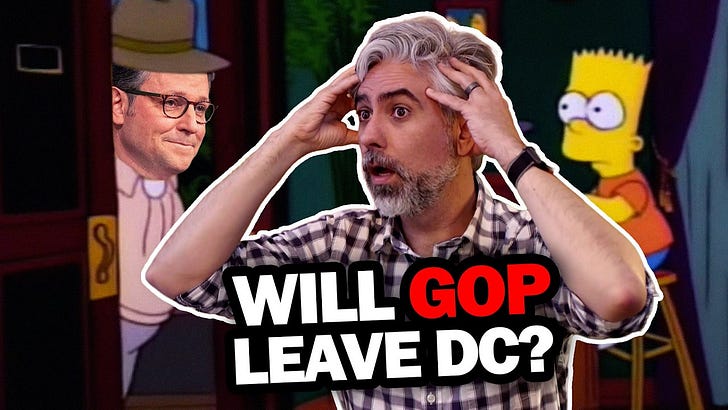
Will the GOP Leave DC Already? What You Should Be Watching For in Iran (with Riley Blanton)
The episode connects Republican fears about the midterms with a volatile Iran conflict whose next phase could reshape regional stability.
- 1House Republicans may limit time in Washington as a razor-thin majority and troubling internal polling raise midterm concerns.
- 2Riley Blanton argues Iran faces economic pressure, internal divisions, and weakened proxies, while the IRGC remains central to regime survival.
- 3The Strait of Hormuz threat produced less global disruption than Iran may have expected, narrowing its leverage while increasing escalation risks.
Don't miss
Riley Blanton explains why the IRGC could be best positioned to exploit unrest inside Iran despite declining operational capabilities.
The brief
Justin opens with a domestic warning: House Republicans may minimize their time in Washington as a narrow majority, internal polling, mail-in ballots, and the Supreme Court shape the midterm outlook.
Riley Blanton of Watchtower Intel describes Iran at an inflection point, with the apparent ceasefire’s end exposing economic pressure, factional tensions, and a regional stalemate that may be breaking down.
The Strait of Hormuz becomes a test of leverage: Iran threatened a major oil chokepoint but failed to create a lasting global shock, leaving sanctions and visible economic strain to do more damage.
The conversation’s sharpest tension is inside Iran: unpaid soldiers, protests, leaked information, and weakened leadership could create openings for the IRGC, even as its operational capabilities have declined.
Blanton also weighs the degradation of Hezbollah, Hamas, and other Iranian proxies, while noting that the Houthis and Iraqi groups retain meaningful capabilities.
The episode ends by defining a forever war through the political and symbolic costs of prolonged deployments, while assessing why wider regional escalation has become less likely.
What was said on this episode
27 statements · 6 positive · 17 negative · 2 mixed · 2 neutral
Republican House members may return home shortly after reconvening
“the House, as controlled by the Republicans, is about to Abe Simpson”
Listen at 2:54
Internal polling shows an unnamed Republican-held seat narrowly ahead
“The internal polling for the Republican running in that district. Now, a Republican held seat is winning by one point.”
Listen at 7:09
Republican members discount leadership’s projected seat gains by twenty
“whatever the leadership is saying, subtract 20”
Listen at 8:48
Some Republicans expect Democrats to gain a fifteen-seat House majority
“let's just expect to lose for the Democrats to have a 15 seat majority”
Listen at 9:11
House Republicans probably will not leave Washington until the midterms
“they're probably not”
Listen at 10:03
The USPS mail-voting dispute will likely remain unresolved past the midterms.
“I don't think, I think it's going to get kicked past the midterms by way of court order.”
Listen at 18:41
Court action will likely postpone Trump’s mail-voting order beyond midterms
“I think it's going to get kicked past the midterms by way of court order”
Listen at 18:41
A September sell-off in government bonds has begun
“A September bond sell-off. has begun”
Listen at 19:18
Higher Treasury yields raise borrowing costs and pressure stock valuations
“Higher treasury yields feed into mortgages and other loans, and those are pressuring stock valuations”
Listen at 20:23
Elevated inflation and yields make Federal Reserve rate cuts harder
“making it harder for the Federal Reserve to cut rates while inflation is above 3%”
Listen at 20:29
A permanent ballroom would be beneficial for the White House
“a ballroom's a good idea for the White House”
Listen at 24:49
Economic pressure has shifted the balance of power away from Iran
“the balance of power has shifted more because of... economic pressure”
Listen at 27:06
The United States struck Larak Island to protect shipping freedom of navigation.
“the fact that he made that statement leads directly into the U.S. protecting that freedom of navigation by striking Laracque Island”
Listen at 33:10
Iran has meaningfully lost leverage over the Strait of Hormuz
“the answer is an unequivocal yes”
Listen at 36:24
Pipeline rerouting now handles about thirty percent of former Hormuz flows
“that capacity has roughly escalated remarkably quickly to about 30% of what previously went through the Strait of Hormuz”
Listen at 36:47
Reserve releases have prevented an apocalyptic collapse of the world economy
“not the apocalyptic world economy crashing, which was the assumption before”
Listen at 37:20
The long-term economic advantage over the strait favors Gulf states and the United States
“the long-term strategic advantage... is in the favor of the Gulf states and the United States, at least economically when it comes to the strait”
Listen at 41:45
Continued economic pressure will produce less optimistic outcomes than initially expected
“we're going to see something that's not what some of the most hopeful and rosy and optimistic at the beginning of all this”
Listen at 46:30
Iran could experience another anti-regime uprising
“we could still very much see, though, an anti-regime uprising”
Listen at 47:55
Iran’s military capability has objectively declined
“Capability has objectively decreased”
Listen at 50:53
All fifteen-plus Iranian ballistic missiles in the cited salvo were intercepted
“all of them intercepted”
Listen at 51:00
Iran now has substantially less missile capacity than before
“we're seeing an Iran with far less, not removed, I don't want to overstate it, but far less missile capacity than before”
Listen at 55:02
Iran can still threaten Hormuz, but shipping through the strait is gradually increasing.
“their ability to continue to threaten the strait is there, but man, is more shipping slowly creeping through.”
Listen at 55:11
A boots-on-the-ground criterion best defines a forever war
“the boots on the ground answer is the cleanest”
Listen at 59:50
The Houthis retain more capability than Iran’s other proxy groups.
“The Houthis probably retain the most capability.”
Listen at 1:07:21
The Houthis retain more capability than Iran’s other major proxies
“The Houthis probably retain the most capability”
Listen at 1:07:21
Without prior proxy attrition, Iran could have ignited a broader regional war
“the region probably would be on fire in the way that Iran had always promised”
Listen at 1:08:47
Statements are attributed to the speaker as said on the episode and reflect their view at the time, not PodLume's. They are not advice.
Weekly email
State of the Pod, every Monday
The week's most-discussed names and stories from podcasts, with the moments behind them. Free, five minutes, unsubscribe in one click.