Oct 22, 2026 · 1h 26m
Modal bets on ephemeral compute for the agent era
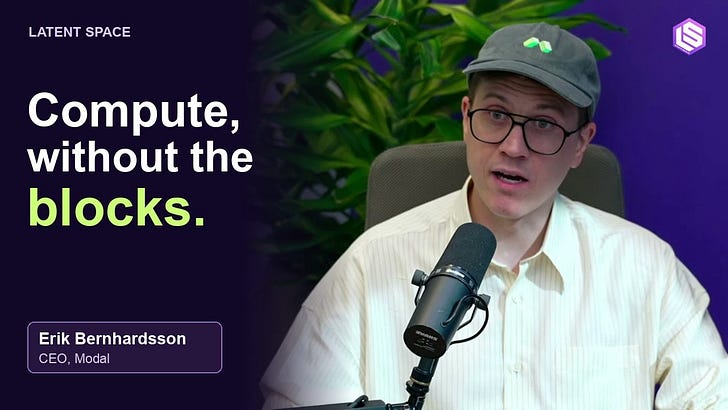
Why AI Compute Comes in Rectangles — Erik Bernhardsson, Modal CEO
As AI workloads shift between inference, agents, training, and isolated execution, infrastructure companies must reconcile bursty demand with expensive, inflexible GPU capacity.
- 1Modal is evolving from serverless compute into infrastructure for inference, agents, training, and isolated code execution.
- 2Snapshotting lets Modal create fast, clonable sandboxes that support massive parallelism for agents, reinforcement learning, and security testing.
- 3The company is betting that better developer experience and granular capacity aggregation can outperform rigid cloud contracts as AI demand shifts.
Don't miss
Bernhardsen explains how snapshotting can turn sandboxes into ephemeral, clonable environments capable of supporting massive parallelism.
The brief
Modal CEO Eric Bernhardsen traces the company’s path from a general-purpose serverless platform to infrastructure for AI inference, agents, training, and isolated code execution.
The central business problem is a mismatch between bursty AI demand and rectangular cloud commitments: GPU capacity is costly, scarce, and difficult to reallocate quickly.
Modal’s Sandboxes use snapshotting to make ephemeral environments fast and clonable, supporting background agents, reinforcement learning, security testing, and large-scale parallel workloads.
The conversation also covers alternative accelerators, NeoCloud financing, training and batch workloads, and the risks of treating GPUs or models as simple commodities.
Bernhardsen argues that developer experience remains infrastructure: clear documentation, fast feedback, and reliable abstractions improve both human and agent performance.
Weekly email
State of the Pod, every Monday
The week's most-discussed names and stories from podcasts, with the moments behind them. Free, five minutes, unsubscribe in one click.