Jul 28, 2026 · 1h 9m
Robotics CEOs forecast rapid rise of humanoid workers and autonomous factories
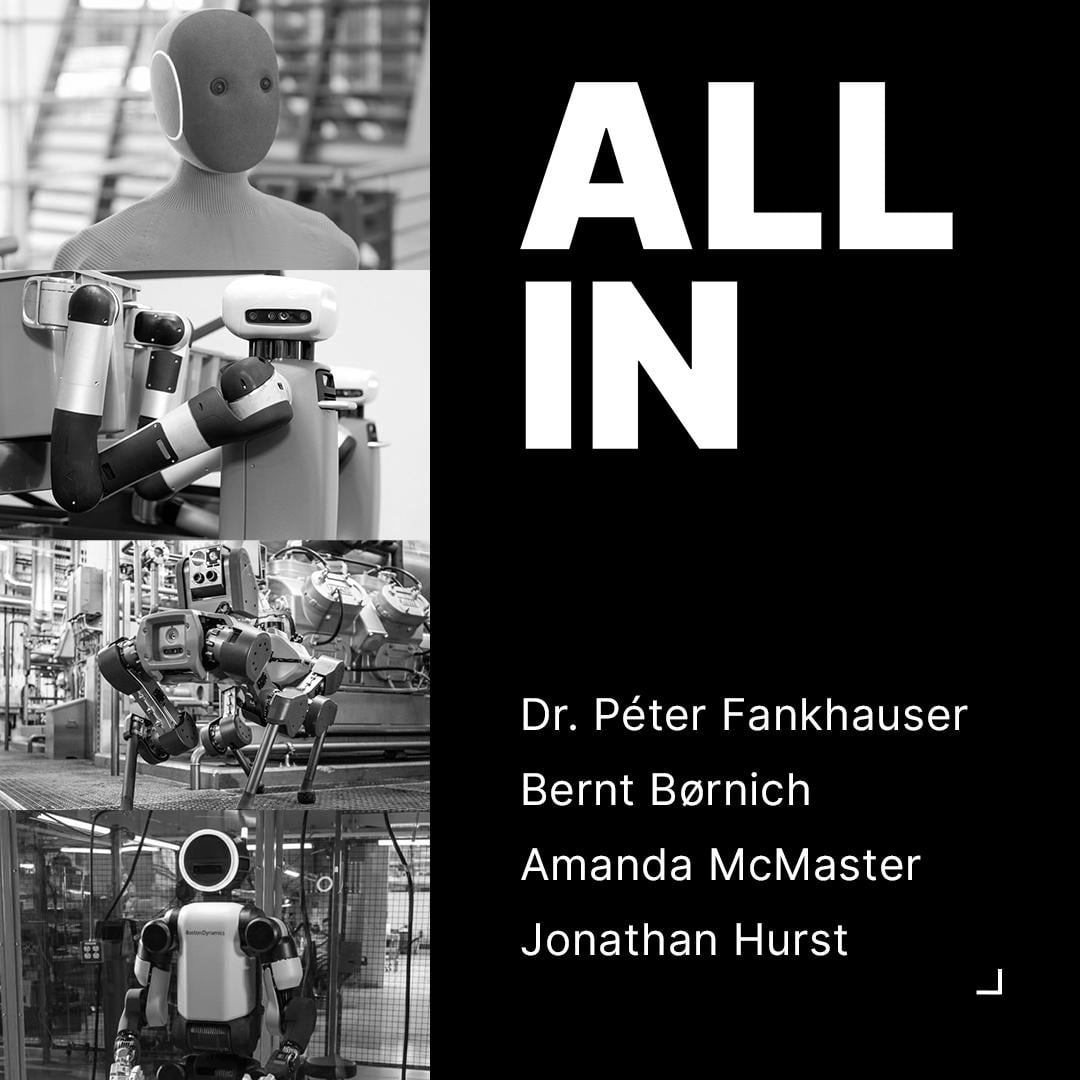
The $1/Hour Worker: Four Robotics CEOs on Humanoids at Home, China's Threat, and the End of Dangerous Jobs
The convergence of advanced AI world models and hardware engineering is rapidly lowering the cost of physical automation, reshaping global labor economics and industrial safety.
- 1Quadrupedal robots are already actively deployed in hazardous environments like offshore oil rigs for industrial inspection.
- 2Household humanoid robots are projected to begin shipping to consumers as open platforms as early as 2026.
- 3Sovereignty and cybersecurity concerns are driving robotics manufacturers to secure supply chains entirely outside of China.
Don't miss
Bernt Børnich outlines the timeline and technology behind Neo, a household humanoid robot scheduled to ship in 2026.
The brief
At the Makina conference in Paris, robotics leaders gathered to discuss the rapid commercialization of quadrupedal and humanoid platforms, signaling a major shift from research laboratories to real-world industrial and domestic environments.
While companies like Anybotics and Boston Dynamics deploy four-legged robots for hazardous industrial inspections, developers like 1X and Agility Robotics are pushing toward humanoids capable of navigating homes and complex warehouse logistics.
This physical AI revolution faces steep hurdles, from securing supply chains outside of China to navigating the ethics of military weaponization, forcing companies to compete on cybersecurity trust and strict non-weaponization policies.
A major inflection point lies in AI world models and simulation, which allow robots to pre-train on general video data and execute complex physical tasks, paving the way for the eventual deployment of affordable household assistants.
As the industry transitions to robot-as-a-service business models, the economic landscape of manual labor is poised for a dramatic transformation, moving closer to fully autonomous, lights-out factories.
What was said on this episode
48 statements · 31 positive · 9 negative · 2 mixed · 6 neutral
Four-legged robots can navigate stairs and locations accessible to people.
“for sure you have a great mobility. You can climb stairs, you can go anywhere a person can go.”
Listen at 2:03
Humanoid robots may be better for narrow spaces and eye-level work.
“Maybe a humanoid is better.”
Listen at 2:56
Sensor-equipped inspection robots can perceive signals beyond human abilities.
“you can go way beyond what a human can do.”
Listen at 4:21
Industrial asset downtime can cost hundreds of thousands of dollars per hour.
“These assets, if they stop, they lose revenues in the hundreds of thousands per hour.”
Listen at 4:25
Anybotics robots currently operate for a maximum of roughly eight hours.
“the maximum is in eight hour range.”
Listen at 5:54
Anybotics built a robot guaranteed not to create sparks in explosive atmospheres.
“we built a special robot that's guaranteed not to create a spark.”
Listen at 7:20
Robots should perform dangerous, remote, boring, and repetitive work instead of people.
“Robots should work in environments where people shouldn't be dangerous, remote. Right. Boring, repetitive tasks.”
Listen at 7:55
Reliable robot repair in explosive atmospheres remains under development.
“getting it to 99.9% reliability in explosive atmosphere. That's still in development.”
Listen at 8:43
Chinese robots demonstrate strong hardware engineering but do not yet solve customers’ complete problems.
“that device is a piece of hardware that can walk beautifully. Great engineering, love it. Do backflips, but they're not solving the problem.”
Listen at 10:37
Anybotics has ISO cybersecurity certification for its sensitive-data operations.
“We have ISO certification for cybersecurity.”
Listen at 10:59
Europe has a responsibility to build its own technologies.
“there's a responsibility in Europe to build technologies”
Listen at 11:59
Péter Fankhauser opposes weaponizing robots.
“I personally don't like it. I hate it.”
Listen at 13:54
Weaponized robots are currently too immature to deploy against people.
“they're not that mature that you would put somebody else in harm's way.”
Listen at 14:08
1X will ship Neo robots to customers in 2026.
“we will ship in 2026.”
Listen at 15:29
A small number of customers will receive Neo robots in 2026.
“there will be a handful of customers that get their NIO in 2026”
Listen at 15:37
Opening Neo as a platform will increase the number of applications developed for it.
“this will mean there will be more things developed on Nio”
Listen at 17:09
1X expects to ship a Neo experience close to full autonomy.
“we will actually be able to ship something that's very close to full autonomy”
Listen at 18:21
Bernt Børnich believes 1X will develop the best robotics model.
“I sincerely believe that our model will be the best one.”
Listen at 21:23
Teleoperation will remain useful even as robot autonomy improves.
“that will still be There.”
Listen at 23:24
Human-like robots can be trained using existing human video data.
“if you get the robot to be similar enough to a human, then you can train on all the available video data out there of humans.”
Listen at 25:09
True robotic intelligence requires far more data than current collection efforts provide.
“you need multiple orders of magnitude more data than anyone is even close to collecting over the next few years”
Listen at 27:25
Robotics will reach hard takeoff within a decade.
“I am extremely sure that we're less than a decade away from hard takeoff.”
Listen at 31:07
Bernt Børnich’s current estimate for robotics hard takeoff is three years.
“My current bet would be 3 years.”
Listen at 31:25
Digital intelligence alone cannot create its own physical substrate.
“the digital intelligence can never create its own substrate. You need the physical part.”
Listen at 31:56
Physical AI will enable these advances within coming years rather than decades.
“all of these things will happen in the coming years as AI becomes physical”
Listen at 32:23
Boston Dynamics Spot has more than 500 customers across 46 countries.
“We have over 500 customers over 46 countries.”
Listen at 35:43
Spot is currently the most-used mobile autonomous robot worldwide.
“It is the, it is the mobile autonomous robot that's used more than any other on the planet right now.”
Listen at 35:47
Customers currently find substantial value in Spot-based industrial inspection.
“Customers are finding a lot of value in industrial inspection.”
Listen at 36:15
Industrial robot customers require return on investment within two years.
“customers need to see your ROI in under two years.”
Listen at 36:50
Spot pricing ranges from $100,000 for the base robot to $300,000 fully loaded.
“it ranges anywhere between, you know, $100,000 for the base robot, all the way up to 300,000”
Listen at 38:11
Spot operates for more than 3,000 hours between human interventions.
“we're at over 3,000 hours.”
Listen at 38:41
The United States cannot afford to let China win in robotics as it did in semiconductors.
“we can't do that with robotics.”
Listen at 43:17
The United States and allies should coordinate to protect robotics intellectual property.
“we need to have a concorded effort to protect our ip”
Listen at 43:19
Explosive ordnance disposal is a strong application for robots.
“Explosive Ordnance disposal is something that's a great use case for robots.”
Listen at 45:10
Boston Dynamics currently performs explosive ordnance disposal work with robots.
“We do that Currently.”
Listen at 45:14
Amanda McMaster says Boston Dynamics has the world’s best and most capable robot.
“we have the best robot and the most capable robot in the world.”
Listen at 46:10
Robot perception is nearly solved and has become a major robotics inflection point.
“the fact that perception is all but solved at this point is a really, really huge inflection point.”
Listen at 49:59
Internet-scale training data does not exist for robot motor control.
“that data does not exist for robot control.”
Listen at 51:27
No single world-model approach will solve robotics training.
“there is no silver bullet.”
Listen at 52:44
Robots currently require far more training data and examples than humans.
“Robots take so much more data and so many more examples than a person.”
Listen at 54:50
Digit V5 will operate safely near people without physical barriers in warehouses.
“Digit V5, which is coming out later this year, is the first time that a humanoid robot, a robot who is balancing, can step out of a work cell and does not need a physical barrier between the robot and the person to maintain safety in this warehouse.”
Listen at 56:16
Agility expects future robots to sell near the price of cars.
“We'll be selling robots, you know, in the vicinity of cost of cars and things like that.”
Listen at 57:45
Digit V5 is designed to operate approximately 20 of every 24 hours.
“20 out of 24 hours for our Digit V5 robot”
Listen at 58:17
Robot value is primarily determined by the cost of the human labor replaced or augmented.
“the value for these robots is really set by the human labor.”
Listen at 59:37
Fully autonomous truck-to-factory package sorting will eventually operate without on-site workers.
“Someday there's going to be an autonomous truck that drives up and they have a completely lights out autonomous package sortation factory”
Listen at 1:01:26
Humanoid package delivery to front doors is on Agility Robotics’ roadmap.
“it's on our roadmap for sure”
Listen at 1:03:03
Robots moving objects can free people from dull, dirty, and dangerous work.
“picking up stuff and putting them somewhere else is such a huge use case that frees people from the classic three Ds of robotics”
Listen at 1:03:33
Engineering skills will remain useful for students amid robotics-driven career changes.
“if students just build some of the core skill sets around engineering, it's going to be applicable and useful.”
Listen at 1:04:56
Statements are attributed to the speaker as said on the episode and reflect their view at the time, not PodLume's. They are not advice.
Books & mentions
All-In with Chamath, Jason, Sacks & Friedberg
Follow the hosts' regular discussions on artificial intelligence, venture capital, and macroeconomics.