Jul 29, 2026 · 2h 39m
Tim Robbins details Hollywood nonconformity and the cost of political dissent
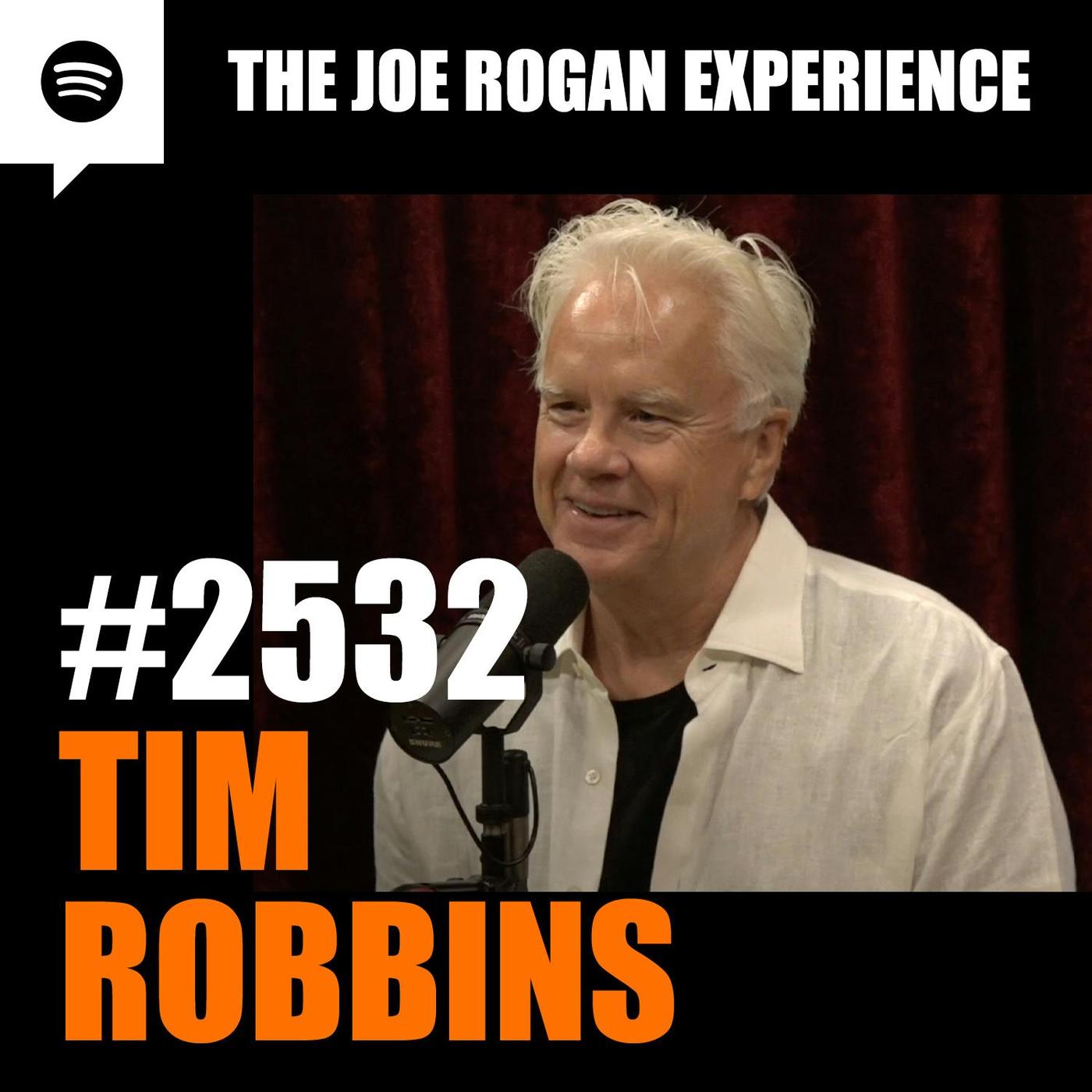
#2532 - Tim Robbins
This conversation offers a rare look at how a major Hollywood figure maintained his principles through intense industry pressure, political blacklisting, and personal evolution.
- 1Choosing artistic integrity over lucrative studio contracts allowed Tim Robbins to preserve his creative independence.
- 2The public compliance and media pressure of the pandemic mirrored the intense political backlash of the 2003 Iraq War.
- 3A long-running prison theater program and a profound ayahuasca experience helped Robbins channel and release his anger.
Don't miss
Tim Robbins recounts the intense media isolation he experienced in 2003 after publicly speaking out against the Iraq War.
The brief
Actor and director Tim Robbins joins Joe Rogan to reflect on his storied career, tracing his path from starring in the legendary film The Shawshank Redemption to his current role in the dystopian science fiction series Silo.
Robbins explains how he navigated Hollywood by turning down high-paying roles that violated his values, choosing instead to protect his creative independence by waiting for projects like Robert Altman's satirical masterpiece The Player.
The conversation turns deeply personal as Robbins recalls the intense media backlash he faced in 2003 for opposing the Iraq War, drawing parallels between that era's political conformity and the compliance seen during the COVID-19 pandemic.
Beyond politics, Robbins shares the profound impact of his 20-year-old prison theater program, which uses emotional expression to rehabilitate inmates, and discusses how a transformative ayahuasca experience helped him release his anger.
What was said on this episode
55 statements · 30 positive · 20 negative · 2 mixed · 3 neutral
Derinkuyu may have held approximately 20,000 people.
“I think it. I think it could. I think it could hold 20,000 people.”
Listen at 4:50
Carbon dating organic objects does not necessarily date the construction of their surrounding structure.
“when you carbon date an object, right? So you could go visit the pyramids today, right, and you could leave behind some stuff, right? And then everybody dies. Humanity dies out in a cataclysm. And then a hundred thousand years from now, people start looking through the piles of some of these sites and the pyramids will probably still be there. And if there was any organic material left, like a book that you left, or you know, a leather bound book or some piece of wood, they could carbon date that. And then that would say the time that you were there, but it wouldn't say the time that the actual structure was made.”
Listen at 5:34
Younger Dryas impacts may have caused a civilization reset.
“there's this thing called the Younger Dries impact theory that's around 11,800 years ago. There's all this evidence that there was massive asteroid impacts all over the Earth, comet impacts, and they think that it was probably a reset of civilization.”
Listen at 7:53
Silo depicts a controlled society enforcing censorship and compliance.
“This is about a controlled society where information is censored and where compliance is necessary. And if you don't comply, you get sent out into the hostile environment.”
Listen at 8:37
Oligarchs are increasingly producing movies portraying themselves favorably.
“So I realized that the oligarchs are starting to make movies about themselves. Oligarchical cinema.”
Listen at 13:48
People who were wrong about the Iraq War received promotions.
“All the people that get it wrong, they get. They got. Particularly Iraq War. They got. Anyone that got it wrong got promotions.”
Listen at 17:11
Media figures who promoted the Iraq War received better jobs.
“people in the media as well, you know, they. They promoted it. They got, you know, better jobs.”
Listen at 17:20
European reporting questioned Iraq’s weapons-of-mass-destruction evidence more openly.
“I was reading stuff from Europe and what they were writing about the weapons of mass destruction and that there wasn't any evidence and it wasn't being covered like it was here. It was more open, more transparent, the reporting.”
Listen at 22:00
Tim Robbins associates ivermectin with his sense of smell returning after one day.
“And, you know, I followed what you were going through with the ivermectin, which was a drug that I had taken, and, you know, I had lost my sense of smell. And a day later, it was back. So I knew there was something going on with that.”
Listen at 25:19
Ivermectin is among the safest medicines and appears on WHO’s essential medicines list.
“Oh, it's one of the safest. Oh, wait a minute. It's in the World Health Organization's essential medicines list.”
Listen at 26:19
The COVID period may have been used to divide society.
“I suspect that that whole period of time was another way to divide us, you know, in the larger picture.”
Listen at 27:25
Tim Robbins rejects trusting people solely because they are considered experts.
“I don't trust virtuous experts. I don't think. I don't think experts are. I don't believe in experts.”
Listen at 31:53
Science should remain data-driven and open to revision rather than permanently settled.
“science is supposed to be data. It's supposed to be measuring data, and it's supposed to never be settled.”
Listen at 33:53
Lockdowns deprived children of two years of socialization and education.
“there's kids that are, you know, had two years robbed of them from socialization and education.”
Listen at 35:11
Children can recover from lockdown-related social and emotional difficulties.
“the good news is you can get out of that funk.”
Listen at 35:41
Society should avoid repeating COVID-era propaganda-driven behavior.
“I just want us to not do it again. You know, I want us to have the knowledge and the consciousness to not fall for that again.”
Listen at 38:48
The COVID period eliminated many spontaneous workplace conversations across disagreements.
“we totally lost the water cooler conversation. That accidental conversation that happens at work with a co worker who you don't necessarily agree with”
Listen at 40:39
Allowing negative tests alongside vaccine passports helped London’s West End rebound faster than Broadway.
“their West End rebounded immediately, unlike Broadway. And the reason it did is because during that time period, you could show a vaccine passport, but you could also show a negative test.”
Listen at 44:33
Prior COVID infection allegedly provides immunity seven times superior to vaccination.
“people that got Covid and then recovered from it who have far superior immunity 7x superior immunity to people who are vaccinated”
Listen at 45:11
Cancel culture operates similarly to Soviet-era punitive social control.
“they felt like cancel culture was basically operating in the same way as the Soviet Union did.”
Listen at 47:38
Theater improvisation teaches incarcerated people alternatives to responding to anger with anger.
“what they come to understand is that. But they don't have to respond to anger with anger. There are other choices. And in fact, in real life, they can do that too”
Listen at 54:03
The Actors’ Gang operates its rehabilitation programs in 18 California prisons.
“now we're in 18 prisons in the state of California doing these programs.”
Listen at 57:02
Art can transform people and shift their consciousness.
“Because art is a transformer. You know, it is something that can shift consciousness.”
Listen at 58:45
Cassette tapes retain more information than heavily compressed MP3 files.
“there's more. There's more information in a little cassette tape than on a. You know what. It's mp3 that's been compressed, you know, and compressed and compressed and compressed.”
Listen at 1:18:38
Recommendation algorithms cannot reliably guide viewers to great films like The Battle of Algiers.
“That's now been replaced by an algorithm. And I'm not trusting that algorithm is going to find it's, you know, it's going to show me the way to Battle of Algiers or any kind of these great movies.”
Listen at 1:23:07
Silo currently has approximately a 100% Rotten Tomatoes rating.
“I think silo's like 100 rotten tomatoes.”
Listen at 1:24:21
A film like The Shawshank Redemption would not be produced in Hollywood today.
“films like Shawshank Redemption would not get made today”
Listen at 1:30:26
AI cannot reproduce Tim Robbins’s individual creative perspective.
“I don't think you could plug that into A.I.”
Listen at 1:38:38
Actors’ unions should prohibit AI from replacing actors.
“The hard line should have been, you know, you cannot use this to replace actors.”
Listen at 1:39:06
Weak AI protections in writers’ union negotiations will have harmful consequences.
“I think that we're going to see the ramifications of that, unfortunately.”
Listen at 1:39:22
Projects made without AI should receive a distinct certification seal.
“I think that's a great idea.”
Listen at 1:40:14
Creative risk is necessary to produce genuinely new and fresh films.
“only, only will the risk produce something genuine and new and fresh.”
Listen at 1:42:20
Superhero films are frequently greenlit because studios view them as reliable investments.
“it's probably why so many superhero movies get greenlit. Right. Because it's one of the only gambles, like if you're gambling on an Avengers movie, like you can't miss”
Listen at 1:43:36
Film distribution will eventually become more egalitarian, though independent release is currently risky.
“in the future there's going to be some form of distribution that. That will be more egalitarian, but right now it's a huge risk.”
Listen at 1:45:37
Independent films require foreign sales before production begins.
“You have to have foreign sales in place.”
Listen at 1:45:56
Pre-selling foreign rights can eliminate investors’ financial risk before filming begins.
“they've already sold it for more than they've paid. And so there's really no risk, no gamble.”
Listen at 1:46:16
Three of Robbins’s post-Oscar films were excellent but largely unseen.
“I was in three movies after I won the Oscar for Mistakes river that I've considered three of the best movies in my career, but nobody's seen them.”
Listen at 1:47:48
Crop storage helped humans survive winters and persist as a species.
“the storage of crops and how you make them survive through the winter, that's a skill that you know that well. That's why we're still here.”
Listen at 2:06:12
A 14-day Master Cleanse without food produces substantially better subjective wellbeing.
“I just did a cleanse, one of those master cleanses. I just did 14 days on, where you don't eat anything for 14 days, and it's amazing how great you feel at the end of it.”
Listen at 2:07:21
The Master Cleanse’s lemon, cayenne, and maple mixture sustains fasting and removes toxins.
“Just lemon juice. Use cayenne pepper and maple syrup, and that'll get you through the day. But every morning, you're doing a purge, so you're cleaning out. You're cleaning all the poisons out.”
Listen at 2:07:37
Fasting produces total mental clarity for Robbins.
“Total mental clarity.”
Listen at 2:08:20
Extended fasting provides constant energy and permits work and sports activity.
“Your energy level is, like, constant throughout the day, and you can work. I play sports with it.”
Listen at 2:08:32
A cleanse restarts the body and eliminates toxins.
“it also it restarts your system. It basically you get rid of the toxins.”
Listen at 2:09:07
Robbins lost 25 pounds during a 14-day fast.
“£25.”
Listen at 2:10:07
Fasting reduces the amount of sleep Robbins needs.
“you sleep last too. You need less sleep for some reason”
Listen at 2:10:55
Sugar is addictive and produces later negative consequences.
“it's very addictive and. And you think, oh, it feels great when you first have it, but then it makes you pay.”
Listen at 2:12:37
Belief in self-healing enables a person to heal themselves.
“if you believe that you can heal yourself, you can heal yourself.”
Listen at 2:14:45
Patients should challenge doctors’ advice and seek a second opinion.
“if you ever get told by a doctor anything, you have to challenge it. You go, go to a different doctor and see if they say the same thing.”
Listen at 2:15:31
Robbins believes his deceased grandfather supernaturally saved his son’s life.
“whatever energy he could muster in whatever phase of being he was, he fucking saved my son's life heroically. No doubt about that.”
Listen at 2:24:40
Robbins believes other planes of existence are accessible through various means.
“I totally believe this stuff. I believe that we. That life, death, there's other planes of existence that we can get to through various means.”
Listen at 2:25:00
Being with people or pets increases longevity through electromagnetic connection.
“It's what makes us live longer if we're with someone else or with a pet.”
Listen at 2:26:30
The lockdown was cruel because it imposed severe loneliness.
“that's why that lockdown was cruel”
Listen at 2:27:15
Approaching life with humility can improve one’s circumstances.
“if you approach life that way, then there is a possibility of making everything better. And it has to do with humility.”
Listen at 2:31:04
Cynicism prevents people from recognizing benevolent human or spiritual helpers.
“If you are closed off and cynical, you will not see your angels.”
Listen at 2:34:14
Loneliness can cause death.
“It'll kill you.”
Listen at 2:38:24
Statements are attributed to the speaker as said on the episode and reflect their view at the time, not PodLume's. They are not advice.

